
Week 4: Speech Work, Reading, Structure, Grammar, Writing, Dictation Basic 4 English Studies Lesson Note
Download Lesson NoteTopic: Week 4: Speech Work, Reading, Structure, Grammar, Writing, Dictation
A.TOPIC – DIALOGUE FURTHER PRACTICE IN EXCUSING, POSSIBILITY, OBLIGATION, PERMISSION, ETC.
PERFORMANCE OBJECTIVES
By the end of the lesson, most of the pupils should have attained the following objectives: –
- use each of the modal auxiliaries in sentences in contextual situations so as to bring out their meaning.
- discuss their shades of meaning.
- reading passage or stories in which these are used, after and practice and intonation.
- use some of the words in the stories to build up sentences.
ENTRY BEHAVIOUR
The pupils
INSTRUCTIONAL MATERIALS
The teacher will teach the lesson with the aid of:
- Any approved course book.
- Release (real objects)
METHOD OF TEACHING
Choose a suitable and appropriate methods for the lessons.
Note – Irrespective of choosing methods of teaching, always introduce an activities that will arouse pupil’s interest or tied them to the lesson.
REFERENCE MATERIALS
- Scheme of Work
- 9 – Years Basic Education Curriculum.
- Course Book
- All Relevant Material
- Online Information
CONTENT OF THE LESSON

PRACTICE IN EXCUSING, POSSIBILITY AND OBLIGATIONS
- ‘Can’ meaning possible
Examples
- Can Segun wash his plates?
- Can you run?
- Can I take his textbook?
- Can Mr. Michael borrows his neighbour’s hoe and cutlass?
- ‘May’ implies possible permission.
Examples
- May I borrow your books please?
- Father May correct the children in public.
- ‘Have to’ meaning obligations.
Example
- Mother must not be disobeyed.
- ‘Ought to’ meaning what is right.
Examples
- Your ought to sweep you class.
PRACTICE DIALOGUE
Pupil’s Activities –
Ayomide – Can I tell you my secret? or please permit me to tell you a secret.
Olamide – Yes, I am listening.
Or
Ayomide – Can I tell you something new?
Olamide: You may (or can) if you like.
Ayomide – Daddy has permitted me to go to the national stadium to watch that football match.
PRESENTATION
To deliver the lesson, the teacher adopts the following steps:
- To introduce the lesson, the teacher revises the previous lesson. Based on this, he/she asks the pupils some questions;
- Lists the modal auxiliaries – can, cannot, may, may not, have to, has to, don’t have to, ought to, ought not to, etc.
Pupil’s Activities – Make sentences with modal auxiliaries.
- Creates short stories around the family.
Pupil’s Activities – Work in short scene to practice the use of modal auxiliaries.
- Constructs a dialogue for the same purpose.
Pupil’s Activities – Practice the use of auxiliaries in the given stories.
- Teacher’s Activities – Make more sentences with modal auxiliaries.
CONCLUSION
- To conclude the lesson for the week, the teacher revises the entire lesson and links it to the following week’s lesson.
- Next Lesson: –
LESSON EVALUATION
Ask pupils to:
- use each of the modal auxiliaries in sentences in contextual situations so as to bring out their meaning.
- discuss their shades of meaning.
- Read passage or stories in which these are used.
- use some of the words in the stories to build up sentences effectively.
- TOPIC – COMPLETE THE SENTENCES WITH ‘CAN’ AND ‘MAY’
PERFORMANCE OBJECTIVES
By the end of the lesson, most of the pupils
REFERENCE MATERIALS
- Scheme of work
- Education Curricul
- Course Book
- Online Information
CONTENT OF THE LESSON
FOCUS QUESTIONS
Dialogue Further Practice in Excusing oneself
C: TOPIC: AS STATE IN Recommended Reading Passages
LEARNING OBJECTIVES
By the end of the lesson, most of the pupils should have attained the following objectives: –
- identify new and difficult words.
- read the passage.
- skim for the main points in passage.
- scan for the specific information.
- answer the questions in complete sentences.
ENTRY BEHAVIOR
The pupils can read and write.
INSTRUCTIONAL MATERIALS
The teacher will teach the lesson with the aid of:
- Course book
- Dictionary
- Pictures
METHOD OF TEACHING
Choose a suitable and appropriate methods for the lessons.
Note :- irrespective of choosing methods of teaching, always introduce an activities that will ensure pupil’s interest or lead them to the lessons.
REFERENCE MATERIALS
- Scheme of Work
- K – Years Basic Education Curriculum
- Course Book
- All Relevant Material
- Online Information
CONTENT OF THE LESSON
FOCUS LESSON
- New Words and their meaning
- Reading Comprehension – A leading passage selected from the course book based on regard and concern for interest of others.
- READING TO FIND THE MAIN POINTS
Note :- For reading focus, let pupils read the passage first.
PRESENTATION
To deliver the lesson, the teacher adopts the following steps:
- To introduce the lesson, the teacher revises the previous lesson. Based on this, he/she asks the pupils some questions.
- Teacher organizes pupils in groups or pairs depending on the size of the class.
- Teacher make list of new words or difficult words on the board.
- Teacher guides pupils as groups or pairs to find the meaning of each word using dictionary
Pupils Activities – Find the meaning of the new words.
- Teacher uses the new and pupil’s responses to introduce the lesson.
Pupils Activities – Pay attention to the lesson to the lesson introduction.
- Teacher allows groups or pairs reading before independently reading.
- Teacher reads and discuss the content of the passage.
Pupil’s Activities – Participate actively in the discussion.
- Teacher highlights the main points.
Pupil’s Activities – Read the passage to skim for the main points.
- Teacher distinguishes the theme and subject matter of the passage.
- Teacher summarizes the lesson on the board with using appropriate lesson evaluation and guides pupils to answer in a complete sentence.
Pupil’s Activities – Participate actively in the summary of the lesson by responding to questions in complete sentences and write as instructed.
CONCLUSION
To conclude the lesson for the week, the teacher revises the entire lesson and links it to the following week’s lesson.
LESSON EVALUATION
Teacher asks pupils to:
- read the passage correctly.
- skim for the main points.
- state the specific information in the passage.
- answers questions in complete sentences.
- TOPIC – MAKING SENTENCES FROM THE TABLE
PERFORMANCE OBJECTIVES
By the end of the lesson, most of the pupils should have attained the following objectives: –
- make sentences from the table.
- draw, copy and complete the sentences in the table.
ENTRY BEHAVIOUR
The pupils.
INSTRUCTIONAL MATERIALS
The teacher will teach the lesson with the aid of:
- Course books.
- Flash card
- Chart
METHOD OF TEACHING
Choose a suitable and appropriate methods for the lessons.
Note – irrespective of choosing methods of teaching, always introduce an activities that will arouse pupils’s interest or lead them to the lessons.
REFERENCE MATERIALS
- Scheme of work
- 9 – Years Basic Education Curriculum
- Course Book
- All Relevant Material
- Online Information
CONTENT OF THE LESSON
FOCUS TABLE
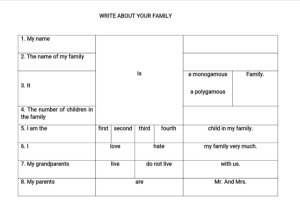
Note – Monogamous means a man with one wife.
Polygamous means a man with more than two wives.
PRESENTATION
To deliver the lesson, the teacher adopts the following steps:
- To introduce the lesson, the teacher revises the previous lesson. Based on this, he/she asks the pupils some questions;
- Discuss the contents of the table with the pupils.
Pupil’s Activities – Participate in the class discussion and make sentences from the table.
CONCLUSION
- To conclude the lesson for the week, the teacher revises the entire lesson and links it to the following week’s lesson.
- Next Lesson –
LESSON EVALUATION
Ask pupils to as stated in the contents of the lesson.
- TOPIC: TEACHING OF NEW AND DIFFICULT WORDS
LEARNING AREA
- Introductory Activities
- New Words/Difficult Words
- Making Sentences with New/Difficult Word
- Spelling and Dictation
- Lesson Evaluation and Weekly Assessment (Test)
PERFORMANCE OBJECTIVES
By the end of the lesson, most of the pupils should have attained the following objectives: –
- pick out new and difficult words from the week comprehension passages.
- pronounce new and difficult words correctly.
- write the meaning of new and difficult words in the passages.
- make a sentence with these words.
- attempt 70% (and above) of weekly assessment correctly.
ENTRY BEHAVIOR
The pupils can use dictionary to find the meaning of new words.
INSTRUCTIONAL MATERIALS
The teacher will teach the lesson with the aid of dictionary and chart showing difficult words.
REFERENCE MATERIALS
- Scheme of Work
- 6-Years Basic Education Curriculum
- Macmillan Brilliant Primary English school book 6
- All Relevant Materials
CONTENT OF THE LESSON
NEW AND DIFFICULT WORDS
1.
2.
3.
4.
5.
PRONUNCIATION OF NEW AND DIFFICULT WORDS
1.
2.
3.
4.
5.
MEANING OF NEW AND DIFFICULT WORDS
1.
2.
3.
4.
5.
MAKING SENTENCES WITH THE NEW WORDS AND DIFFICULT WORDS
1.
2.
3.
4.
5.
PRESENTATION
To deliver the lesson, the teacher adopts the following steps:
- To introduce the lesson, the teacher revises the previous lesson. Based on this, he/she asks the pupils some questions;
- Guides pupils to identify new and difficult words from the passage.
Pupil’s Activities – Scan the meaning of the new words.
- Write the new and difficult words on the board and let the pupils to find the meaning of each word in the dictionary.
Pupil’s Activities – Find the meaning of each word in the dictionary.
- Supports pupils to make sentences with the new and difficult words.
Pupil’s Activities – Make a sentence each with the words.
- Organize pronunciation and spelling competition (whole and group spelling) with the new and difficult words.
Pupil’s Activities – Participate actively in the individual or group competitions.
- Summary the lesson with dictation.
Pupil’s Activities – Take part in the dictation.
- Prepare weekly assessment (test) questions.
Pupil’s Activities – Attempt 70% (and above) of weekly assessment correctly.
CONCLUSION
To conclude the lesson for the week, the teacher revises the entire lesson and links it to the following week’s lesson.
NEXT LESSON
Take time to preview the next lesson, identify new and difficult words and give pupils as assignment.
LESSON EVALUATION/ASSIGNMENT
Ask pupils to:
- Pronounce and spell new and difficult words correctly.
- Find the meaning of new and difficult words.
- make sentences with new and difficult words.
- Write dictated words correctly.
First Term English Studies Lesson Notes for Other Topics
Supplementary Reading : "The Little Star's Journey"
Explore lesson notes covering all topics.
Vocabulary Building
Explore lesson notes covering all topics.
Oral And Written Comprehension
Explore lesson notes covering all topics.

Composition: About My School
Explore lesson notes covering all topics.

Structure: Concept Of Print Illustrations, Pictures And Diagrams
Explore lesson notes covering all topics.

Oral And Written Comprehension
Explore lesson notes covering all topics.

Pronunciation Of Multi-Syllabic Words
Explore lesson notes covering all topics.

Vocabulary Building
Explore lesson notes covering all topics.

Structure: Regular And Irregular Plurals
Explore lesson notes covering all topics.
Phonic Pronunciation Of Diphthongs
Explore lesson notes covering all topics.
Writing Poem: "Twinkle Twinkle Little Star"
Explore lesson notes covering all topics.

Structure: National Values
Explore lesson notes covering all topics.

Conversation Practice
Explore lesson notes covering all topics.

Structure: Reading To Obtain Information
Explore lesson notes covering all topics.

Oral And Written Comprehension
Explore lesson notes covering all topics.

Lesson Notes for Other Classes

Basic 2 Lesson Note
The complete lesson note to guide your studies.
Basic 3 Lesson Note
The complete lesson note to guide your studies.
Basic 5 Lesson Note
The complete lesson note to guide your studies.

JSS1 Lesson Note
The complete lesson note to guide your studies.
JSS2 Lesson Note
The complete lesson note to guide your studies.

JSS3 Lesson Note
The complete lesson note to guide your studies.