
Analysis Of August Wilson’s Fences SS2 Literature-in-English Lesson Note
Download Lesson NoteTopic: Analysis Of August Wilson’s Fences
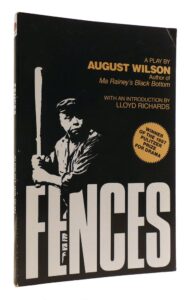
READING AND CONTENT ANALYSIS OF FENCES
Fences are divided into two acts. Act One has four scenes and Act Two has five. The play begins on a Friday, Troy and Bono’s payday. Troy and Bono go to Troy’s house for their weekly ritual of drinking and talking. Troy has asked Mr. Rand, their boss, why the black employees aren’t allowed to drive the garbage trucks, only to lift the garbage. Bono thinks Troy is cheating on his wife, Rose. Troy and Rose’s son, Cory, has been recruited by a college football team. Troy was in the Negro Leagues but never got a chance to play in the Major Leagues because he got too old to play just as the Major Leagues began accepting black players. Troy goes into a long epic story about his struggle in July of 1943 with death. Lyons shows up at the house because he knows it is Troy’s payday. Rose reminds Troy about the fence she’s asked him to finish building.
Cory and Troy work on the fence. Cory breaks the news to Troy that he has given away his job at the local grocery store, the A&P, during the football season. Cory begs Troy to let him play because a coach from North Carolina is coming to Pittsburgh to see Cory play. Troy refuses and demands Cory to get his job back.
Act One, Scene Four takes place on Friday and mirrors Scene One. Troy has won his case and has been assigned as the first coloured garbage truck driver in the city. Bono and Troy remember their fathers and their childhood experiences of leaving home in the South and moving north. Cory comes home enraged after finding out that Troy told the football coach that Cory may not play on the team. Troy warns Cory that he is “strike one,” against him.
Troy bails his brother Gabriel out of jail. Bono and Troy work on the fence. Bono explains to Troy and Cory that Rose wants the fence because she loves her family and wants to keep close to her love. Troy admits to Bono that he is having an affair with Alberta. Bono bets Troy that if he finishes building the fence for Rose, Bono will buy his wife, Lucille, the refrigerator he has promised her for a long time. Troy tells Rose about a hearing in three weeks to determine whether or not Gabriel should be recommitted to an asylum. Troy tells Rose about his affair. Rose accuses Troy of taking and not giving. Troy grabs Rose’s arm. Cory grabs Troy from behind. They fight and Troy wins. Troy calls “strike two” on Cory.
Six months later, Troy says he is going over to the hospital to see Alberta who went into labour early. Rose tells Troy that Gabriel has been taken away to the asylum because Troy couldn’t read the papers and signed him away. Alberta had a baby girl but died during childbirth. Troy challenges Death to come and get him after he builds a fence. Troy brings home his baby, Raynell. Rose takes in Raynell as her child but refuses to be dutiful as Troy’s wife.
On Troy’s payday, Bono shows up unexpectedly. Troy and Bono acknowledge how each man made good on his bet about the fence and the refrigerator. Troy insists that Cory leave the house and provide for himself. Cory brings up Troy’s recent failings with Rose. Cory points out that the house and property, from which Troy is throwing Cory out, should be owned by Gabriel whose government checks paid for most of the mortgage payments. Troy physically attacks Cory. Troy kicks Cory out of the house for good. Cory leaves. Troy swings the baseball bat in the air, taunting Death.
Eight years later, Raynell plays in her newly planted garden. Troy has died from a heart attack. Cory returns home from the Marines to attend Troy’s funeral. Lyons and Bono join Rose too. Cory refuses to attend. Rose teaches Cory that not attending Troy’s funeral does not make Cory a man. Raynell and Cory sing one of Troy’s father’s blues songs. Gabriel turns up, is released or escapes from the mental hospital. Gabe blows his trumpet but no sound comes out. He tries again but the trumpet will not play. Disappointed and hurt, Gabriel dances. He makes a cry and the Heavens open wide. He says, “That’s the way that goes,” and the play ends.
CHARACTERS AND CHARACTERIZATION
- Troy Maxson: The husband of Rose, and father to Cory and Lyons, Troy is the central character of Fences. Shaped by the effects racism has had on his life—by the struggles it created in his youth and the career ambitions that it thwarted, including his desire to be a baseball player—Troy lives in the shadow of what could, and what should, have been. The play can largely be described as charting how Troy’s actions, as they’re informed by his past, affect those around him: how his shattered sense of hope ripples into and distorts the aspirations and dreams of those around him—how the racism of his world growing-up continues to express itself through Troy’s actions, indirectly shaping those of a new generation.
As a result of Troy’s experiences, he has become a man who at once espouses and insists on rigid practicality to protect himself and his family from the world, even as he indulges (or can’t stop himself from indulging) in a kind of wild impracticality of his own as a way to escape or redress the unfairness he perceives as having thwarted his own life.
This inner contrast – which to those around him can feel like hypocrisy – is evident in a variety of ways. For instance, Troy can’t see anything practical, or therefore worthwhile, in the professions (music and baseball, respectively) to which his sons Lyons and Cory each aspire. But at the same time, Troy’s affair with Alberta suggests that he’s perfectly willing to engage in something not grounded in practicality, but rather in pure pleasure divorced from the needs of his family. Similarly, Troy’s willingness to protest the unfair treatment of blacks in his workplace (they’re only hired to carry garbage, while whites are exclusively hired to drive the trucks), embodies a progressive view on the possibilities of race which mirrors the possibilities that his sons see for the future of race relations.
But, in Cory’s particular case, he sees such possibilities as unrealistic (i.e., his belief that Cory will never succeed in professional football because black players aren’t given a chance). Troy’s inner conflict seems also to play out in the way he puts a fantastical spin on the reality of his past, such as telling fanciful tales about encounters he’s had with a personified form (the grim reaper or the devil) of death. These fantasies of Troy suggest that his past failures and suffering have pushed his mind, perhaps as a kind of involuntary self-defence, to favour imagination and fictional constructions over any consistent, constant consideration of his real past.
Yet, while August Wilson seems concerned with highlighting this conflict and hypocrisy at the core of Troy’s character, he’s perhaps not condemning Troy personally. Rather, Wilson shows how Troy is the product of historical, racist forces beyond his control; he shows how Troy is a vehicle for these forces, for their reproduction and reinforcement of a new generation.
- Cory Maxson: The teenage son of Troy and Rose Maxson. A senior in high school, Cory gets good grades and college recruiters are coming to see him play football. Cory is a respectful son, a compassionate nephew to his disabled Uncle Gabriel, and generally, a giving and enthusiastic person. An ambitious young man who has the talent and determination to realize his dreams, Cory comes of age during the play when he challenges and confronts Troy and leaves home. Cory comes home from the Marines in the final scene of the play, attempting to defy Troy by refusing to go to his funeral, but Cory changes his mind after sharing memories of his father with Rose and Raynell.
- Rose Maxson: Troy’s wife and mother of his second child, Cory. Rose is a forty-three-year-old African-American housewife who volunteers at her church regularly and loves her family. Rose’s request that Troy and Cory build a fence in their small, dirty backyard represents her desire to keep her loved ones close to her love. Unlike Troy, Rose is a realist, not a romantic longing for the bygone days of yore. She has high hopes for her son, Cory and sides with him in his wish to play football. Rose’s acceptance of Troy’s illegitimate daughter, Raynell, as her child, exemplifies her compassion.
- Gabriel Maxson: Troy’s brother. Gabriel was a soldier in the Second World War, during which he received a head injury that required a metal plate to be surgically implanted into his head. Because of the physical damage and his service, Gabriel receives checks from the government that Troy used in part to buy Maxson’s home where the play takes place. Gabriel wanders around the Maxson family’s neighborhood carrying a basket and singing. He often thinks he is not a person, but the angel Gabriel who opens the gates of heaven with his trumpet for Saint Peter on Judgment Day. Gabriel exudes a child-like exuberance and a need to please.
- Jim Bono: Troy’s best friend of over thirty years. Jim Bono is usually called “Bono” or “Mr. Bono” by the characters in Fences. Bono and Troy met in jail, where Troy learned to play baseball. Troy is a role model to Bono. Bono is the only character in Fences who remembers, first-hand, Troy’s glory days of hitting home runs in the Negro Leagues. Less controversial than Troy, Bono admires Troy’s leadership and responsibility at work. Bono spends every Friday after work drinking beers and telling stories with Troy in the Maxson family’s backyard. He is married to a woman named Lucille, who is friends with Rose. Bono is a devoted husband and friend. Bono’s concern for Troy’s marriage takes precedence over his loyalty to their friendship
- Lyons Maxson: Troy’s son, fathered before Troy’s time in jail with a woman Troy met before Troy became a baseball player and before he met Rose. Lyons is an ambitious and talented jazz musician. He grew up without Troy for much of his childhood because Troy was in prison. Lyons, like most musicians, has a hard time making a living. For income, Lyons mostly depends on his girlfriend, Bonnie whom we never see on stage. Lyons does not live with Troy, Rose and Cory, but comes by the Maxson house frequently on Troy’s payday to ask for money. Lyons, like Rose, plays the numbers, or local lottery. Their activity in the numbers game represents Rose and Lyons’ belief in gambling for a better future. Lyons’ jazz playing appears to Troy as an unconventional and foolish occupation. Troy calls jazz, “Chinese music,” because he perceives the music as foreign and impractical. Lyons’ humanity and belief in himself garner respect from others.
- Raynell Maxson: Troy’s illegitimate child, mothered by Alberta, his lover. August Wilson introduces Raynell to the play as an infant. Her innocent need for care and support convinces Rose to take Troy back into the house. Later, Raynell plants seeds in the once barren dirt yard. Raynell is the only Maxson child who will live with few scars from Troy and is emblematic of new hope for the future and the positive values parents and older generations pass on to their young.
- Alberta: Troy’s buxom lover from Tallahassee and Raynell’s mother. Alberta dies while giving birth. She symbolizes their exotic dream of Troy to escape his real-life problems and live in an illusion with no time.
- Bonnie: Lyons’ girlfriend who works in the laundry at Mercy Hospital.
- Mr. Stawicki: Cory’s boss at the A&P.
- Coach Zellman: Cory’s high school football coach who encourages recruiters to come to see Cory play football.
- Mr. Rand: Bono and Troy’s boss in the Sanitation Department doubted that Troy would win his discrimination case.
- Miss Pearl: Gabe’s landlady at his new apartment.

Third Term Literature-in-English Lesson Notes for Other Topics

Analysis Of August Wilson's Fences II
Explore lesson notes covering all topics.

Analysis Of Non-African Drama: Look Back In Anger By John Osborne
Explore lesson notes covering all topics.

Analysis Of Non-African Drama: Look Back In Anger By John Osborne II
Explore lesson notes covering all topics.

Non-African Poetry: The Good Morrow By John Donne
Explore lesson notes covering all topics.

Non-African Poetry: The Good Morrow By John Donne II
Explore lesson notes covering all topics.

Analysis Of Binsey Poplars By G.M Hopkins II
Explore lesson notes covering all topics.

Analysis Of Binsey Poplars By G.M Hopkins
Explore lesson notes covering all topics.

African Prose: Amma Darko's Faceless
Explore lesson notes covering all topics.

Textual Analysis Of Faceless
Explore lesson notes covering all topics.

Non-African Poetry: William Blake's - The Schoolboy
Explore lesson notes covering all topics.

Poetic Analysis Of Piano And The Drums
Explore lesson notes covering all topics.

Poetic Analysis Of The Schoolboy
Explore lesson notes covering all topics.

African Poetry: Gabriel Okara's Piano And The Drums
Explore lesson notes covering all topics.


Lesson Notes for Other Classes

JSS1 Lesson Note
The complete lesson note to guide your studies.
JSS2 Lesson Note
The complete lesson note to guide your studies.

SS1 Lesson Note
The complete lesson note to guide your studies.
SS3 Lesson Note
The complete lesson note to guide your studies.