
Federalism SS2 Government Lesson Note
Download Lesson NoteTopic: Federalism
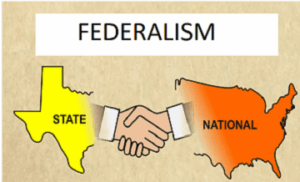
ORIGIN OF NIGERIAN FEDERALISM
Nigerian federalism can be traced far back to 1914, when the Northern and Southern protectorates were amalgamated through with unitary form of administration. Since then, governmental powers that existed in Nigeria started to be shared between the central government headed by the governor-general and the governments of Northern and Southern protectorates headed by the lieutenant governors. Therefore, with the autonomous parts of the Northern and the Southern provinces, the administrative system of Nigeria wore a somewhat outlook of a federation.
The further division of the country into three regions in 1946 by the then Governor of Nigeria Sir Arthur Richards under the Richards constitutional arrangements, gave more support to the emergence of Nigeria with a federal system of government. The 1951 Macpherson constitution gave further concrete support to the establishment of a federal system of government in Nigeria.
Apart from the division of Nigeria into three regions Northern, Western and Eastern regions, the constitution appointed lieutenant governors to head these regions and granted legislative powers to the legislative and executive councils that were established. The 1954 Lyttleton constitution removed the final shades of a unitary state from Nigeria by establishing a true federal state. The constitution that took effect on October 1, 1954, shared powers between the central and the regional government. The constitution went further to re-organize the judiciary to be in line with the federal structure of the country. Federalism involves the sharing of powers between the central government and other subordinate units(s), e.g. local government and state/ region. In 1954, we had two tiers of government- the central and regions, both had their powers defined and shared by the constitution. Exclusive legislative functions went to the central government; concurrent legislative functions went to both the central and regional governments while residual functions went to the regions.
FACTORS RESPONSIBLE FOR NIGERIAN FEDERALISM
- Cultural Diversity: Differences in culture, religion, language, custom, tradition, etc among different ethnic groups make the operation of a federal system possible.
- The fear of one ethnic group dominating others necessitated the establishment of federalism in Nigeria.
- To protect the interests of minority groups.
- The large population and wide geographical areas of Nigeria, make it necessary to establish federalism in Nigeria.
- To ensure rapid and even development of all parts of Nigeria.
- To bring the government near to the people of Nigeria.
- To bring about the division of powers to reduce the burden involved and make the art of governance less energy-sapping, time-saving, less fatiguing and make government more effective.
- To create more employment opportunities through the division of powers and the duplication of ministries and offices.
- To make it possible for diverse laws that will suit the diverse communities in Nigeria.
To preserve the local independence or autonomy of every ethnic group in Nigeria.

Third Term Government Lesson Notes for Other Topics
Development Of Political Parties
Explore lesson notes covering all topics.
Development Of Political Parties III
Explore lesson notes covering all topics.
The Structure Of Nigerian Federalism
Explore lesson notes covering all topics.
Development Of Political Parties II
Explore lesson notes covering all topics.
Minor Political Crisis In Nigeria
Explore lesson notes covering all topics.
Electoral Crisis
Explore lesson notes covering all topics.
Basic Principles Of Government: Rule Of Law
Explore lesson notes covering all topics.
Fundamental Human Rights
Explore lesson notes covering all topics.
Separation Of Power
Explore lesson notes covering all topics.
Intergroup Relations
Explore lesson notes covering all topics.

Pressure Groups
Explore lesson notes covering all topics.
Political Parties And Party System
Explore lesson notes covering all topics.
Citizenship
Explore lesson notes covering all topics.

Centralization And Decentralization
Explore lesson notes covering all topics.
Representative Government & Popular Participation
Explore lesson notes covering all topics.


Lesson Notes for Other Classes
JSS1 Lesson Note
The complete lesson note to guide your studies.

JSS2 Lesson Note
The complete lesson note to guide your studies.

SS1 Lesson Note
The complete lesson note to guide your studies.

SS3 Lesson Note
The complete lesson note to guide your studies.