
Oral, Structure, Vocabulary Development, Words For The Week 11 SS2 English Studies Lesson Note
Download Lesson NoteTopic: Oral, Structure, Vocabulary Development, Words For The Week 11
ORAL: NASAL CONSONANTS: /m/ AND /n/
Nasal sounds are produced when air is expelled through the nose as well as the mouth. This is because the velum, or soft palate, is lowered, which allows air to pass through the nasal cavity.
The three nasal sounds in English are /m/, /n/, and /ŋ/.
/m/ is produced by closing the lips together. Examples of words with the /m/ sound include mat, mom, and jam.
/n/ is produced by touching the tongue to the roof of the mouth behind the teeth. Examples of words with the /n/ sound include no, net, and sing.
NOTE:
To correctly pronounce the nasal sounds, it is important to keep the velum lowered while producing the sounds. This can be difficult at first, but with practice, it will become easier.
Sentences that use the nasal sounds:
- The man sat on the bench and ate his lunch.
- The moon was full and bright in the sky.
- The camel walked through the desert.
- The hammer hit the nail on the head.
- The hymn was sung by the choir.
STRUCTURE: CLAUSE (ADJECTIVAL CLAUSE)

An adjectival clause is a group of words that functions as an adjective in a sentence. It describes or gives more information about a noun or pronoun. Adjectival clauses are also called relative clauses because they usually begin with relative pronouns like who, whom, whose, which, or that.
Characteristics of an Adjectival Clause
- Begins with a relative pronoun: e.g.: who, whom, whose, which, or that.
- It describes a noun or pronoun
- It contains a subject and a verb
Examples of Adjectival Clauses
- The book that I borrowed was interesting.
– The adjectival clause is “that I borrowed.” It describes the noun “book.”
- The teacher who helped me is very kind.*
– The adjectival clause is “who helped me.” It gives more information about the noun “teacher.”
- She met the girl whose bag was lost.
– The adjectival clause is “whose bag was lost.” It tells more about the noun “girl.”
Relative Pronouns and Their Uses in Adjectival Clauses
- Who: Used for people.
Example: The boy who won the race is my friend.
- Whom: Also used for people, but usually as the object of the verb or preposition.
Example: The girl whom I saw is very tall.
- Whose: Shows possession.
Example: The man whose car broke down called for help.
- Which: Used for things or animals.
Example: The book which I read was very interesting.
- That: Can be used for both people and things in restrictive clauses.
Example: The bag that I bought is red.
ASSIGNMENT
Write a short paragraph about your best friend. Use at least two adjectival clauses to describe them.
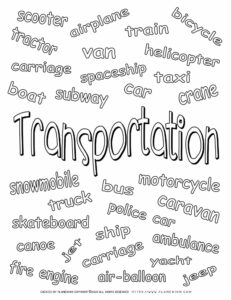
VOCABULARY DEVELOPMENT: WORDS ASSOCIATED TRANSPORTATION
- Ocean liner –a ship used to convey passengers and some cargo across the ocean.
- Berth – a place for a ship to anchor.
- Rudder – a wooden or metal blade at the back of a ship that swings to and fro to control its direction.
- Cargo – goods carried by ship, a place or vehicle.
- Speedometer – an instrument in a vehicle for tells its speed.
- Chauffeur – a person employed to drive someone’s car.
- Commuter – a person who makes regular journeys of some distance.
- Freightliner/liner train – a train that carries large amounts of goods in special containers.
- Derail – to cause to run off the rails/railway lines.
- Terminus – the last stop on a railway.
- Airliner – a large passenger aircraft.
- Fuselage – the main body of an aircraft.
- Cockpit – the part of a plane or racing car in which the pilot and co-pilot sit.
- Tarmac/runway – is a way for landing or taking off.
- Terminal – a bus station for passengers going to or arriving from an airport.
- Hangar – a big building (shed) where planes are kept.
ASSIGNMENT
Write out five other words associated with transportation and use them in sentences.
WORDS FOR THE WEEK
Wallow, Submission, Vociferous, Reservoir, Ribaid, Pugnacious, Evince, Tirade, Mandate, Yob

Third Term English Studies Lesson Notes for Other Topics
Structure, Comprehension, Vocabulary Development, Words For The Week 10
Explore lesson notes covering all topics.
Structure, Writing , Vocabulary Development, Words Of The Week 9
Explore lesson notes covering all topics.

Oral, Structure, Comprehension , Writing, Words Of The Week 8
Explore lesson notes covering all topics.
Structure, Writing, Vocabulary Development, Words For The Week 6
Explore lesson notes covering all topics.
Oral, Comprehension ,Grammar, Words For The Week 5
Explore lesson notes covering all topics.

Grammar, Oral, Writing, Words For The Week 4
Explore lesson notes covering all topics.

Grammar, Summary, Vocabulary Development, Words For The Week 3
Explore lesson notes covering all topics.

Grammar, Writing, Vocabulary Development, Words For The Week 2
Explore lesson notes covering all topics.
Grammar: Revises Tenses, Words For The Week 1
Explore lesson notes covering all topics.

Persuasive Speech: Meaning, Features & How to Write it
Explore lesson notes covering all topics.
Articles : Difference Between An Article & A Letter
Explore lesson notes covering all topics.

Phrasal Verbs
Explore lesson notes covering all topics.
Speech Writing: Features & Common Mistakes
Explore lesson notes covering all topics.

Vocabulary Development: Synonym
Explore lesson notes covering all topics.

Vocabulary Development - Antonyms & Adjuncts
Explore lesson notes covering all topics.


Lesson Notes for Other Classes

JSS1 Lesson Note
The complete lesson note to guide your studies.
JSS2 Lesson Note
The complete lesson note to guide your studies.

SS1 Lesson Note
The complete lesson note to guide your studies.

SS3 Lesson Note
The complete lesson note to guide your studies.