
Oral, Structure, Comprehension , Writing, Words Of The Week 8 SS2 English Studies Lesson Note
Download Lesson NoteTopic: Oral, Structure, Comprehension , Writing, Words Of The Week 8
VOWEL SOUNDS: COMPARISON OF /i/ and /v/, /u/ and /u:/, /ae/ and /a/
- COMPARISON OF /U/ AND /U:/
The vowel /u/ is a short vowel sound that is produced by rounding the lips and lowering the tongue. It is similar to the vowel sound in the word “full.”
The vowel /u:/ on the other hand is a long vowel sound that is produced by rounding the lips and lowering the tongue even further. It is similar to the vowel sound in the word “fool.”
Here is how to pronounce the vowels/u/ and /u:/ correctly:
/u/: Make a tight “oo” sound, as in the word “full.”
/u:/: Make a longer “oo” sound, as in the word “fool.”
Differences Between/u/ and /u:/
- /u/: is a shorter vowel sound than /u:/.
- /u/: is often followed by a consonant, such as in the word “full.”
- /u:/: is often followed by a vowel, such as in the word “fool.”
Words Associated With The Vowels /u/ and /u:/
/u/: full, would, put, cup, mug, fun, sun, run
/u:/: fool, pool, rule, soup, soup, blue, true, few
- COMPARISON OF /ae/ and /a:/
i. The Sound /a:/
/a:/ is a long vowel sound, often referred to as the “long A” sound. It is produced by keeping the mouth open and the tongue low, with the lips relaxed.
Steps to pronounce it;
– Open your mouth wider.
– Keep your tongue low and towards the back of your mouth.
– Make sure the sound is prolonged.
Examples of Words with /a:/:
- a) Car: /ka:/
- b) Father: /ˈfa:ðər/
- c) Garden: /ˈɡa:dn/
- d) Part: /pa:t/
- e) Calm: /ka:m/
ii. The Sound /æ/
/æ/ is a short vowel sound, often referred to as the “short A” sound. It is produced by keeping the mouth open but less wide than for /a:/, and the tongue is positioned slightly higher and more forward in the mouth.
Steps to pronounce it:
– Open your mouth moderately.
– Keep your tongue low and towards the front of your mouth.
– The sound should be short and crisp.
Examples of Words with /æ/:
- Cat: /kæt/
- Apple: /ˈæpl/
- Back: /bæk/
- Hat: /hæt/
- Man: /mæn/
- COMPARISON OF /i/ and /i:/
/i/ is a short vowel sound. It is pronounced by raising the middle of the tongue towards the roof of the mouth, but not as high as for /i:/. The lips are slightly spread. Examples of words that contain the /ɪ/ sound are hill, ink, village, women, sit, fit, fifth, rich, trick, nymph, rhythm, and symbol.
/i:/ is a long vowel sound. It is pronounced by raising the middle of the tongue towards the roof of the mouth more than for /ɪ/, and the lips are spread wider. Examples of words that contain the /i:/ sound are: bee, need, machine, kerosene, sea, receive, we, these, seize, be, free, tree, ceiling, glee, margarine, Peter, beans, seem, beat, leaf, deceive, people, quay, key, eat, meet, leaf, cheek.
STRUCTURE: ADJUNCTS, CONJUNCTS AND DISJUNCTS
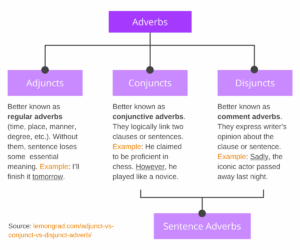
In English grammar, adjuncts, conjuncts, and disjuncts are types of adverbials. They are words or phrases that provide additional information to a sentence. Each has a different role in how it modifies or connects ideas in a sentence.
ADJUNCTS
An adjunct is a word or phrase that adds extra information to a sentence. It tells us more about the action, like when, where, how, and why something happens. Without an adjunct, the sentence can still be complete, but with less detail.
Examples:
- Yesterday, we played football. (Time)
– He worked at the library. (Place)
– She spoke quietly. (Manner)
In these examples, “yesterday” tells us when they played football, “at the library” tells us where he worked, and “quietly” tells us how she spoke. Removing these words won’t make the sentences incorrect, but the extra details help make them clearer.
CONJUNCTS
A conjunct is used to connect two sentences or clauses. It shows the relationship between two ideas, such as addition, contrast, or cause and effect. Conjuncts help the sentences flow better.
Examples:
- I studied hard; therefore, I passed the exam. (Cause and effect)
- She wanted to leave early; however, she stayed until the end. (Contrast)
- He was tired, yet he continued working. (Contrast)
Conjuncts like “therefore,” “however,” and “yet” join two parts of a sentence. They show the logical relationship between ideas. For instance, “therefore” shows that passing the exam is the result of studying hard.
DISJUNCTS
A disjunct gives the speaker’s or writer’s opinion, attitude, or comment about the whole sentence. It does not affect the main action of the sentence but adds to the speaker’s feelings or perspective.
Examples:
- Honestly, I don’t think that’s a good idea.
- Unfortunately, the meeting was cancelled.
- Clearly, he wasn’t prepared for the test.
In these sentences, “honestly,” “unfortunately,” and “clearly” show how the speaker feels about the statement. “Honestly” shows that the speaker is giving their true opinion, “unfortunately” shows sadness or disappointment, and “clearly” shows the speaker’s strong belief.
DIFFERENCES BETWEEN ADJUNCTS, CONJUNCTS, AND DISJUNCTS
- Adjuncts add extra information to the action (e.g., time, place, manner).
- Conjuncts join or connect ideas in a sentence (e.g., cause, addition, contrast).
- Disjuncts show the speaker’s attitude or comment on the entire sentence.
ASSIGNMENT
Write five sentences of your own, using at least one adjunct, one conjunct, and one disjunct.
WRITING: EXPOSITORY ESSAYS
An expository essay is a type of essay where the writer explains a topic in detail. The purpose of this kind of essay is to give clear information or explain something to the reader. It doesn’t involve opinions or arguments but focuses on facts and evidence.
Examples of Expository Essay Topics
- How to maintain a healthy lifestyle.
- The benefits of education.
- The process of recycling.
STRUCTURE OF AN EXPOSITORY ESSAY
An expository essay follows a simple structure. This structure helps you to organize your ideas.
i. Introduction
The introduction is the first paragraph of your essay. Here, you introduce the topic and explain what the essay will be about. It should grab the reader’s attention and give a brief overview of the topic.
ii. Body Paragraphs:
The body paragraphs give a detailed explanation of the topic. Each paragraph should focus on one main idea. The use of examples, facts, and clear explanations is important.
iii. Conclusion:
The conclusion is the final part of your essay. It summarizes the main points and gives the reader a final thought on the topic. It should not introduce new information but should wrap up the essay clearly and concisely.
Steps in Writing an Expository Essay
- Choose a Topic
- Plan Your Ideas
- Write a Draft
- Revise and Edit
Example of an Expository Essay Outline
Topic: “The Importance of Education”
i. Introduction:
– Define education.
– Briefly state why education is important.
ii. Body Paragraph 1:
– Explain how education helps individuals acquire knowledge.
iii. Body Paragraph 2:
– Discuss how education opens up job opportunities.
iv. Body Paragraph 3:
– Talk about how education contributes to personal development.
v. Conclusion:
– Summarize the importance of education in society and for individuals.
ASSIGNMENT
Write an expository essay on the topic “How to Improve Family Functioning through Love, Cooperation, and Communication.”
WORDS FOR THE WEEK
Seminar, Quandary, Panah, Ruse, Quagmire, Ominous, Novice, Mundane

Third Term English Studies Lesson Notes for Other Topics
Oral, Structure, Vocabulary Development, Words For The Week 11
Explore lesson notes covering all topics.
Structure, Comprehension, Vocabulary Development, Words For The Week 10
Explore lesson notes covering all topics.
Structure, Writing , Vocabulary Development, Words Of The Week 9
Explore lesson notes covering all topics.
Structure, Writing, Vocabulary Development, Words For The Week 6
Explore lesson notes covering all topics.
Oral, Comprehension ,Grammar, Words For The Week 5
Explore lesson notes covering all topics.
Grammar, Oral, Writing, Words For The Week 4
Explore lesson notes covering all topics.
Grammar, Summary, Vocabulary Development, Words For The Week 3
Explore lesson notes covering all topics.
Grammar, Writing, Vocabulary Development, Words For The Week 2
Explore lesson notes covering all topics.
Grammar: Revises Tenses, Words For The Week 1
Explore lesson notes covering all topics.
Persuasive Speech: Meaning, Features & How to Write it
Explore lesson notes covering all topics.
Articles : Difference Between An Article & A Letter
Explore lesson notes covering all topics.
Phrasal Verbs
Explore lesson notes covering all topics.
Speech Writing: Features & Common Mistakes
Explore lesson notes covering all topics.
Vocabulary Development: Synonym
Explore lesson notes covering all topics.
Vocabulary Development - Antonyms & Adjuncts
Explore lesson notes covering all topics.


Lesson Notes for Other Classes
JSS1 Lesson Note
The complete lesson note to guide your studies.
JSS2 Lesson Note
The complete lesson note to guide your studies.
SS1 Lesson Note
The complete lesson note to guide your studies.
SS3 Lesson Note
The complete lesson note to guide your studies.