
Inflation SS2 Economics Lesson Note
Download Lesson NoteTopic: Inflation
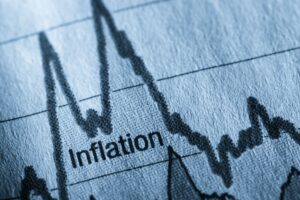
Inflation is a persistent rise in the general level of the price of goods and services. Inflation occurs when there is an increase in money supply without a corresponding increase in the volume of production.
TYPES OF INFLATION
- Demand-Pull Inflation
- Cost Push Inflation
- Hyper-Inflation
- Creeping Inflation
- Demand Pull Inflation: This occurs when there is excess demand for goods and services over the supply. The factors responsible for this type of inflation may be due to population increase, increase in workers’ salaries and wages, etc.
- Cost-push Inflation: Producers pay for factors of production, any slight increase in the price of factor input will reflect in the price per unit. For example: if there is an increase in the price of flour, sugar, or butter, automatically the price of bread would be high.
- Hyperinflation: This occurs when the prices of goods and services are rising fast to the extent that money is losing its value or its ability to buy goods. War, budget deficits, etc are the major causes of hyperinflation. Hyperinflation is also known as galloping inflation or runaway inflation.
- Creeping Inflation: This type of inflation occurs when there is a slow but steady rise in the general prices of goods and services. It is also known as persistent inflation
CAUSES OF INFLATION
- Inflation occurs when there is excess demand for goods and services e.g. demand pulls inflation.
- Low productivity e.g. agriculture;
- Increase in salaries and wages.
- High cost of production.
- Budget deficit i.e. when government expenditure is more than its income.
- Inflation can also be caused if there is an increase in population that will force demand to rise.
- Excessive bank lending.
- The high cost of importing raw materials can lead to a high cost of goods.
- Hoarding which is an act of creating artificial scarcity.
- Inflation can be caused due to industrial action by workers e.g. strike, tools down etc.
- Poor storage facilities.
- Money laundering which is the mass transfer and injection of money into circulation.
EFFECTS OF INFLATION
Inflation as a phenomenon is a necessary evil. In other words, it has positive and negative effects on the overall economy.
Positive Effects Of Inflation
- During inflation, the debtor gains at the expense of the creditor.
- The inflation period serves as a period where businessmen make a profit.
- Inflation stimulates investment.
- The employment rate is high during inflation.
- Due to the second, third and fourth points stated above, inflation helps the economy to grow.
Negative Effects Of Inflation
- The lenders (creditors) incur a loss because the money loses its value as inflation persists.
- Distortion in the economy due to agitation for an increase in wages and salaries.
- Fixed-income earners e.g. salary earners suffer a lot during inflation.
- Money loses its value during inflation.
- It leads to a balance of payment problems.
- Inflation discourages savings since money loses its value day in and day out.
- Fall in the living standard of the people.
HOW TO CONTROL INFLATION
- In an attempt to stem inflation, the government should encourage industrialization to make goods and services available.
- Where inflation is triggered by an increase in money supply, an effective interest rate could be adopted i.e. increasing the interest rate to discourage excess borrowing.
- Effective use of fiscal policy e.g. Taxation as a way of reducing the disposable income of workers can help to check inflation.
- Removal of bottlenecks in the distribution system. This will enhance the free flow of goods.
- Legislation could be put in place to check the activities of hoarders.
- Contractionary monetary policy can also help to check inflation where inflation is caused by an increase in money supply.
- Subsidies for farmers, and businesses, will help in solving the problem of an increase in the prices of inputs e.g. hoe, cutlass.
- Wage freezing i.e. the government should not increase salaries.
TERMINOLOGIES ASSOCIATED WITH INFLATION
- Inflation Gap: This is an economic situation in which the total demand in the economy exceeds the total supply of goods and services available to satisfy demand. To arrive at this, subtract the total amount of money available for spending from the total money value of the actual goods and services available to meet the demand.
- Inflation Spiral: A price increase will make workers demand an increased income (wages and salaries). This will cause a rise in the general level of price. This is known as the inflation spiral.
- Disinflation: The direct control of consumers’ expenditure as a way of checking inflation is known as disinflation. This is done by reducing the supply of money and increasing interest rates etc.
- Reflation: This refers to the economic state of affairs in which prices, employment, output etc. are picking up again as a result of conscious government policy to that effect.
- Stagflation: When a high rate of inflation exists at the same time as industrial production is slowing down, then we refer to this as stagflation.
- Slumpflation: Slumpflation occurs when economic conditions in which much reduced economic activity co-exist with inflation.
DEFLATION
Deflation is defined as a persistent fall in the general level of price. This is a situation where the volume of money in circulation is not sufficient to meet up with the prevalent economic situation. This is the direct opposite of inflation. This is a fall in the general level of price as a result of a decrease in the volume of money in circulation.
CAUSES OF DEFLATION
- Deflation is caused by the failure of the government to spend i.e. Budget surplus.
- When banks increase their interest rate, it discourages borrowing as such money supply drops. This amounts to deflation.
- Where productivity exceeds the demand coupled with a decrease in money supply then deflation sets in.
- Where workers are excessively taxed leaving them with little disposable income, their marginal propensity to consume drops thereby leading to deflation.
ASSIGNMENT
- An inflation in which the price level rises steadily at an average rate of about 2% per annum is best described as (a) galloping (b) induced(c) creeping (d) suppressed (e) run-away
- Inflation in any economy_____ (a) has no monetary connection (b) implies a sustained decrease in the general price (c) always increase the value of the national currency(d) tends to redistribute income (e) tends to bring down market prices
- Which of the following statements is not true in an inflation period? (a) the purchasing power of money diminishes (b) wages rise simultaneously with the price (c) more money runs after a limited quantity of goods (d) Fixed-income earners lose (e) aggregate real demand exceeds aggregate real supply.
- Inflation caused by an increase in demand is known as ___________(a)cost-push inflation (b) hyper-inflation © demand-pull inflation(d) creeping inflation (e) runaway inflation
- One way to solve the economic problem of inflation in a country is by increasing the (a) supply of commodities (b) supply of currency(c) salaries of workers(d) demand for commodities

Third Term Economics Lesson Notes for Other Topics
Financial Institutions
Explore lesson notes covering all topics.
Public Finance
Explore lesson notes covering all topics.
Money
Explore lesson notes covering all topics.
Budget
Explore lesson notes covering all topics.
Capital Market
Explore lesson notes covering all topics.
National Income
Explore lesson notes covering all topics.
Theory Of Income Determination
Explore lesson notes covering all topics.
Theory Of Multiplier
Explore lesson notes covering all topics.
Financial Institutions
Explore lesson notes covering all topics.
The Nature Of Nigerian Economy
Explore lesson notes covering all topics.
Agriculture
Explore lesson notes covering all topics.
Mining
Explore lesson notes covering all topics.

Channels Of Distribution
Explore lesson notes covering all topics.


Lesson Notes for Other Classes

JSS1 Lesson Note
The complete lesson note to guide your studies.
JSS2 Lesson Note
The complete lesson note to guide your studies.
SS1 Lesson Note
The complete lesson note to guide your studies.

SS3 Lesson Note
The complete lesson note to guide your studies.