
Budget SS2 Economics Lesson Note
Download Lesson NoteTopic: Budget
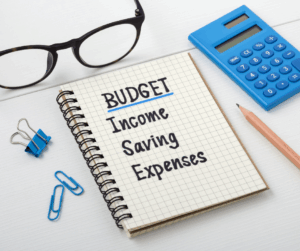
A budget may be defined as a financial statement of the total estimated revenue and the proposed expenditure of a government in a given period, usually a year.
FUNCTION / USES / IMPORTANCE OF BUDGETS
The national budget is used to achieve the following objectives:
- It is used as a means of raising revenue.
- It is used to control inflation.
- It is used as a remedy for depression (recession) or deflation.
- It is used to correct a balance of payments deficit.
- It is used as a tool for economic planning.
- It is a means of enhancing public welfare and reducing income inequality in the country.
- Budgets are used to allocate resources between different sectors of the economy.
- It is used to control the economy to foster economic growth and development.
TYPES OF BUDGET
- Balance Budget: This is when the total estimated revenue is equal to the proposed expenditure of the government. This means that nothing will be left as a reserve from the money collected in the form of revenue
- Surplus Budget: A budget is called a surplus budget when the total estimated revenue is more than the proposed expenditure. In this type of budget, not all the estimated revenue is proposed to be spent in that year. That is, there will be a reserve.
- Deficit Budget: This is when the government’s total proposed expenditure for the period is more than the total estimated revenue. The shortfall in revenue is sourced through borrowings, printing of more currency, aids and grants etc.
ECONOMIC CONDITIONS WARRANTING THE ADOPTION OF THE DIFFERENT TYPES OF BUDGETS
- A budget surplus is desirable in periods of inflation because it reduces aggregate demand thereby reducing inflationary pressure in the economy
- A deficit budget is used in the following instances:
(a) To reduce unemployment by increasing aggregate demand.
(b) To finance a national emergency such as war
(c) To remedy a deflationary trend
NATIONAL DEBT
National debt or Public Debt refers to the total of debts owed by the government of a country both internally and externally. The debts may or may not be with interest
REASONS WHY GOVERNMENT BORROW
- To finance the deficit budget
- To finance a huge capital project
- To prosecute a war i.e. for the procurement of ammunition and other war materials
- To service existing loans
- To manage an emergency eg flood, drought, epidemic, famine
- To correct an unfavourable balance of payment
INSTRUMENTS OF GOVERNMENT BORROWING IN NIGERIA
- Treasury Bills used for short-term borrowing i.e. 90 days
- Treasury Certificates- used for medium-term borrowing i.e. 1 2 years
- Development Stocks used for long above
- Stabilization Securities
- National Saving Scheme
- Negotiation with External Financial Institutions
- Municipal Revenue Bond
EFFECTS OF HUGE NATIONAL DEBT ON THE ECONOMY OF A COUNTRY
- It reduces the availability of foreign exchange.
- It makes a country susceptible to the dictates of external creditors.
- It makes it difficult for the country to source fresh loans i.e. it lowers a country’s credit ratings.
- A large domestic debt will influence the distribution of income in the country.
- The servicing of an external debt will involve an outflow of resources which can otherwise be used for economic development.
- The servicing of a large national debt will limit the government’s ability to provide welfare / social services to the people
REVENUE ALLOCATION
Revenue allocation refers to the sharing of the nation’s wealth among various tiers of government or various units that make up the country. The various units include Federal, State and local governments.
Parts Of Revenue Allocation
Revenue allocation is grouped into two major parts namely:
- Vertical Revenue Allocation
- Horizontal Revenue Allocation
- Vertical Revenue Allocation In vertical revenue allocation, revenue accruing to the federal account is shared among the three tiers of government Federal, State and Local government.
- Horizontal Revenue Allocation: Under horizontal revenue allocation, revenue accruing to the federation account is shared among the units within a given level of government. It involves certain principles based on some factors to be applied in revenue allocation. These principles include:
- Population size
- Landmass
- Derivation, e.g. oil-producing areas.
- Ecological problems.
REVENUE ALLOCATION FORMULA
This involves the weight assigned to various principles e.g. Federal government 48.5%, State 24%, Local government 20%, special fund 7.5%. These are just for a short time. It should be noted that there is no fixed revenue allocation. It changes from time to time. The Revenue Mobilization Allocation and Fiscal Commission (RMFC) is always at work trying to work out a proposal for a new revenue-sharing formula.
ASSIGNMENT
- The government impose taxes mainly to
(a) punish the citizen
(b) provide social amenities
(c) donate to poorer countries
(d) execute white elephant projects
- Budget deficit can be financed by (a) reducing the level of taxation
(b) printing more money
(c) lending to financial institutions (d) employing more workers.
- A continuous fall in the general price level is called
(a) recession
(b) depression
(c) deflation
(d) stagflation.
- Budget surplus implies that
(a) expenditure equals revenue
(b) expenditure is less than revenue (c) expenditure is greater than taxation
(d) direct tax is more than indirect tax.
- The greatest revenue-earning industry in Nigeria is
(a) construction
(b) agriculture
(c) manufacturing
(d) mining.

Third Term Economics Lesson Notes for Other Topics
Inflation
Explore lesson notes covering all topics.
Financial Institutions
Explore lesson notes covering all topics.
Public Finance
Explore lesson notes covering all topics.
Money
Explore lesson notes covering all topics.
Capital Market
Explore lesson notes covering all topics.
National Income
Explore lesson notes covering all topics.
Theory Of Income Determination
Explore lesson notes covering all topics.
Theory Of Multiplier
Explore lesson notes covering all topics.
Financial Institutions
Explore lesson notes covering all topics.
The Nature Of Nigerian Economy
Explore lesson notes covering all topics.
Agriculture
Explore lesson notes covering all topics.
Mining
Explore lesson notes covering all topics.

Channels Of Distribution
Explore lesson notes covering all topics.


Lesson Notes for Other Classes

JSS1 Lesson Note
The complete lesson note to guide your studies.
JSS2 Lesson Note
The complete lesson note to guide your studies.

SS1 Lesson Note
The complete lesson note to guide your studies.

SS3 Lesson Note
The complete lesson note to guide your studies.