
Hydrocarbons SS2 Chemistry Lesson Note
Download Lesson NoteTopic: Hydrocarbons
INTRODUCTION TO ORGANIC CHEMISTRY
Organic chemistry is the chemistry of carbon compounds except compounds such as carbon (II) oxide, carbon (IV) oxide and trioxocarbonate (IV). Carbon has the unique ability to form numerous organic compounds because it can catalyze. Catenation is the ability of atoms of an element to form bonds between its atoms and produce a long chain structure.
All organic compounds contain carbon as the main element together with one or more other elements such as hydrogen, oxygen, chlorine, nitrogen and sulphur.
UNIQUE NATURE OF CARBON
- The valency of carbon: the electronic configuration of carbon is as follows:
C = 6: 1s² 2s¹ 2px¹ 2py¹ 2pz¹
Carbon forms covalent bonds and after bond formation, it has neither a vacant orbital nor a lone pair of electrons. This makes many carbon compounds chemically stable.
- The bond between carbon and hydrogen is non-polar. Thus, hydrogen atoms attached to carbon do not weaken carbon-carbon bonds.
- The types of orbital hybridization available to carbon: carbon can form three types of hybridizations: SP3, SP2 and SP hybridization. Hence, it can form single, double or triple covalent bonds between its atoms.
- Large amount of energy is required to break carbon single bonds.
CHARACTERISTICS FEATURE OF ORGANIC COMPOUNDS
- Organic compounds are covalent.
- They are non-polar substances and are insoluble in polar solvents.
- They have low melting and boiling points.
- They are highly flammable.
- Their reactions are relatively slow compared to inorganic chemical reactions.
CLASSIFICATION OF ORGANIC COMPOUNDS
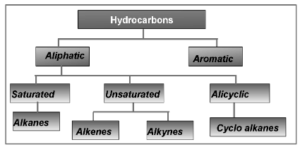
Organic compounds are classified into Aliphatic and Aromatic compounds.
- Aliphatic Compounds: These are compounds whose molecules are composed of chains of carbon atoms. They can be:
- Straight chain compounds e.g pentane
- Branched-chain compounds e.g 2-methyl butane
Straight and branched chain aliphatic compounds exist as open chains and are called ACYCLIC compounds. Aliphatic compounds which exist as closed chains are called the CYCLIC compounds i.cyclopropane.
- Aromatic Compounds: Benzene, C6H6, is a typical aromatic compound. Other aromatics compounds are derivatives of benzene e.g. C6H5OH.
DEFINITION OF TERMS USED IN ORGANIC CHEMISTRY
- Homologous Series
Homologous series is a family of organic compounds which follows a regular structural pattern and in which each successive member differs in its molecular formula by –CH2- group.
The simplest series of compounds in organic chemistry is the Alkane series. The general molecular formula of the alkane series is CnH2n+2. It is the parent series from which every other series is obtained. Other homologous series include the Alkenes, Alkynes, Alkanols, Alkanoic acids, etc.
Characteristics Of Homologous Series
- All members conform to general molecular formula, e.g for alkanes, CnH2n+2
- Each successive member differs in the molecular formula by – CH2- group.
- All members undergo similar chemical reactions.
- The physical properties of members change gradually along the series.
- All members are prepared by the same method.
Alkyl And Functional Groups
- Alkyl groups: Alkyl groups are all groups derived from the alkanes by the loss of a hydrogen atom. Alkyl groups have a general formula of CnH2n+1. They are named after the parent alkane by replacing the ending –ane with –yl. The alkyl group derived from the first two members of the parent alkane series are:
Parent alkane Alkyl group/Formula
Methane, CH4 Methyl/-CH3
Ethane, C2H6 Ethyl/-C2H5
Functional groups: The substituent of hydrogen atoms in the alkane series to form the alkyl group determines the chemical properties of the compound formed thereafter. This substituent is called FUNCTIONAL GROUP.
A functional group is an atom, a radical or a bond common to a homologous series and which determines the chemical properties of the series.
Examples of functional groups include the hydroxyl group -OH, amino group NH2, carboxyl group -COO, and double and triple bonds.
The Alkyl group in a compound determines the physical properties of the compound; while the functional group determines the chemical properties of the compound.
SATURATED AND UNSATURATED COMPOUNDS
Saturated compounds are compounds containing atoms joined together by a single covalent bond. Alkanes are saturated compounds, e.g ethane, C2H6
Unsaturated compounds are compounds containing atoms joined together by double or triple bonds. Alkenes and alkynes are unsaturated compounds,
e.gEthene, C2H4
- FORMULAE OF ORGANIC COMPOUNDS
Organic compounds are characterized by the following formulae
- Empirical formula
- Molecular formula
- Structural formula
- Empirical Formula is the simplest formula which indicates the component elements and ratio of the combination of atoms in a compound.
- Molecular Formula is a chemical formula of a compound which indicates the actual number of atoms of each element in a compound.
- Structural Formula is a formula which indicates how atoms are arranged within the molecule of a substance.
The structural formula can be:
- Open structural formula
- Condensed structural formula
ASSIGNMENT
Pick the correct option ONLY.
- An exceptionally large number of carbon compounds is essentially due to the ability of
(a). carbon to catenate liberally (b).various groups to catenate
(c). nitrogen, hydrogen, phosphorus and the halogens to catenate with themselves
(d). hydrocarbons to dominate other groups.
- Which of the following is not a characteristic feature of organic compounds?
(a). Covalent in nature (b). They dissolve in all polar solvents (c).Low melting and boiling points (d).Highly flammable
- Functional groups in organic compounds
(a). determine the chemical properties of the homologous series (b). does not modify the other when they are more than one molecule (c).have a general formula which may include the functional group (d). are responsible for the physical properties.
- Homologues have the same
(a).empirical formula (b).structural formula (c).general formula (d). molecular formula
- The four main classes of hydrocarbons are
(a).methane, ethene, ethyne and benzene(b).ethane, ethene, ethyne and toluene (c).cycloalkane, cycloalkene, alkynes and arenes(d). alkanes, alkenes, alkynes and aromatics
- Write the open chain structure of the following:
i.CH3C(CH3)2CH2CH(CH3)CH2CH3
- (CH3)2CHCH2CH(CH2Cl)CH3
iii. CH3C(Br)2CH2CH3

Third Term Chemistry Lesson Notes for Other Topics
Water
Explore lesson notes covering all topics.

Solubility
Explore lesson notes covering all topics.
Mass-Volume Relationship
Explore lesson notes covering all topics.
Volumetric/Quantitative Analysis
Explore lesson notes covering all topics.
Unsaturated Hydrocarbons
Explore lesson notes covering all topics.
Alkanols
Explore lesson notes covering all topics.
Carbon And It'S Compounds VI - Hydrocarbon
Explore lesson notes covering all topics.
Carbon And It'S Compounds VII - Octane & Petrol
Explore lesson notes covering all topics.
Carbon And It'S Compounds V - Trioxocarbonate (IV) Acid
Explore lesson notes covering all topics.
Carbon And It'S Compounds IV - Coal & Fuel Gases
Explore lesson notes covering all topics.
Carbon And It'S Compounds III
Explore lesson notes covering all topics.
Carbon And Its Compounds II
Explore lesson notes covering all topics.
Carbon And Its Compounds I
Explore lesson notes covering all topics.
Chemical Industries
Explore lesson notes covering all topics.
Chemical Industries II
Explore lesson notes covering all topics.


Lesson Notes for Other Classes
JSS1 Lesson Note
The complete lesson note to guide your studies.

JSS2 Lesson Note
The complete lesson note to guide your studies.

SS1 Lesson Note
The complete lesson note to guide your studies.

SS3 Lesson Note
The complete lesson note to guide your studies.