
Terrestrial Habitat SS2 Biology Lesson Note
Download Lesson NoteTopic: Terrestrial Habitat
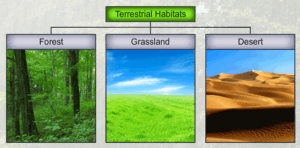
Organisms of the land are called terrestrial organisms. They include plants and animals that are found living on the ground and under the ground.
Terrestrial habitat is subdivided into four main parts, namely:
- Marsh
- Forest
- Grassland/ savanna
- Arid land/ desert
MARSH
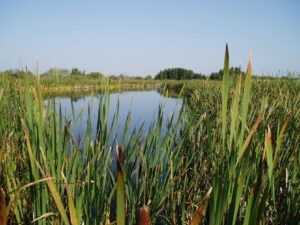
Marsh is a low land, flooded in the rainy season and usually waterlogged because of poor drainage. The vegetation is predominantly grasses and shrubs. When trees grow in a marsh, it is called a swamp. Marsh is a transition between the aquatic habitat and terrestrial habitat.
Formation Of A Marsh
Marshes develop as a result of water overflowing its banks to accumulate on the adjoining coastal or lowland areas such as floodplains or rivers. This can be enhanced with extensive rainfall. When ponds and lakes are filled up with soil and organic debris of plants, marshes can also be formed.
Marshes formation is therefore a gradual process. Marshes can either be freshwater or saltwater marshes.
Characteristics Of A Marsh
- A marsh is a lowland.
- It is always flooded, wet and waterlogged.
- It sometimes has a pool of standing water.
- It has a high relative humidity
- Its water sometimes contains many decaying organisms
- The water has a foul smell
Organisms Of The Marsh
There are various plants and animals in this habitat. The plants include algae, grasses, water lettuce, water lilies, white and red mangroves, raphia palms etc.
Animals found in the marsh include mangrove crabs, lagoon crabs, hermit crabs, mud-skippers, fishes, frogs, snakes, crocodiles, mammals etc.
Adaptive features of organisms of the marsh include:
- They must be able to tolerate the salinity of the soil or water.
- They have to tolerate low oxygen concentrations in the soil or water.
Plants of freshwater marsh have other adaptive features similar to those of freshwater habitats. Likewise the plants of saltwater marsh.
- Saprophytic organisms (e.g. bacteria) which live on dead organic matter in marshes have to adapt to anaerobic conditions.
Food Chains In Marshes
Flowering plants → insects → frogs → crocodiles
Humus → earthworms → frogs → snakes
FORESTS
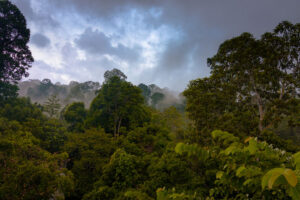
A forest is a community of plants in which tree species are dominant. There are different kinds of forests whose distribution is determined mainly by climatic factors such as temperature, rainfall and at times by soil elevation and man’s activities such as farming, lumbering, bush burning, construction of roads and building.
The major type of forest in Nigeria is the rainforest
Characteristics Of A Forest
- The forest is rich in epiphytes and climbers.
- The interior of the forest has high humidity, low light intensity and a damp floor.
- Presence of tall trees with canopies and existing in layers (stratified).
- Trees are mesophytes with broad leaves.
- The trees have buttress roots to support their heavy weight and height.
- The trees have thin barks for gaseous exchange and transpiration.
Plants Distribution And Adaptation
Forest plants (trees) include African walnut, mahogany, teak, obeche, iroko, oil palm, ferns (pteridophytes), bryophytes (mosses and liverwort), epiphytes (orchid), fungi and mistletoe e.t.c. these plants adapt to life in the forest in the following ways;
- Possession of strong tap root systems and buttress roots.
- Possession of tall unbranched trunks.
- Possession of broad leaves
- Epiphytes have mechanisms (the aerial roots) storing water and absorbing moisture from the air while growing on tree branches.
- Mistletoe (plant parasite) develops a root system that can penetrate the stem of a plant withdrawing manufactured food directly from the phloem vessels of the host plant.
Animals Distribution And Adaptation
Most forest animals are arboreal (living on trees) and these include bats, monkeys, snakes, squirrels, birds, tree frogs, and chameleons. Some live in the soil e.g. earthworms and beetles while others live among the litter on the ground e.g. millipedes, ants, and snails.
These animals adapt to the forest in the following ways:
- Monkeys have prehensile tails and long limbs for climbing and jumping.
- Bats modify their limbs into wings for flight.
- Green snakes have protective colouration to camouflage.
- Chameleon has a prehensile tail and opposable digits for grasping as well as protective colouration to camouflage.
- Apes move in groups for protection, with a high sense of sight
- Earthworms and snails have water-permeable cuticles to reduce water loss and prevent desiccation.
- Birds have powerful wings for flight
Food Chains In A Forest
Green plants → grasshoppers → toads →hawks
Green plants → monkeys → lions

Third Term Biology Lesson Notes for Other Topics
Grassland Habitats
Explore lesson notes covering all topics.
Estuarine And Freshwater Habitat
Explore lesson notes covering all topics.
Habitat - Marine Habitat
Explore lesson notes covering all topics.
Fruits
Explore lesson notes covering all topics.
Pollination In Plants
Explore lesson notes covering all topics.
Reproductive System In Flowering Plants
Explore lesson notes covering all topics.
Ecology Of Population
Explore lesson notes covering all topics.

Food Storage
Explore lesson notes covering all topics.
Reproduction In Unicellular Organisms And Invertebrates
Explore lesson notes covering all topics.
Arid Land/Deserts
Explore lesson notes covering all topics.
Terrestial Habitat
Explore lesson notes covering all topics.
Towards Better Health - How to Control Harmful Microorganisms
Explore lesson notes covering all topics.
Freshwater Habitat
Explore lesson notes covering all topics.
Aquatic And Estuarine Habibat
Explore lesson notes covering all topics.
Microoraganisms In Action
Explore lesson notes covering all topics.


Lesson Notes for Other Classes

JSS1 Lesson Note
The complete lesson note to guide your studies.

JSS2 Lesson Note
The complete lesson note to guide your studies.

SS1 Lesson Note
The complete lesson note to guide your studies.

SS3 Lesson Note
The complete lesson note to guide your studies.