
Basic Economic Principles – Law of Demand, Supply & Diminishing Returns SS2 Agricultural Science Lesson Note
Download Lesson NoteTopic: Basic Economic Principles – Law of Demand, Supply & Diminishing Returns
The following economic concept explains the behaviour of consumers of agricultural goods. These concepts or elements include:
- Wants: this is the desire or needs of man to own goods and services that give satisfaction. These wants are insatiable because the resources needed to cater for them are limited (in short supply). The basic needs or wants of man are food, clothing and shelter.
- Scarcity: this refers to the limited supply of resources needed to meet (satisfy) wants.
- Choice: this is the system employed in selecting one need to satisfy out of several alternatives.
- Scale of preference: a list of unsatisfied wants in order of importance. This is relative to the individual.
- Opportunity Cost: the satisfaction of one want or need at the expense of another. It is expressed in terms of the value or worth of a forgone alternative. It is also referred to as the true or real cost while money cost is the amount spent to acquire a particular good or service.
PRINCIPLES OF DEMAND AND SUPPLY
- Demand: Demand may be defined as the quality of goods a consumer is willing and ready to buy at a given price over a given period. Demand is effective when the willingness to buy is backed by the ability to pay.
Law Of Demand
The law of demand states that the higher the price, the lower the quantity of goods that will be demanded or the lower the price, the higher the quantity of goods that will be demanded.
Demand Schedule
This is a table showing the relationship between the price and quantity of that commodity demanded. This table below obeys the law of demand.
| PRICE N | QUANTITY DEMANDED |
| 100 | 10 |
| 80 | 20 |
| 60 | 30 |
| 40 | 40 |
| 20 | 50 |
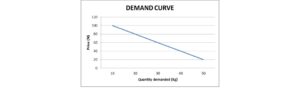
Demand Curve
The demand Curve is a graph showing the relationship between the price and quantity of that commodity demanded. This curve is derived from the demand schedule.
Demand Curve:
Factors Affecting Demand
- Price of goods.
- The price of other commodities.
- Income of the consumer.
- Changes in the taste of consumers.
- Population.
- Periods of festivals.
- Expectation of changes in prices.
- Taxation.
- Supply: Supply may be defined as the quantity of goods which a producer is willing and ready to offer for sale at a given price over a given period. The quantity of goods offered for sale in the market is referred to as effective supply.
Law Of Supply
The law of supply states that the higher the price, the higher the quantity of produce that will be supplied or the lower the price, the lower the quantity of produce that will be offered for sale.
Supply Schedule
The supply Schedule is the table which shows the relationship between the price and quality of the commodity supplied. See the table below.
| PRICE N | QUANTITY SUPPLIED KG |
| 100 | 50 |
| 80 | 40 |
| 60 | 30 |
| 40 | 20 |
| 20 | 10 |
Supply Curve
Supply Curve is a graph showing the relationship between price and quantity of goods supplied or offered for sale. The supply schedule is used to draw the supply curve as shown below.
Supply Curve:

Factors Affecting Supply
- Price of good
- Level of Technology
- Cost of production
- Government Policy
- Weather condition
- Taxation
- Price of other commodities
- Number of producers
- Natural disasters
LAW OF DIMINISHING RETURNS
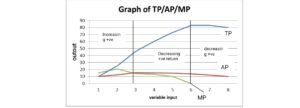
The law states that as successive amounts of a variable factor are applied to one or more fixed factors, output might increase a lot at first, but there comes a point at which the use of an additional amount of the variable factor will add less to output than the proceeding amount.
In other words, it states that as more and more units of a variable factor of production are added to a fixed factor, after a certain point, the marginal product diminishes or declines.
Diminishing returns are caused by poor/inexperienced management resulting in the use of more than the required amount of one or more factors of production thereby making them less effective.
Importance Of Law Of Diminishing Returns In Agriculture
- It enables managers to effectively combine factors of production to attain optimal output.
- It minimizes wastage of unproductive input.
DEFINITION OF TERMS
- Fixed factors: these are assets or resources whose value does not change in the short run e.g Land
- Variable factor: these are assets or resources whose value changes in the short run e.g capital, labour
- Total product (TP or Q): the overall quantity of output or yield produced by the farm.
- Average product (AP): the overall quantity of output or yield produced by the farm per variable input.
- Marginal product (MP): the change in quantity produced resulting from a change in variable input.
This can be represented in the table below;
| FIXED FACTOR | VARIABLE FACTOR | TOTAL OUTPUT KG | MARGINAL PRODUCT KG | AVERAGE PRODUCT KG |
| 10 | 1 | 10 | – | 10 |
| 10 | 2 | 25 | 15 | 12.5 |
| 10 | 3 | 46 | 21 | 15.3 |
| 10 | 4 | 60 | 14 | 15 |
| 10 | 5 | 73 | 13 | 14.6 |
| 10 | 6 | 83 | 10 | 13.8 |
| 10 | 7 | 83 | 0 | 11.9 |
| 10 | 8 | 80 | -3 | 10 |
Graph demonstrating the law of diminishing return
ASSIGNMENT (WAEC PQ)
- State the law of diminishing returns.
- Using the table below, make an input-output graph and describe the relationship between fertilizer used and maize yield.
| Qty of fertilizer (bags) | 0 | 4 | 8 | 12 | 16 | 20 | 24 | 28 | 32 | 36 |
| Maize yield (kg) | 8 | 24 | 48 | 80 | 120 | 150 | 170 | 180 | 180 | 170 |
- Explain the main cause of diminishing returns in agricultural production.

Third Term Agricultural Science Lesson Notes for Other Topics

Establishment Of Fish Pond
Explore lesson notes covering all topics.

Forest And Forest Uses
Explore lesson notes covering all topics.

Effect of Forest on The Environment
Explore lesson notes covering all topics.

Common Weeds Found On The Farm
Explore lesson notes covering all topics.
Crop Improvement
Explore lesson notes covering all topics.
Farm Records
Explore lesson notes covering all topics.
Agricultural Pollution
Explore lesson notes covering all topics.

Farm Accounts
Explore lesson notes covering all topics.

Animal Nutrition
Explore lesson notes covering all topics.

Fish Farming & Classification Of Fish
Explore lesson notes covering all topics.

Maintenance Practices And Precautionary Measures
Explore lesson notes covering all topics.
Problems Of Agricultural Mechanization
Explore lesson notes covering all topics.
Sources Of Farm Power
Explore lesson notes covering all topics.
Classification Of Crops
Explore lesson notes covering all topics.
Husbandry Of Selected Crops I - Cereals Cultivation
Explore lesson notes covering all topics.


Lesson Notes for Other Classes

JSS1 Lesson Note
The complete lesson note to guide your studies.

JSS2 Lesson Note
The complete lesson note to guide your studies.

SS1 Lesson Note
The complete lesson note to guide your studies.

SS3 Lesson Note
The complete lesson note to guide your studies.