
Sound Waves SS2 Physics Lesson Note
Download Lesson NoteTopic: Sound Waves
PRODUCTION OF WAVES
Sound waves are produced by vibrating objects. Some of the sources of sound are talking, shouting, beating, beating drums, blowing of flutes, shooting of a rifle, a ringing telephone, the noise from moving cars and aeroplanes and musical instruments.
TRANSMISSION OF SOUND WAVES
Sound travels from place to place as sound waves. Sound must have a substance to travel through i.e. it does not travel through a vacuum. There is nothing in a vacuum to pass on vibrations. Sound waves are longitudinal waves i.e. the air vibrates backwards and forwards as the wave is moving.
It can travel through solids, liquids and gases. The air changes the vibration into impulses which are carried into the brain for interpretation.
CHARACTERISTICS OF SOUND
- Pitch: This depends on the frequency of the sound waves. If the frequency is increased, the pitch of the sound also increases.
- Loudness: The loudness of the sound depends on its intensity. The intensity of the sound of the wave is the rate of the flow of energy per unit area, perpendicular to the direction of the wave.
Intensity is proportional to the square of the amplitude. The greater the intensity, the louder the sound.
- Quality: This is the property which enables us to distinguish the same note played on different instruments e.g. a piano and an organ, the quality of musical notes depends on the harmonies. When a note is produced, the strongest, audible frequency heard is the fundamental. All other frequencies present are harmonics or overtones.
FORCED VIBRATION
If tuning fork A is struck and stopped, you find that it will cause tuning fork B to vibrate, provided both forks have the same frequency. This is called forced vibration. Other forms of forced vibration include:
- Resonance
Resonance is a special case of forced vibration which occurs when a system is made to vibrate at its natural frequency as a result of forced vibrations received from another source of the same frequency.
Resonance In Strings
Stationary waves can occur on a stretched string or wire. This is obtained by varying the driving frequency of the string.
MUSICAL INSTRUMENTS
- Wind Instruments
Clarinets, flutes, saxophones, and trumpets are examples of wind musical instruments. A musical note originates from a source vibrating uniformly with one or more constant frequencies music is a combination of musical notes.
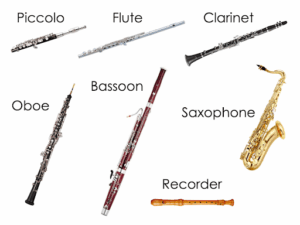
All wind instruments use resonating air columns to produce their sounds. Sounds from wind instruments may originate from:
- Air vibrating over an opening e.g. organ and flute.
- The vibrating lips of a brass instrument e.g. trumpet.
- A vibrating heel e.g. clarinet, saxophone.
Some columns are of fixed length, their resonant frequencies being altered by the opening or the closing of holes in the column e.g. clarinet, or a recorder, and some instruments are played by altering the length of the air column e.g. a trumpet.
- Stringed Instruments
The guitar, the sonometer and the piano are examples of stringed musical instruments. These instruments may be set in vibration by a bow, or plucked with a finger e.g. a violin is bowed while a guitar is plucked. The frequency of a vibrating string depends on its length, the mass and the force that keeps the string taut.
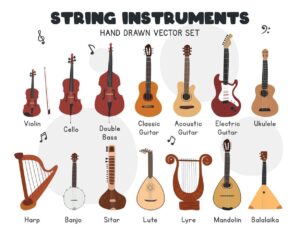
Stringed instruments vibrate as a whole and in loops at the same time e.g. the violin. These vibrations produce both the fundamental and overtones frequencies.
3. Percussion Instruments (drums, bell, talking drum)
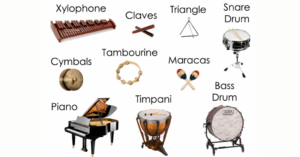
Percussion instruments produce musical notes when they are struck or hit. They have rods, plates or membranes that vibrate when struck; for example, there are rods in bells, plates (bars) in xylophones and membranes in drums.
ECHOES AND THEIR APPLICATION
An echo is the repetition of sounds caused by the reflection of sound waves from a hard surface. Such as buildings, walls and cliffs are good reflectors of sound.
Echoes have practical importance in the development of sonar, speed traps, prospecting for oil and determining the speed of sound. In the determination of the speed of sound by echo, we use the expression
2x = V t
Where
V = velocity of sound
x = distance between the source of sound and the reflecting surface
t = total time taken
VIBRATION IN STRINGS, CLOSED AND OPEN PIPES
- Vibration In Strings
Waves travel along a horizontal rope fixed at one end, and the other end is free to move. A sound wave is generated from a fixed string that is allowed to move at the other end. In this mode of vibration, the vibrating wire produces a sound of the lowest possible note whose frequency is called fundamental frequency. The mode of vibration is giving rise to the fundamental mode of vibration.
The distance between the two consecutive modes is Λ/2 and this is equal to the length of the string l.
L = Λ/2 or Λ = 2l
For any wave, we have v = fΛ where v is the velocity, f is the frequency, and Λ the wavelength.
- Vibrations Produced In Closed Pipes.
In a closed pipe, only odd numbers of harmonics are present as overtones accompanying the fundamental note. The possible harmonics are fо , 3fо , 5fо , 7fо etc.
Where fо = fundamental frequency. fo = v/4l
- Vibrations Produced In Open Pipes
In an open pipe, the harmonics present are 2fо, 3fо, 4fо,5fо etc. , that is, both odd and even harmonics are present as overtones. fo = v/2l
ASSIGNMENT
- The natural frequency of a simple pendulum depends only on A. area B. amplitude C. length D. speed
- A tuning fork sounds louder when its stem is pressed against a tabletop than when held in the air because A. a larger mass of air is set vibrating by the tabletop B. the whole table vibrates in resonance C. the whole table has acquired a larger frequency D. the fork and the table have the same frequency
- What type of motion does the skin of a talking drum perform when it is being struck with a drumstickA. random B. rotational C. vibratory D. translational
- Which of the following statements is not true?A. musical notes consist of a combination of sounds of regular frequency B. sound travels faster in solids than in gases C. the loudness of sound is determined by its frequency D. the pitch of a note depending on the frequency of vibration of the source
- Calculate the wavelength of a note which is one octave lower than a note of 256 Hz in a medium in which the speed of sound is 352m/s A. 0.69m B. 1.38m C. 2.75m D. 5.50m

Third Term Physics Lesson Notes for Other Topics
Triangular And Rectangular Prisms
Explore lesson notes covering all topics.

Lenses
Explore lesson notes covering all topics.

Optical Instruments
Explore lesson notes covering all topics.

Dispersion Of White Light
Explore lesson notes covering all topics.

Description And Property Of Fields
Explore lesson notes covering all topics.

Electric Field
Explore lesson notes covering all topics.

Particulate Nature Of Matter
Explore lesson notes covering all topics.
Fluids At Rest And In Motion - Surface Tension
Explore lesson notes covering all topics.

Units Of Measurements And Electrical Continuity Testing
Explore lesson notes covering all topics.


Lesson Notes for Other Classes

JSS1 Lesson Note
The complete lesson note to guide your studies.

JSS2 Lesson Note
The complete lesson note to guide your studies.

SS1 Lesson Note
The complete lesson note to guide your studies.

SS3 Lesson Note
The complete lesson note to guide your studies.