
Lumbering In Equatorial Africa, Zaire And Nigeria SS2 Geography Lesson Note
Download Lesson Note
Lesson Notes
Topic: Lumbering In Equatorial Africa, Zaire And Nigeria
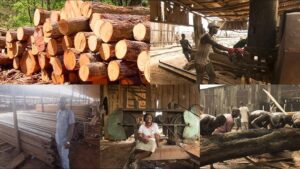
Lumbering is defined as the felling of economic trees in the forest for domestic, industrial or commercial purposes.
Lumbering is practised in Equatorial African regions like Zaire (around Kinshasa, Ituri etc) and in Nigeria (around Benin City, Sapele, Port-Harcourt etc).
Favorable Factors For Lumbering in Zaire and Nigeria are:
- The presence of dense tropical rainforest.
- Presence of economic trees.
- Presence of a wide market for the products.
- High demand for hardwood in foreign countries.
- High demand for timber as fuel.
- Efficient sawmill industries to process the raw timber.
- Efficient transport like rivers and reads to move logs to sawmills or ports.
- Favourable equatorial climate.
METHODS OF LUMBERING
- In the regions; the lumbermen search for economic trees in the forest.
- A platform of about 2-3 high is built around trees of buttress roots.
- The tree is then cut down either with an axe, handsaw or powered saw.
- The branches of the tree are cut off after felling and the whole tree is cut into logs for easy transportation.
ECONOMIC IMPORTANCE OF LUMBERING
Economic trees like Iroko, Obeche, Opepe, Mahogany, African Walnut, Okoume and Limber are of great importance such as:
- Lumbering provides foreign exchange through the export of timbers.
- It employs many people e.g. sawmillers, lumbermen etc.
- It provides plywood and planks.
- Plywoods and planks are used in the construction of houses and furniture.
- Timber is used for the construction of canoes and boats.
- It provides income to the government through the licenses and permits given to timber contractors.
- Trees in the forest help to control soil erosion as well as a windbreak.
DIFFERENCES IN LUMBERING BETWEEN NIGERIA AND ZAIRE
- The Forest area (necessary for lumbering) of Zaire is more than the total land area of Nigeria. That is, the forest area of Zaire is seven times the forest area of Zaire.
- The forest areas in Nigeria are closer to the coast than in Zaire. While in Zaire, the forest area is about 1500 km from the coast.
- Transportation of timber is quite a more serious problem in Zaire than in Nigeria because of the long distance from the coast. Besides, major rivers in Zaire do not flow directly to the sea.
- In Zaire, vast areas are still virgin forests but in Nigeria the original tropical rain forest has largely disappeared, giving way to secondary growth.
PROBLEMS OF LUMBERING
Problems associated with the exploitation of timber in both Nigeria and Zaire include:
- It causes soil erosion.
- It also leads to the depletion of natural forest products.
- It can lead to leaching of soil.
- Most trees are not in pure stand, this makes lumbering difficult.
- It can lead to flooding.
- It can lead to the disappearance of wildlife
- The presence of buttress roots in some trees makes felling very difficult and dangerous.
SOLUTIONS TO THE PROBLEMS
- Forest guards should be employed to check the illegal felling of trees and ensure the planting of new ones.
- Roads should be constructed around lumbering areas for easy transportation of logs.
- Afforestation or planting of two trees when one is cut down should be encouraged.
ASSIGNMENT
- The artificial felling of trees is called ____ (a) deforestation (b) afforestation (c) lumbering
- One of these is not an economic tree in Nigeria ____ (a) Iroko (b) Opepe (c) Baobab
- One of these regions in Zaire is known for lumbering activities.(a) Ituri (b) Bening City (c) Port-Harcourt
- One of the problems of lumbering is that ____ (a) It can lead to the growth of towns (b) It can kill the lumberman during felling © The trees are in pure stand
- The forest area of Zaire is about _____ times bigger than that of Nigeria. (a) 3 (b) 5 (c) 7



Lesson Notes for Other Classes

JSS1 Lesson Note
The complete lesson note to guide your studies.

JSS2 Lesson Note
The complete lesson note to guide your studies.

SS1 Lesson Note
The complete lesson note to guide your studies.

SS3 Lesson Note
The complete lesson note to guide your studies.