
Earthquakes SS2 Geography Lesson Note
Download Lesson NoteTopic: Earthquakes
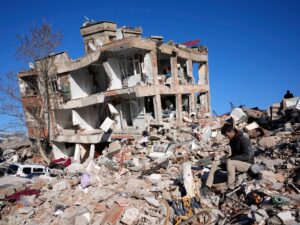
An earthquake is the shaking of the Earth’s surface resulting from a sudden release of energy in the Earth’s crust that creates seismic waves. This release of energy is often caused by the movement of tectonic plates beneath the Earth’s surface.
The following are the causes of earthquakes:
- Tectonic Plate Movements: The primary cause of earthquakes is the movement of tectonic plates. Earth’s lithosphere is divided into large plates that float on the semi-fluid asthenosphere beneath them. When these plates interact at plate boundaries, stress builds up, and when this stress is released, it causes an earthquake.
- Subduction Zones: In subduction zones, where one tectonic plate is forced beneath another, intense pressure builds up. When this pressure is released, it results in powerful earthquakes.
- Transform Boundaries: At transform boundaries, two plates slide past each other. The friction between these plates can cause stress to build up until it is suddenly released in the form of an earthquake.
- Volcanic Activity: Earthquakes can also be associated with volcanic activity. As magma moves beneath the Earth’s surface, it can cause the surrounding rocks to fracture, leading to earthquakes.
FEATURES ASSOCIATED WITH EARTHQUAKE OCCURRENCE
The following features are associated with earthquake occurrence:
- Epicenter: The point on the Earth’s surface directly above the earthquake’s point of origin (focus).
- Focus (Hypocenter): The actual location where the earthquake originates beneath the Earth’s surface. The depth of the focus can vary.
- Seismic Waves: These are the energy waves generated by the sudden release of energy during an earthquake. There are primary (P) waves, secondary (S) waves, and surface waves.
- Faults: A fault is a fracture in the Earth’s crust along which movement has occurred. Earthquakes often happen along these fault lines.
- Aftershocks: Smaller earthquakes that follow the main shock and can occur for days, months, or even years after the initial earthquake.
- Magnitude and Intensity: Magnitude measures the energy released at the source, while intensity describes the degree of shaking at specific locations. The Richter scale and the moment magnitude scale are commonly used to quantify earthquake magnitudes.
EFFECTS OF EARTHQUAKES ON MAN AND HIS ENVIRONMENT
- Loss of Life and Injury: Earthquakes can cause casualties due to building collapses, landslides, and other secondary effects. Injuries can result from falling debris and structural damage.
- Infrastructure Damage: Buildings, bridges, roads, and other infrastructure can be severely damaged or destroyed, disrupting transportation and communication networks.
- Displacement and Homelessness: Population displacement occurs as people are forced to leave damaged or unsafe areas. Many become homeless, requiring temporary shelter and humanitarian assistance.
- Economic Impact: Earthquakes can have a significant economic toll due to the destruction of businesses, industries, and agricultural facilities. Rebuilding efforts are costly and can strain resources.
- Psychological Impact: Individuals may suffer from psychological trauma, anxiety, and stress due to the fear, uncertainty, and loss experienced during and after an earthquake.
- Environmental Impact: Earthquakes can trigger landslides, tsunamis, and changes in the landscape, impacting ecosystems and biodiversity. Soil liquefaction may also occur, affecting agriculture.
- Tsunamis: Underwater earthquakes, especially those near subduction zones, can trigger tsunamis, causing massive waves that inundate coastal areas and result in widespread destruction.
- Public Health Crisis: Disruption of water and sanitation systems can lead to the spread of waterborne diseases. Inadequate healthcare infrastructure may struggle to handle injuries and illnesses

Third Term Geography Lesson Notes for Other Topics
Hydrosphere (Oceanic Basins)
Explore lesson notes covering all topics.

Fruit Farming In The Mediterranean Regions Of Africa
Explore lesson notes covering all topics.
Irrigation Agriculture In Nile Basin And The Niger Basin
Explore lesson notes covering all topics.

Climate And Vegetation
Explore lesson notes covering all topics.
Location, Size, Position And Political Division Of Africa
Explore lesson notes covering all topics.
Geographic Information System (GIS)
Explore lesson notes covering all topics.

Africa: Relief And Drainage
Explore lesson notes covering all topics.
Nigeria: Transportation
Explore lesson notes covering all topics.
Nigeria: Communication
Explore lesson notes covering all topics.

Manufacturing Industries In Nigeria
Explore lesson notes covering all topics.

Nigeria: Commercial Activities
Explore lesson notes covering all topics.

ECOWAS
Explore lesson notes covering all topics.
Map Reading And Measurements Of Distances On Maps
Explore lesson notes covering all topics.

Conventional Symbols Direction And Bearing
Explore lesson notes covering all topics.
Basic Concepts And Component Of GIS
Explore lesson notes covering all topics.


Lesson Notes for Other Classes

JSS1 Lesson Note
The complete lesson note to guide your studies.

JSS2 Lesson Note
The complete lesson note to guide your studies.

SS1 Lesson Note
The complete lesson note to guide your studies.

SS3 Lesson Note
The complete lesson note to guide your studies.