
Pollination In Plants SS2 Biology Lesson Note
Download Lesson NoteTopic: Pollination In Plants
This is the transfer of mature pollen grains from the anther of one flower to the mature stigma of the same or another flower of the same plant or another plant of closely related species. Pollination usually precedes fertilization. There are two types of pollination namely; self-pollination and cross-pollination.
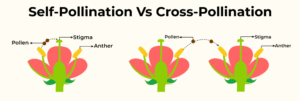
- Self Pollination
This is the transfer of mature pollen grain from the anther of a flower to the stigma of the same flower or to that of another flower of the same plant e.g. tomato and pear. Therefore, self-pollination involves only one parent plant i.e. bisexual flowers or monoecious plants
Advantages of Pollination
- It ensures effective pollination in bisexual flowers.
- It avoids the wastage of pollen grains.
Disadvantages Of Self Pollination
- Production of weak offspring due to continuous self-pollination.
- The offspring are less adaptive to the environment.
Features Of Self Pollinated Flowers
Features favouring self-pollination include:
- Homogamy: This is the ripening of the anther and stigma of a bisexual flower at the same time
- Cleistogamy: This is when ripe pollen grains are deposited on the stigma which then becomes ripened at the same time.
- Cross-Pollination
This is the transfer of mature pollen grains from the anther of a flower to the stigma of a flower on another plant of the same or closely related species e.g. hibiscus, pawpaw. Therefore cross pollination involves two parent plants i.e. unisexual flowers or dioecious plants. Cross-pollination depends on external agents like wind, insects etc
Advantages Of Cross-Pollination
- Production of healthier offspring.
- Production of viable seeds
- The offspring are more adapted to the environment.
- Formation of new varieties with good characteristics
Disadvantages Of Cross-Pollination
- It depends on external agents e.g. wind and insects.
- It leads to wastage of pollen grain especially in wind pollination.
Features Of Cross Pollinated Flowers
i. Dioecious flowers: When male and female flowers occur on separate plants e.g. pawpaw
ii. Dichogamy: When male and female parts mature at different times. Dichogamy can be
protandry: when another matures or ripens before the stigma e.g. sunflower, okra and cotton
protogyny when the stigma matures before another e.g. palms and figs.
iii. Possession of brightly coloured petals to attract insects e.g. hibiscus.
iv. Possession of a sweet smell for attracting insects e.g. rose flower.
v. Unisexual flowers
vi. Self-incompatibility
vii. Position of anthers and stigmas
AGENTS OF POLLINATION
Agents of pollination (pollinators) are the organisms which help in the transfer of pollen grains from the anther to the stigma of flowers. These pollinators include insects, birds, snails, bats and man and also physical factors like wind and water.
The two major agents of pollination are:
- insects
- wind
Flowers pollinated by them are marked with certain features that will be stated below:
Characteristics Of Insect Pollinated Flowers (Entomophilous)
- Large conspicuous petals and sepals.
- Bright colouration.
- Possession of scent.
- Presence of nectars.
- Presence of rough, sticky and relatively few pollen grains.
- Flat, sticky stigma to receive pollen grains.
- Entomophilous flowers include hibiscus, crotalaria, pride of barbadous, etc.
Characteristics of Wind Pollinated Flower (Anaemophilous Flower)
- Small inconspicuous petals and sepals.
- Dull coloured flowers.
- Absence of scent.
- Absence of nectars.
- Large quantity of pollen grains
- Pollen grains are small, lightened and sticky.
- Elongated sticky stigma with large surface area.
- Examples include cereals like maize, guinea corn and rice.

Third Term Biology Lesson Notes for Other Topics
Grassland Habitats
Explore lesson notes covering all topics.
Terrestrial Habitat
Explore lesson notes covering all topics.
Estuarine And Freshwater Habitat
Explore lesson notes covering all topics.
Habitat - Marine Habitat
Explore lesson notes covering all topics.
Fruits
Explore lesson notes covering all topics.
Reproductive System In Flowering Plants
Explore lesson notes covering all topics.
Ecology Of Population
Explore lesson notes covering all topics.
Food Storage
Explore lesson notes covering all topics.
Reproduction In Unicellular Organisms And Invertebrates
Explore lesson notes covering all topics.
Arid Land/Deserts
Explore lesson notes covering all topics.
Terrestial Habitat
Explore lesson notes covering all topics.
Towards Better Health - How to Control Harmful Microorganisms
Explore lesson notes covering all topics.
Freshwater Habitat
Explore lesson notes covering all topics.
Aquatic And Estuarine Habibat
Explore lesson notes covering all topics.
Microoraganisms In Action
Explore lesson notes covering all topics.


Lesson Notes for Other Classes
JSS1 Lesson Note
The complete lesson note to guide your studies.
JSS2 Lesson Note
The complete lesson note to guide your studies.

SS1 Lesson Note
The complete lesson note to guide your studies.

SS3 Lesson Note
The complete lesson note to guide your studies.