
Habitat – Marine Habitat SS2 Biology Lesson Note
Download Lesson NoteTopic: Habitat – Marine Habitat
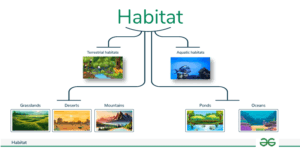
A habitat is a place where organisms (plants, microorganisms and animals) are naturally found e. g. the habitat of tadpoles is the bottom of freshwater ponds or streams. There are three main types of habitats, namely; aquatic habitat (in or around water), terrestrial habitat (in or on land) and arboreal habitat (in or on trees).
There are three kinds of aquatic habitat:
- Marine/saltwater habitat e.g. ocean, seas
- Brackish water habitat (where salt and freshwater mix) e.g. delta, lagoon, bay
- Freshwater habitat (containing little or no salt) e.g. lakes, rivers, streams.
MARINE HABITATS
Characteristics of marine habitats are as follows:
- The marine habitats constitute the largest habitat in the biosphere (70% of the earth’s area)
- They do not undergo sudden or rapid changes in physical factors such as temperature, PH and specific gravity. Hence they show the greatest stability of all habitats.
- Chemical composition – marine water consists of many kinds of dissolved ions including Na+, K+, Mg2+, Ca2+, Pb43-, I-, NO3- e. t. c.Hydrogen (H+) concentration (PH): – salt water is alkaline in nature with a PH of about 8.0 9.0 near the surface.
- Salinity (salt concentration of water). The seawater has a high salinity. The average salinity of seawater is 35 parts per thousand.
- The density of marine water is high. It is about 1.028 while that of freshwater is 1.0. This allows many organisms to float in it.
- The temperature of the sea changes less quickly than that of the land. However, the temperature falls with an increase in the depth of the sea.
- Oxygen concentration is highest at the surface where the atmospheric oxygen dissolves in water. The concentration of oxygen decreases with depth.
- Waves are the temporary movement of surface water of the sea which occurs in any direction. They are caused by wind blowing against the surface of water. They also bring about the mixing of seawater. Waves can also beat against the shore and sometimes cause it to be eroded.
Tides alternate rise and fall of the surface of the sea at least twice daily. Tides are caused by water distribution resulting from the combined gravitational pull of the earth by the sun and moon.
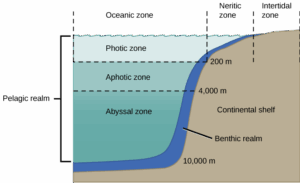
ZONATION OF MARINE HABITAT
- Horizontal Zonation
The marine habitat is made up of the seashore and open sea. The major zones of the marine habitat are generally as follows:
- Supratidal or splash zone is the exposed zone with occasional moisture being the area where water splashes when waves break at the shore.
- Intertidal or neritic zone is the planktonic zone which is exposed at low tide or covered by water at high tide. This zone has high photosynthetic activities because of abundant sunshine. Water temperature fluctuates.
- The subtidal or littoral zone is about 200m deep, constantly underwater, with abundant sunlight and nutrients.
- The benthic zone is about 500 m deep with low light penetration and low nutrients. The water is dark, cold and with little oxygen. Hence, it is unfavourable for life.
- Abyssal or pelagic zone is about 7000m deep with low light penetration, low temperature and high pressure. The low light leads to low photosynthetic activities. Hence food production is primarily by chemosynthesis.
- Hadal or aphotic zone is the deepest, over 7000m deep. This forms the floor or the bed of the ocean. No light penetration or photosynthesis
- Vertical Zonation
Based on light penetration or depth, the marine habitat can be zoned into three:
- Euphotic zone is the area in direct contact with sunlight. Hence, there is enough light penetration for photosynthesis. Therefore producers, consumers and decomposers are all present.
- Disphotic zone is a region of dim light. Light penetrates the water with low intensity for photosynthesis to take place. Consumers and decomposers are found in this zone.
- The aphotic zone is the bottom or bed of the seas and oceans. It is characterized by cold dark water without light penetration and very few living organisms.
DISTRIBUTION OF ORGANISMS AND ADAPTATION TO MARINE HABITAT
- Organisms of the splash zone include periwinkles; crustaceans e.g. ghost crabs, seaweeds and sargassum (algae).
- Those intertidal zones include starfish, sea anemones, sponges, sea urchins, annelids, Mollusca and barnacles.
- In the subtidal zone are snails, crabs, lobsters and crayfish.
- The benthic zone is unfavourable for life. The producers are absent, and only a few saprophytic animals are present.
- The neritic zone houses plankton (microscopic floating organisms e.g. diatom, algae, protozoa, crustaceans and worms) and nekton (e.g. fishes, crabs, prawns and whales).
- Oceanic water houses sharks, croakers, sea catfish, mackerel, bonga fish etc.
ADAPTATION OF ANIMALS TO MARINE HABITAT
Animals including barnacles, fishes, crustaceans etc. Found surviving in marine habitats do so with the following adaptive features;
- Barnacles have:
- Protection mantle for attachment to rock shore and water retention
- Cilia for feeding.
- Shell that prevents desiccation (drying up)
- Fish possess:
- reduced or no kidney to retain urea in their body to cope with high salinity e.g. cartilaginous fishes like shark, dogfish etc.
- Salt-secreting glands in their gills or eyes for maintaining osmoregulation (salt balance) e.g. bony fishes like tilapia, herring etc.
- Tube feet which enable them to hold on to rock shores and hard shells to prevent desiccation e.g. starfish, whales.
- Whale has:
- fins for stability in water
- An organ in front of the nostril for detecting pressure changes in water.
- A thick layer of dermal fat insulation or food reservoir.
- Shrimps possess powerful claws for holding food or prey.
- Periwinkles possess lungs for breathing and feet for attachment.
- Crabs burrow fast into the mud to protect them against predators, strong waves or hide.
ADAPTATION OF PLANTS TO MARINE HABITAT
Plants such as seaweeds, algae, Vesuvius and diatoms are naturally found in marine habitats with the following adaptive features;
- Seaweeds have:
- Holdfast for attachment.
- mucilaginous cover to prevent desiccation.
- Divided leaves or floating devices for buoyancy.
- Algae (e.g sargassum) have:
- chlorophyll for photosynthesis.
- Small size or large surface area for floating in water.
- Planktons (e.g. diatoms) possess:
- air space in their tissues
- Rhizoid for attachment to rocks
- Air bladder for buoyancy (floating).
Examples of food chains in a marine habitat include:
Diatom → crabs → tilapia
Diatom →zooplankton → tilapia →shark

Third Term Biology Lesson Notes for Other Topics
Grassland Habitats
Explore lesson notes covering all topics.
Terrestrial Habitat
Explore lesson notes covering all topics.
Estuarine And Freshwater Habitat
Explore lesson notes covering all topics.

Fruits
Explore lesson notes covering all topics.
Pollination In Plants
Explore lesson notes covering all topics.
Reproductive System In Flowering Plants
Explore lesson notes covering all topics.
Ecology Of Population
Explore lesson notes covering all topics.

Food Storage
Explore lesson notes covering all topics.
Reproduction In Unicellular Organisms And Invertebrates
Explore lesson notes covering all topics.

Arid Land/Deserts
Explore lesson notes covering all topics.
Terrestial Habitat
Explore lesson notes covering all topics.

Towards Better Health - How to Control Harmful Microorganisms
Explore lesson notes covering all topics.
Freshwater Habitat
Explore lesson notes covering all topics.
Aquatic And Estuarine Habibat
Explore lesson notes covering all topics.
Microoraganisms In Action
Explore lesson notes covering all topics.


Lesson Notes for Other Classes
JSS1 Lesson Note
The complete lesson note to guide your studies.

JSS2 Lesson Note
The complete lesson note to guide your studies.

SS1 Lesson Note
The complete lesson note to guide your studies.

SS3 Lesson Note
The complete lesson note to guide your studies.