
Ecology Of Population SS2 Biology Lesson Note
Download Lesson NoteTopic: Ecology Of Population
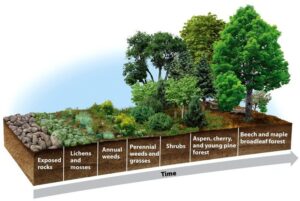
ECOLOGICAL SUCCESSION
The orderly change in the inhabitants of an area over time is called succession. It can also be defined as the step-by-step orderly and gradual replacement of communities of organisms that leads to a climax community.
An illustration of succession is that of a pond. Rain carries sediment from surrounding land into the pond, filling it and making it shallower. Algae that live in the pond die and eventually fall to the bottom, adding organic materials to the sediment.
Some plants such as pond weeds grow at the bottom. These plants make up the pioneer community. The pioneer plants are the first to inhabit the changing environment. The roots of these underwater plants hold much silt, quickly building up the bottom cover of the pond. As they die, their organic matter accumulates at the bottom. The water along the edges becomes so shallow that water lilies and other floating plants replace the pioneer plants.
The final stage of succession in a particular area is called a climax community. The species that constitute the climax community differ from biome to biome. A climax community is also a stable community because its appearance and species composition are stable. To become the climax, the community would have gone through a sequence of species.
TYPES OF SUCCESSION
There are two types of succession; these are:
- Primary succession
- Secondary succession
- Primary Succession
This is a type of succession that begins from bare ground, bare rock or bare body of water.
- Primary succession
Primary succession on land may be studied on a building site where a heap of subsoil, stones or cement block is left over after construction. In an aquatic habitat, primary succession may be observed in a new artificial pond.
The first in any succession are called primary colonizers and are usually autotrophic plants. These have simple requirements for life and can withstand exposures. By the second year of the primary succession in addition to more algae and lichens, mosses may begin to grow. As they grow, they wear out some soil and some of them die and decay, creating more soil for their successor.
By the third year, small herbaceous plants may be present. These in turn help to change the habitat by overshadowing the smaller plants, causing them to die out and dropping their leaves, thus making the soil suitable for other organisms. As years pass by, more species come into the habitat, while some face out. A succession of species continues till the climax is reached. Then, bigger life forms like shrubs and trees are found growing.
- Secondary Succession
Secondary succession is a succession that occurs when an area has not been stripped of soil and vegetation. It occurs more rapidly than primary succession because soil has already been formed. It also occurs when a farmer abandons an old field. Secondary succession begins from an existing community which has been interfered with by man and other factors. Fire, drought and floods can cause secondary succession.
Differences Between Primary And Secondary Succession
| SN | PRIMARY SUCCESSION | SECONDARY SUCCESSION |
| 1 | Starts on a bare surface | Starts on an already colonized surface |
| 2 | It is slower or takes a longer time to reach a climax community. | It is faster or takes a shorter time to reach a climax community. |
| 3 | Starts with lower organisms. | Starts with fairly complex organisms. |
CHARACTERISTICS OF SUCCESSION
- Plants form pioneer organisms being the producers.
- The number of organisms is usually increased from year to year until a climax is reached.
- The diversity of organism species increases from year to year.
- Succession is orderly and progressive starting with microscopic green plants and ending with big trees.
- Each generation of species alters the habitat by making more soil, and when they die the soil becomes more fertile.
- There is competition among organisms in that the various species present compete for the available resources such as water, CO2, O2, light and space. The plants that are more able to compete displace others.
- Changes in species composition as the fittest survive and the unfit fade out.
OUTCOME OF SUCCESSION
- Changes in the physical environment due to structural changes in the species and the activities in the community.
- Simple organisms which start the succession are usually replaced by more complex ones in an evolutionary trend.
- Equilibrium point is attained through colonization of abandoned farmland by a wide variety of organisms.
- The outcome of succession is the climax or stable community.
OVERCROWDING
This is a situation in which a population increases beyond a point called the carrying capacity where the resources (e.g. food and space) are not enough to support all the individuals in the population. Therefore, overcrowding reduces the food and space available for individual species in the population.
Factors Causing Overcrowding
- Natality: An increase in the rate at which a particular species gives birth in a restricted area results in overcrowding.
- Increase in food supply
- Decrease in mortality: Overcrowding results when the rate of death of organisms in a habitat is lower than the rate of birth.
- Immigration: The inflow of individuals into a habitat increases the population which later causes overcrowding.
- Lack of dispersal of fruits or seeds of plants.
- Social habits of animals like termites, ants and bees lead to their multiplication in the colony.
Inadequate space
Effects Of Overcrowding
These include:
- Shortage of food since the available food in the habitat is rapidly eaten up due to overcrowding.
- Shortage of space due to increasing population of species.
- Competition occurs as the organisms struggle for scarce resources e.g. food, and space. The stronger ones get the resources while the weaker ones are deprived i.e. survival of the fittest.
- Anti-social behaviours like fighting or cannibalism can result from the stress of overcrowding.
- Easy spread of diseases e.g. tuberculosis in humans (air-borne).
- Preying or feeding on each other when food is in short supply.
- Death of organisms as weaker organisms in overcrowding areas easily die off due to lack of food and space.
Adaptation To Avoid Overcrowding
To survive overcrowding, plants and animals have developed the following adaptive features:
- Territorial Behaviour
Animals like mammals, lizards, birds etc establish territories of which they are possessive. They fight for and defend the territories against any intruders. A successful claim of the territory ensures sufficient food, space mating partners and parental care for the organisms.
- Swarming
This is exhibited by some social animals such as termites and bees when some of them move out from an old colony to a new one. Hence, overcrowding is avoided.
- Emigration
This is the outward movement of animals out of their locality to another place of settlement. This prevents overcrowding.
- Dispersal Of Seeds And Fruits
This could be by water, wind, animals, insects and explosive mechanisms. The seeds and fruits are carried far away from the parent plants. Hence, overcrowding is prevented.
- Formation Of Canopies
This is an attribute of forest trees. This helps the plants to trap enough sunlight and also prevents the shorter plants below from getting the light. The lower plants eventually die off and overcrowding is avoided.
- Production Of Chemicals
Roots of some plants produce chemicals which prevent the growth of other plants close to them. Therefore, overcrowding is avoided.

Third Term Biology Lesson Notes for Other Topics
Grassland Habitats
Explore lesson notes covering all topics.
Terrestrial Habitat
Explore lesson notes covering all topics.
Estuarine And Freshwater Habitat
Explore lesson notes covering all topics.
Habitat - Marine Habitat
Explore lesson notes covering all topics.
Fruits
Explore lesson notes covering all topics.
Pollination In Plants
Explore lesson notes covering all topics.
Reproductive System In Flowering Plants
Explore lesson notes covering all topics.

Food Storage
Explore lesson notes covering all topics.
Reproduction In Unicellular Organisms And Invertebrates
Explore lesson notes covering all topics.
Arid Land/Deserts
Explore lesson notes covering all topics.
Terrestial Habitat
Explore lesson notes covering all topics.
Towards Better Health - How to Control Harmful Microorganisms
Explore lesson notes covering all topics.
Freshwater Habitat
Explore lesson notes covering all topics.
Aquatic And Estuarine Habibat
Explore lesson notes covering all topics.
Microoraganisms In Action
Explore lesson notes covering all topics.


Lesson Notes for Other Classes
JSS1 Lesson Note
The complete lesson note to guide your studies.
JSS2 Lesson Note
The complete lesson note to guide your studies.

SS1 Lesson Note
The complete lesson note to guide your studies.

SS3 Lesson Note
The complete lesson note to guide your studies.