
Introduction To Molding SS1 Visual Arts Lesson Note
Download Lesson NoteTopic: Introduction To Molding
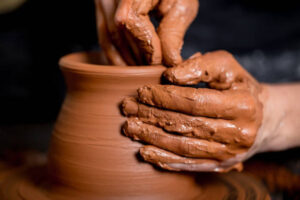
CLAY
Clay is a fine-grained earth material that is sticky and can be moulded into desired shapes when wet and hard or glassy when dried or fired. It is a naturally occurring material composed mainly of fine particles of hydrous aluminium silicates and other minerals.
Generally, clay is plastic with appropriate water content which aids its ability to be manipulated into shapes.
There are two types of clay;
- Primary Clay: This is clay that is formed, sedimented and remains at the primary or original site of formation. Primary clay is sometimes coarse and pure in the state, free from impurities. The clay that falls under this category includes kaolin or china clay.
- Secondary Clay: These are clay that has been transported from their primary or original site of formation by wind, water, melted ice, and erosion to a secondary site of sedimentary deposit. Their particles are fine but contain a lot of oxides and impurities. Secondary clays are more plastic than the primary clays and come in different colours before and after firing.
Clay is one of the most useful materials in the natural occurrence that is gotten from the earth. Clay may be found wet or in any stage in between. It looks like mud in its wet stage while in its dry state, it may look like rock. In its natural state, clay can be easily moulded and manipulated by hand, a quality referred to as plasticity which makes clay interesting to use.

STAGES OF CLAY
- Slip: This is clay watered down to a muddy state that is used for joining other clay pieces or sealing.
- Plastic: The stage at which clay has an adequate amount of water in it that enables it to be workable.
- Leather- Hard: This is the stage when the clay is partially dry, to the point of shrinking and can be joined to other clay pieces or carved into shape. It can be recycled at this stage.
- Greenware: This is a stage of the clay in a bone-dry state, but it can be carved into shapes, though very fragile. It can be recycled at this stage.
- Bisque Ware: The state in which the clay has been fired once in the kiln, also known as a glazing stage cannot be recycled at this stage.
- Earthenware (glazeware): This is when the clay has been fired twice in the kiln(second fire with low fire). Cannot be recycled at this stage.
- Stoneware: This is also clay fired twice with the second firing done at high fire or temperature, to a vitrified state. Cannot be recycled at this stage.
USES OF CLAY
- Clay is a very basic yet strong artistic medium, an indispensable architectural material and a tremendous healing agent.
- It is used for making pottery, both utilitarian and decorative sculptors use clay for modelling and casting of sculptural pieces.
- It is used for making bricks.
- Clay is used for manufacturing tiles, both wall and floor and pipe for drainage and sewage.
- Clay has been used by native African and Indian tribes for treating stomach ulcers, insect bites and other forms of digestive illnesses.
- It is used for foundry work, for the making of moulds and the casting of bronze, metal, and plastic electrical insulators.
- Clay is used for the manufacture of clay ridge tile, roofing sheets, clay pots for water storage, ceramic plates and cups.
CLAY PREPARATION
There are two types of clay preparation which are dependent on the kind of product to be made and the quality of the raw materials available. The making of some products requires the use of extremely fine clay while others do not.
The two processes of clay preparation include the dry process and the wet process. It could be done through a hand or manual method or a machine or a combination of both methods.
- Dry Process: This process entails the direct drying of clay under the sun, spread on the ground or on a raised platform that can be covered in case of rain. When the clay is properly dry, it is then transferred to a mortar where it is ground into clay powder at the time of fitting to the type of product it is going sed for
- Wet Process: The wet process of clay preparation can also be done manually by machine or by a combination of the two methods. To start this process, bring clay either from the clay storage or excavation site to your workspace.
Clay can come in wet, rock-dry or leather-hard states. Patiently go through the clay with the aid of the hand, piece by piece to remove foreign bodies or impurities in the case of already wet clay. The clay is then kneaded to further break down the clay particles into finer pieces and work it towards achieving plasticity.

Third Term Visual Arts Lesson Notes for Other Topics

Historical Foundation Of Nigerian Arts
Explore lesson notes covering all topics.

Historical Foundation Of Nigerian Arts II
Explore lesson notes covering all topics.

Museums And Art Galleries In Nigeria
Explore lesson notes covering all topics.


Lesson Notes for Other Classes

JSS1 Lesson Note
The complete lesson note to guide your studies.

JSS2 Lesson Note
The complete lesson note to guide your studies.

SS2 Lesson Note
The complete lesson note to guide your studies.

SS3 Lesson Note
The complete lesson note to guide your studies.