
Historical Foundation Of Nigerian Arts SS1 Visual Arts Lesson Note
Download Lesson NoteTopic: Historical Foundation Of Nigerian Arts
INTRODUCTION
Nigeria consists of many tribes, languages and dialects with different artistically rich cultures which is reflected in the art of these different people. Ancient traditional arts are expressed in various forms, e.g. stylized, naturalistic and symbols such as ancestral spirits, and media used include wood clay, bronze stones etc.
-
NOK CULTURE (ARTS)
Features include:
i. Nok got its name from a small village “Nok” near Jema’a in Kaduna state close to Jos plateau.
ii. These artworks represent the oldest sculpture tradition in Nigeria.
iii. The first discovery took place in 1928 in a tin mining outfit around Nok
iv. The second discovery was in 1943 when the head “Jema’a” head at Tsauni such sites are by name called situ, Teruga, Agwazo, Isaun, Odegi, Kagara South of Abuja
v. In 1956, more terracotta heads were discovered at about eight meters inside the ground near Jema’a, Katsina-Ala, Wamba in Benue state and old Abuja whose figure suggests traditional worship items.
viThe Nok art is dated between 500 BC and 200 AD, through a radiocarbon experiment.
vii. Nok Art is mainly terracotta (i.e.) Fired or baked clay which was fired in a wood fire.
viii. Nok art was scientifically excavated by Bernard Fagg between 1945 and 1944.
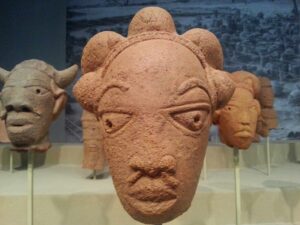
Characteristics Of Nok Arts
- Nok sculptural human heads have rings like hair-do that are elaborated (i.e.) buns hairstyles.
- The pupils of the eyes, nostrils, and mouth are pierced and are represented by small holes.
- The eyes in the terracotta heads are presented in the form of a segment of a circle or a triangular form (i.e.) the use of geometrical shapes.
- Some terracotta heads (bust) are adorned with string pendants, heavy anklets, bracelets and beads on their chests.
- Nok culture is the oldest culture in Nigeria.
- They are made up of terracotta red or baked clay.
- The figures are mainly naturalistic expressions with individual polished stones, axes, ornaments of iron and ns. Showing that the culture began between the Stone Age and entered into the Iron Age.
Styles Of The Art Works
- Nok sculptural pieces are in Terracotta and a high technology was exhibited in the works in their furnaces.
- Human figures from Nok are usually represented in a stylized manner while animal figures are highly naturalistic.
- There were sub-styles which ranged from the semi-naturalistic to the highly stylized sculptures.
- Their knowledge of the chemical ability to fire is demonstrated by the fact that many of these sculptures have survived in good condition for over 2000 years.
- Flat stone and grindstones used in grinding grain attest to the fact that the Nok people were sedentary farmers
- Their mode of dressing coupled with fondness for personal adornment are indicators that this society was very sophisticated
-
IGBO UKWU ARTS 9TH CENTURY A.D.
Igbo Ukwu sculptures were discovered first in 1939 at Anambra in Igbo Ukwu and they date back to the 9th century AD, objects found consist of bronze cast by lost wax or cire perdue method.
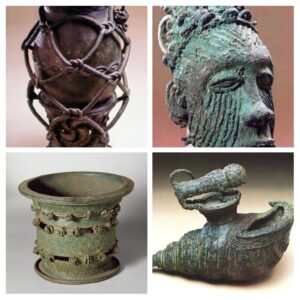
Thurstan Shaw scientifically excavated the works in 3 different sites namely:
- Igbo Isaiah
- Igbo Richards
- Igbo Jonah
These are the three brothers of Anozie’s family.
- Igbo Isaiah: This site was discovered while Isaiah Anozie was digging a well in his compound. Artifacts like bronze heads, ornamented bowls, staff heads and vessels in the form of snail shapes; roped decorated terracotta water pots.
- Igbo Richard: The discovery there was associated with EzeNri or priesthood materials such as elephant tusks, highly decorated terracotta bowls, staff heads and vessels, bronze objects and beads used in burying the deceased.
- Igbo-Jonah: The items found there represented a deliberate disposal of unwanted objects which may cast away objects belonging to a dead person.
Characteristics Of Igbo Ukwu Arts
- Igbo Ukwu artworks are elaborately decorated with intricate designs on them.
- The artworks are mostly bronze
- The sculptures and ornaments have detailed decorations of tiny pellets, relief spiral decorations on pots and insect decorations on bowls and figures
- The emphasis is mostly on vessels and containers.
-
IFE ARTS 10TH-11TH CENTURY A.D.
Ife is regarded as the cultural headquarters and the ancestral home of the Yoruba race of Nigeria. Ife is in Osun state and the artworks date back to the 19th century A.D. and are mainly presented in three media namely terracotta, bronze and stone.
The German anthropologist/ ethnographer Leo Frobenius dug up some terracotta in 1910.
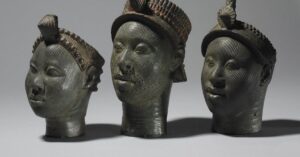
Style Of The Art Works
If art is a court art; (although Benin art is more pronounced as a court art than ife art) the Ooni of Ife controlled the art and artists. The bronze works show control over the cire- perdue process; the artworks are realistic.
Characteristics Of The Ife Art Works
- The priestly kings were normally portrayed more than life-size, elaborately dressed with beads, diadems on their heads and pendants on the chest.
- The animals represented in Ife arts are only in terracotta.
- Ife figures have profuse scarification
- The works are naturalistic (i.e.) realistic
- The artworks are for kingly and shrine worship.

Third Term Visual Arts Lesson Notes for Other Topics

Introduction To Molding
Explore lesson notes covering all topics.

Historical Foundation Of Nigerian Arts II
Explore lesson notes covering all topics.

Museums And Art Galleries In Nigeria
Explore lesson notes covering all topics.


Lesson Notes for Other Classes

JSS1 Lesson Note
The complete lesson note to guide your studies.

JSS2 Lesson Note
The complete lesson note to guide your studies.

SS2 Lesson Note
The complete lesson note to guide your studies.

SS3 Lesson Note
The complete lesson note to guide your studies.