
Pricing SS1 Marketing Lesson Note
Download Lesson NoteTopic: Pricing
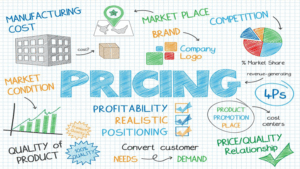
Price is the sum or amount of money at which a thing is valued, or the value which a seller sets on his goods in the market; that for which something is bought or sold, or offered for sale; equivalent in money or other means of exchange; current value or rate paid or demanded in the market or barter; cost.
Pricing is the process of determining what a producer will charge in exchange for its products. Pricing can also be defined as the process of assigning a monetary value to goods and services by a firm or the process adopted by a firm in setting the selling price of its products.
PRICING STRATEGIES IN MARKETING
- Market penetration pricing strategy
- Market skimming pricing strategy
- Satisfactory rate of return
- Product line pricing
- Discriminatory pricing strategy.
- Psychological pricing strategy.
- Competitive based pricing
- Predatory pricing strategy.
- Mark-up pricing strategy
- Target return/profit pricing
- Differential pricing strategy.
- Geographic pricing strategy
PRICING STRATEGIES
- Cost-plus pricing method/markup pricing strategy: With this method, the firm calculates the cost of producing the product and adds a percentage profit to get the price.
- Geographical Pricing: With this method, different prices are set for the same product in different locations.
- Prestige Pricing: This is used to create a high image for a product by pricing it high. For most people, a high-quality product must be associated with high cost.
- Customary Pricing: This is where firms are rather traditional in their approach to prices. Such firms would adjust the products in terms of size and content rather than changing the prices.
- Promotional Pricing: It is setting a lower price for certain products to encourage customers to buy the product.
- Target Rate-of-return: The price is set by adding a desired return on investment to the cost of the product.
- Premium Pricing: This is setting the price higher than competitors during the introduction of the product. Skimming strategy.
- Market Penetration: It is setting prices lower than competitors to attract buyers.
- Psychological Pricing: The price is set to encourage customers to buy a product based on emotion rather than logic. gour
- Price Lining: This is setting different prices for products within a specific group.
- Price Leadership Strategy: This is setting a product price at a level of the market leader’s price.
- Loss Leader Pricing Strategy: This is setting a price below cost to attract prospective buyers to buy other products in the shop.
- Competitive Bidding Pricing Strategy: This is setting a price at the lowest offer of a bidder about other bidders.
One of the four major elements of the marketing mix is price. Pricing is an important strategic issue because it is related to product positioning. Furthermore, pricing affects other marketing mix elements such as product features, channel decisions and promotion.
Pricing can be difficult to get right. We do not know exactly how much the other party is prepared to pay, but we need customers to sustain and grow our businesses. So, how do we ensure money is not left on the table, yet we still make the sale?
Too many businesses have been lost because they priced themselves out of the marketplace. On the other hand, too many businesses and sales staff leave “money on the table”. One strategy does not fit all, so adopting a pricing strategy is a learning curve when studying the needs and behaviours of customers and clients.
PRICE DETERMINANTS
- Ability To Pay: This is the ability of a consumer to pay for a particular product or service. It is an important factor that organizations must put into consideration 25ing before setting the price of a product or service. hem ning no
- Competition: If there is strong competition in a market, customers are faced with a wide choice of whom to buy from. They may buy from the cheapest provider or perhaps from the one which offers the best customer service But customers will certainly be mindful of what is a reasonable or normal price in the market.
Most firms in a competitive market do not have sufficient power to be able to set prices above their competitors.
- Profit Maximization: Maximizing profits is said to be the objective of all firms. Management of an organization should also not forget that they need to make a profit from selling a product which is the main reason why the organization is set up.
IMPORTANCE OF PRICE TO A PRODUCER
- Raising of revenue-Price plays a pivotal role in the marketing of goods and services as it attracts revenue for the business.
- Sales Volume – Price can be used to increase the volume of sales.
- Product Value-Price can be used to determine the value of the product to the customer.
- Corporate Image-Price can be used to build an image for the company.
- Product Quality-Price gives a perception of quality a customer is likely to receive.
- Prevention of Competition-Price can be used to prevent competitors from entering the market.
- Market Share – It can be used to increase the company’s market share.
- Inducement-Price can be used to induce customers to purchase more of the company’s products.
- Price helps the producer in marketing planning and analysis.
- It helps the producer to compare between producing a product and outsourcing the product to another company.
- Profitability – It can be used to increase profitability.
ASSIGNMENT
- Explain pricing in detail (WASSCE June 2016).
- Explain four pricing strategies
i. Premium pricing
ii. Penetration pricing
iii. Economy pricing
iv. Price skimming (WASSCE June 2019).

Third Term Marketing Lesson Notes for Other Topics
Co-Operative Societies
Explore lesson notes covering all topics.
Facilitators
Explore lesson notes covering all topics.
Food Processing Industries
Explore lesson notes covering all topics.
Banks
Explore lesson notes covering all topics.
Basins And Boards
Explore lesson notes covering all topics.
Microfinance Companies
Explore lesson notes covering all topics.
Marketing Of Mineral Products
Explore lesson notes covering all topics.

Advertising II - Advantages & Disadvantages of Advertising
Explore lesson notes covering all topics.
Advertising
Explore lesson notes covering all topics.
Promotion
Explore lesson notes covering all topics.
Merchandising
Explore lesson notes covering all topics.


Lesson Notes for Other Classes

JSS1 Lesson Note
The complete lesson note to guide your studies.

JSS2 Lesson Note
The complete lesson note to guide your studies.
SS2 Lesson Note
The complete lesson note to guide your studies.

SS3 Lesson Note
The complete lesson note to guide your studies.