
Political Parties And Party System SS1 Government Lesson Note
Download Lesson NoteTopic: Political Parties And Party System
MEANING OF POLITICAL PARTY
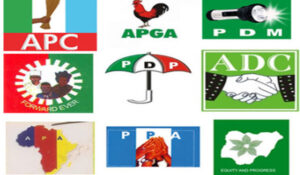
A political party can be defined as an organised group of individuals sharing a similar ideology about how to serve the national interest and seeking to acquire governmental power to run the affairs of a state. The aim of controlling the government machinery is the major distinguishing factor between political parties and other similar groups in the political system such as pressure groups.
TYPES OF POLITICAL PARTIES
- Mass Party: The party emphasizes large membership hence; requirements for membership are either very easy or non-existent e.g. communist party in China. It developed in response to the extension of the franchise. The manifesto emphasizes people’s welfare.
- Elite Party: It developed at a time when the franchise was restricted. It comprises trained and professional party members who are expected to exhibit a high sense of political commitment and discipline. They believe it is their exclusive right to control the government e.g. PDP (Nigeria)
- Broker Party: It is a party for both the rich and the poor bridging the gap between the two. It promotes equality and the welfare of the people.
- Charismatic Party: It is formed by and evolved around a unique and enviable character that is the unit of attraction for other members e.g. UPN, PRP (2ND republic) and NCP(4TH republic)
Religious Party: It is a party formed along religious lines, which is dependent on the religious doctrines in a country.
FUNCTIONS OF POLITICAL PARTIES:
- They articulate i.e. advance the interests of the different groups in a society.
- They aggregate i.e. collate together and advance the interests of the desperate states of opinions, views and ideas in a society.
- They serve as agents of political socialization and education.
- They recruit and train political leaders for the state.
- They mobilize the people for political activities and for discharging their obligation to the state.
- They unite people of different cultures, languages and religions.
- They formulate policies and programmes that often become the goals of government and societies.
- Opposition parties serve as watchdogs and a check on the government in power
- They form the government upon winning an election.
- They facilitate peaceful change of government.
COMPARISON BETWEEN POLITICAL PARTIES AND PRESSURE GROUPS
- Political parties aim at winning elections and controlling the government, while pressure groups aim at pursuing the interests of their members.
- Political parties submit candidates that contest elections while pressure groups do not.
- Political parties do not limit membership but pressure groups admit only qualified members.
- Political parties address several issues; pressure groups are only concerned with issues concerning their members.
- Political parties continue to attract more members after winning elections; pressure groups cease to agitate after achieving their goals.
- While political parties are distinctly organised with defined leadership, pressure groups are not.
- While good political parties are organised to reach everybody in society, pressure groups are not.
ASSIGNMENT
- One of the importance of political parties is-
( a) forming a trade union (b) opposing the passage of bills into laws (c) serving as watchdogs (d) influencing government policies
- Limited membership is an example of
(a) A broker party (b) A mass party (c) An elite party (d) A religious party
- The primary objective of all political parties is to
(a) act as watchdog (b) educate the electorate (c) eradicate corruption in public life (d) control the government
- The party that emphasises large membership is called
(a) elite party (b) zero party
(c) mass party (d) broker party
- While political parties aim at forming a government, pressure groups aim at
(a) causing social unrest (b) influencing government decisions (c) imposing military rule (d) capturing power
- Discuss the functions of political parties.
Third Term Government Lesson Notes for Other Topics
Development Of Political Parties
Explore lesson notes covering all topics.
Development Of Political Parties III
Explore lesson notes covering all topics.
The Structure Of Nigerian Federalism
Explore lesson notes covering all topics.
Federalism
Explore lesson notes covering all topics.
Development Of Political Parties II
Explore lesson notes covering all topics.
Minor Political Crisis In Nigeria
Explore lesson notes covering all topics.
Electoral Crisis
Explore lesson notes covering all topics.
Basic Principles Of Government: Rule Of Law
Explore lesson notes covering all topics.
Fundamental Human Rights
Explore lesson notes covering all topics.
Separation Of Power
Explore lesson notes covering all topics.
Intergroup Relations
Explore lesson notes covering all topics.

Pressure Groups
Explore lesson notes covering all topics.
Citizenship
Explore lesson notes covering all topics.

Centralization And Decentralization
Explore lesson notes covering all topics.
Representative Government & Popular Participation
Explore lesson notes covering all topics.


Lesson Notes for Other Classes
JSS1 Lesson Note
The complete lesson note to guide your studies.
JSS2 Lesson Note
The complete lesson note to guide your studies.

SS2 Lesson Note
The complete lesson note to guide your studies.

SS3 Lesson Note
The complete lesson note to guide your studies.