
Basic Principles Of Government: Rule Of Law SS1 Government Lesson Note
Download Lesson NoteTopic: Basic Principles Of Government: Rule Of Law
DEFINITION OF THE RULE OF LAW
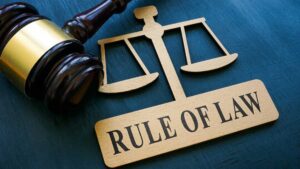
The rule of law may be defined as the absolute supremacy or predominance of the law over everybody, both the rich and the poor, rulers and the ruled and all decisions taken in a country. According to Professor A.V. Dicey, those entrusted with the administration of the country should rule or exercise their authority by the established laws of the land and such established laws should be regarded as supreme.
THE MAIN PRINCIPLES OF THE RULE OF LAW
Professor A.V. Dicey propounded the following three tenants or features of the rule of law:
- Equality Before the Law: In Dicey’s view, all men are equal before the law of the land. No man is above the law.
- Impartiality: This principle assumes the notion of legality which means due process of law in dealing with offenders.
- The Rights of the Individuals: This principle states that citizens of a country should enjoy certain basic inalienable rights and liberties under the law, violation of which they have the right to seek redress in the law court.
OTHER PRINCIPLES ARE
- Law and order should be maintained in society.
- To avoid the breakdown of law and order and a violation of laws and for these laws to be enforced, certain agencies must be set up.
- There should be no government influence or censorship of the press.
- There must be legal limitations on the action of the government.
- Laws should not be made to have retrospective effects or be back-dated.
- Those found guilty of offences by courts of law should be allowed to appeal against the judgment in higher courts.
- Punishment meant for an offender must agree with the offence he committed as laid down by the law.
FACTORS THAT LIMIT THE APPLICATION OF THE RULE OF LAW
- The state of emergency: Citizens of a country may be denied some of their fundamental human rights when a state of emergency or curfew is declared in a country.
- The type of government adopted in a country: For instance, military rule and a one-party system of government can limit the rights of citizens.
- Partial judiciary or independence of the judiciary is also a limitation to the rule of law.
- Special or Administrative tribunals who adopt a special system of trial different from that of the ordinary courts at times do not allow citizens to know their rights and fight for them.
- Poverty, illiteracy and ignorance can make men not know their rights and fight for them.
- Diplomatic Immunity: Governors or presidents cannot be tried while in office. Ambassadors cannot be sued and prosecuted in the country where they are serving rather they can be repatriated.
- Parliamentary Immunity: Members of the parliament are free from prosecution
- Police brutality: In most societies, the fear of police is the beginning of wisdom. Most police brutalize citizens during arrest and as such deny them their rights.
Obnoxious laws: In some countries, some laws seek to limit the rights of citizens. These laws are usually harsh.
FACTORS THAT CAN ENSURE THE SUCCESSFUL OPERATION OF THE RULE OF LAW
- There should be a public trial of an accused person, not a secret trial.
- The press must be free not gagged.
The democratic political system in a country facilitates the rule of law.
- The judiciary must be independent and impartial.
- Citizens should be granted the right to appeal against any judgment they feel they do not like.
- There should be no delay in justice as this in turn will lead to justice being denied.
- Accused person should have access to lawyers to defend them and such lawyers should have access to all relevant documents or files and information concerning their clients.
- Adequate information should be made available about the existence of different laws, especially newly enacted laws. That is to say, every law must be publicized, as ignorance of the law is not an excuse.
- To avoid tyranny, the principle of separation of powers and checks and balances should be adopted in government.
- There must be a constitution that will embody the laws of the land and spell out the rights and obligations of the citizens.
- A sovereign parliament will also aid the successful operation of the rule of law.
- Citizens should be made to have basic education which will warrant them to know their rights when such rights are infringed upon they can seek redress in a court of law.
- There should be an atmosphere of peace and order in a country because the rule of law is undermined in a period of war.

Third Term Government Lesson Notes for Other Topics
Development Of Political Parties
Explore lesson notes covering all topics.
Development Of Political Parties III
Explore lesson notes covering all topics.
The Structure Of Nigerian Federalism
Explore lesson notes covering all topics.
Federalism
Explore lesson notes covering all topics.
Development Of Political Parties II
Explore lesson notes covering all topics.
Minor Political Crisis In Nigeria
Explore lesson notes covering all topics.
Electoral Crisis
Explore lesson notes covering all topics.
Fundamental Human Rights
Explore lesson notes covering all topics.
Separation Of Power
Explore lesson notes covering all topics.
Intergroup Relations
Explore lesson notes covering all topics.

Pressure Groups
Explore lesson notes covering all topics.
Political Parties And Party System
Explore lesson notes covering all topics.
Citizenship
Explore lesson notes covering all topics.

Centralization And Decentralization
Explore lesson notes covering all topics.
Representative Government & Popular Participation
Explore lesson notes covering all topics.


Lesson Notes for Other Classes

JSS1 Lesson Note
The complete lesson note to guide your studies.

JSS2 Lesson Note
The complete lesson note to guide your studies.

SS2 Lesson Note
The complete lesson note to guide your studies.

SS3 Lesson Note
The complete lesson note to guide your studies.