
Vocabulary Development – Antonyms & Adjuncts SS1 English Studies Lesson Note
Download Lesson NoteTopic: Vocabulary Development – Antonyms & Adjuncts
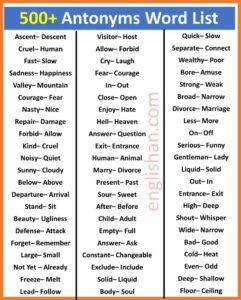
VOCABULARY DEVELOPMENT: ANTONYMS
Antonyms are words which do not resemble each other in any way. They have a direct opposite meaning to each other.
An antonym therefore is a word which has a meaning opposite to the meaning of another word. It shows a relationship in contrast. It means then that when it is one word, it is not the other. For example, If it is “wrong”, it is not “right”.
NB: As you choose the opposite of a word (an antonym); you should make sure that you have the correct meaning of the word you use, for a word is rarely an exact equivalent of another.
WORDS WHICH ARE OPPOSITE IN MEANING
| SN | WORD | OPPOSITE |
| 1 | Good | Bad |
| 2 | Tall | Short |
| 3 | Friendly | Hostile |
| 4 | Rich | Poor |
| 5 | Temporary | Permanent |
| 6 | Love | Hate |
| 7 | Black | White |
| 8 | Man | Woman |
WORDS OF NEARLY OPPOSITE MEANING
| SN | WORD | OPPOSITE |
| 1 | Cheerful | Unhappy |
| 2 | Confused-thoughts | Orderly-thoughts |
| 3 | Sickly | Healthy |
| 4 | Relieve | Aggravate |
| 5 | Harmonious | Discordant |
| 6 | Reward | Punish |
| 7 | False | Genuine |
| 8 | Adores | Dislike |
| 9 | Tough | Tender |
| 10 | Outspoken | Reserved |
ANTONYMS DERIVED BY ADDING A PREFIX
| SN | WORD | OPPOSITE |
| 1 | Serious | Unserious |
| 2 | Understand | Misunderstand |
| 3 | Possible | Impossible |
| 4 | Normal | Abnormal |
| 5 | Belief | Unbelief |
| 6 | Spell | Misspell |
| 7 | Discipline | Indiscipline |
| 8 | Favour | Disfavour |
| 9 | Legal | Illegal |
| 10 | Smoker | Non-smoker |
ANTONYMS DERIVED BY CHANGING THE SUFFIX TO A WORD
| SN | WORDS | OPPOSITE |
| 1 | Useful | Useless |
| 2 | Harmful | Harmless |
| 3 | Careful | Careless |
| 4 | Limit | Limitless |
| 5 | Fearful | Fearfulness |
| 6 | Hopeful | Hopeless |
| 7 | Powerful | Powerless |
| 8 | Pity | Pityless |
GRAMMAR: ADJUNCTS (ADVERBS)
An adjunct (an adverbial) is a word or phrase added to a sentence to give you more information about a thing or an action.
Adjuncts are also adverbials modifying verbs. They are adverbs or phrases that add meaning to the verb in a sentence or parts of sentences.
Adjunct can also be defined as a word or group of words which tells us when, where, why, how often and how an action is or was performed.
Examples:
- ‘She went home yesterday’ and ‘He ran away in a panic.’ (‘Yesterday’ and ‘panic’ are adjuncts.)
Functions Of Adjuncts
Unlike adverbs, adjuncts are not just single words that belong to the class of adverbs. They can be a group of words and they can be in the form of the following:
- The noun phrase to indicate time, as in the previous week, last year, two hours ago etc
- Adverbs or adverb phrases that function as adverbs to indicate manner; as in: so suddenly, quickly, very slowly.
- The prepositional phrase to show time and place, e.g, in the backyard, after the party by the special grace of God etc
Types Of Adjunction (Adverbial)
- Adjunct of time (When?)
- Adjunct of Place (Where?)
- Adjunct of Reason (Why?)
- Adjunct of Purpose (Why?)
- Adjunct of Manner (How?)
- Adjunct of Time: a word or group of words which tell us when an action is or was performed. E.g:
- They met last year.
- I will be there by two O’clock.
- Adjunct of Place: a word or group of words that tell us where an action is or was performed. E.g:
- It was found on the table.
- I met him at university.
- Adjunct of Reason: a word or group of words that tell us why an action is or was performed. E.g:
- The students were making noise since they had nothing to do.
- The girls were beaten by the principals because of stealing.
- Adjunct of Purpose: is also a word or group of words that tells us why an action is or was performed as an adjunct of reason. E.g:
- She wore her best so that she would emerge as Miss World.
- He came here to meet with the coach.
- Adjuncts of Manner: a word or group of words that tells us how an action is or was performed. E.g:
- The man quickly went away.
- He caught the ball as if he were a goalkeeper.
ASSIGNMENT
Study the following sentences, write out and name the adjuncts contained in each:
- He was at home.
- Uche preached as though he were a vicar.
- You must see the principal when you come back.
- Ada wore the dress so that she would be recognized.

Third Term English Studies Lesson Notes for Other Topics
Oral, Structure, Vocabulary Development, Words For The Week 11
Explore lesson notes covering all topics.
Structure, Comprehension, Vocabulary Development, Words For The Week 10
Explore lesson notes covering all topics.
Structure, Writing , Vocabulary Development, Words Of The Week 9
Explore lesson notes covering all topics.

Oral, Structure, Comprehension , Writing, Words Of The Week 8
Explore lesson notes covering all topics.
Structure, Writing, Vocabulary Development, Words For The Week 6
Explore lesson notes covering all topics.
Oral, Comprehension ,Grammar, Words For The Week 5
Explore lesson notes covering all topics.

Grammar, Oral, Writing, Words For The Week 4
Explore lesson notes covering all topics.
Grammar, Summary, Vocabulary Development, Words For The Week 3
Explore lesson notes covering all topics.

Grammar, Writing, Vocabulary Development, Words For The Week 2
Explore lesson notes covering all topics.
Grammar: Revises Tenses, Words For The Week 1
Explore lesson notes covering all topics.

Persuasive Speech: Meaning, Features & How to Write it
Explore lesson notes covering all topics.
Articles : Difference Between An Article & A Letter
Explore lesson notes covering all topics.

Phrasal Verbs
Explore lesson notes covering all topics.
Speech Writing: Features & Common Mistakes
Explore lesson notes covering all topics.
Vocabulary Development: Synonym
Explore lesson notes covering all topics.


Lesson Notes for Other Classes
JSS1 Lesson Note
The complete lesson note to guide your studies.
JSS2 Lesson Note
The complete lesson note to guide your studies.

SS2 Lesson Note
The complete lesson note to guide your studies.

SS3 Lesson Note
The complete lesson note to guide your studies.