
Phrasal Verbs SS1 English Studies Lesson Note
Download Lesson NoteTopic: Phrasal Verbs
READING COMPREHENSION: READING FOR SUMMARY
Practical to Approach Summary Writing.
There are two approaches to summary writing: the précis and the question-answer type. For the sake of WAEC, we will look at the rules guiding the second one.
Rules of Summary
- Read the passage twice or three times and make sure you understand it before attempting the questions.
- Answers to summary questions must be as short as possible. You will be penalized for wordiness.
- You must write your answers in your own words; lifting attracts zero.
- Avoid the inclusion of extraneous materials in your answers.
- Your answers must be written in sentences and numbered. Answers in phrases will attract a penalty.
- Ensure your answers are error-free. Grammatical errors will also be penalized.
- Avoid ambiguous expressions in your answers. Be as clear as possible.
GRAMMAR: PHRASAL VERBS
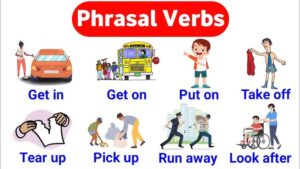
A phrasal verb is a group of two or three words that begins with a verb and is followed by a particle. This article can either be a preposition or an adverb. Phrasal verbs are also referred to as examples of idiomatic expressions since the meanings are not deductible from the meaning of the items that make it up. Check this out:
He ran down his opponents.
The meaning of run down cannot be discovered by adding up the separate meaning of run and down. Thus, the two items have come together to produce a separate meaning different from what each item means individually, which in this sentence means, disparage.
The hint to take away from here is that, for every phrasal verb, it is possible to find a singular verb that means the same thing and could be used to replace the phrasal verb. See the following examples:
| SN | WORD | PHRASAL VERBS |
| 1 | Call on | Visit |
| 2 | Put on | Wear |
| 3 | Decide on | Choose |
| 4 | Give in/up | Surrender |
| 5 | Look after | Tend/nurse |
| 6 | Ask of | Demand |
| 7 | Come across | Meet |
| 8 | Find out | Discover |
| 9 | Look into | Investigate |
| 10 | Take off | Remove |
Note that the phrasal verbs above contain a verb and a particle each.
Further examples:
- The Constance family called on my parents last week.
- Lolade put on her best gown for the party.
It is also possible to have phrasal verbs with two particles. Let us consider some examples.
| SN | WORD | PHRASAL VERBS |
| 1 | Feel up to | Feel capable of doing |
| 2 | Get on with | Have a good relationship |
| 3 | Come forward with | Give ideas/information |
| 4 | Watch out for danger | To be careful because of |
| 5 | Pull out of | Decide not to continue |
| 6 | Move on to | To change to a different |
| 7 | Catch up with | Get to the same level |
| 8 | Add up to | Result in a total of |
| 9 | Make up for | Compensate |
ASSIGNMENT
Look up the meanings of the following phrasal verbs in your dictionary and use them in a sentence each:
- Do away with
- Feel up to
- Get on with
- Come forward with
- Watch out for
- Stand out from
- Face up to
- Lash out at
- Lash out on
- Lose out on

Third Term English Studies Lesson Notes for Other Topics

Oral, Structure, Vocabulary Development, Words For The Week 11
Explore lesson notes covering all topics.
Structure, Comprehension, Vocabulary Development, Words For The Week 10
Explore lesson notes covering all topics.
Structure, Writing , Vocabulary Development, Words Of The Week 9
Explore lesson notes covering all topics.

Oral, Structure, Comprehension , Writing, Words Of The Week 8
Explore lesson notes covering all topics.

Structure, Writing, Vocabulary Development, Words For The Week 6
Explore lesson notes covering all topics.
Oral, Comprehension ,Grammar, Words For The Week 5
Explore lesson notes covering all topics.

Grammar, Oral, Writing, Words For The Week 4
Explore lesson notes covering all topics.

Grammar, Summary, Vocabulary Development, Words For The Week 3
Explore lesson notes covering all topics.

Grammar, Writing, Vocabulary Development, Words For The Week 2
Explore lesson notes covering all topics.
Grammar: Revises Tenses, Words For The Week 1
Explore lesson notes covering all topics.

Persuasive Speech: Meaning, Features & How to Write it
Explore lesson notes covering all topics.
Articles : Difference Between An Article & A Letter
Explore lesson notes covering all topics.
Speech Writing: Features & Common Mistakes
Explore lesson notes covering all topics.

Vocabulary Development: Synonym
Explore lesson notes covering all topics.

Vocabulary Development - Antonyms & Adjuncts
Explore lesson notes covering all topics.


Lesson Notes for Other Classes

JSS1 Lesson Note
The complete lesson note to guide your studies.

JSS2 Lesson Note
The complete lesson note to guide your studies.

SS2 Lesson Note
The complete lesson note to guide your studies.

SS3 Lesson Note
The complete lesson note to guide your studies.