
Arid Land/Deserts SS1 Biology Lesson Note
Download Lesson NoteTopic: Arid Land/Deserts
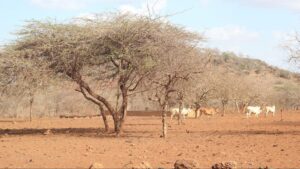
ARID LANDS [DESERTS]
These are areas of very low rainfall and high evaporation rates. They are the driest habitats, receiving less than 25cm of annual rainfall. Arid lands are of two types;
Hot deserts e.g. Sahara desert (North Africa), Kalahari desert (South Africa)
Cold deserts e.g. deserts in North America
CHARACTERISTICS OF A DESERT
- Water is very scarce
- Temperature is very high by the day and very low by the night
- Vegetation is very scanty
- The soils are sandy or rocky
- Strong winds occur frequently and sunshine is very intense
- Presence of drought resistance plants (xerophytes)
PLANTS DISTRIBUTION AND ADAPTATION IN DESERTS
Desert plants include thorny bushes, cacti, scattered dwarf acacia, date palms, wiring grasses, baobab trees and euphorbia species. They adapt to this habitat in the following ways;
- Plants have thin leaves to reduce transpiration
- Cacti leafless have thorns to reduce transpiration and thick succulent stems to store water
- Acacia (drought resistant) has deep roots which absorb underground water
- The Baobab tree has waxy leaves which can be hairy or needle-shaped to reduce the rate of transpiration
- Wiring grass has narrow and slender leaves to reduce transpiration.
ANIMAL DISTRIBUTION AND ADAPTATION IN SPORTS
The Desert animals include camel, rodents, lizards, snakes, zebras, desert tortoises, grasshoppers, wasps, ants etc. They survive in the following ways;
- Most desert animals excrete solid wastes to conserve water.
- Kangaroos, rats remain in burrows during the day to avoid excessive heat
- Reptiles have scales to reduce water loss
- Camels can survive several days without drinking water. They can withstand a wide range of body temperature up to 40oc.
- Locusts have water-proof bodies and impervious cuticles
FOOD CHAINS IN ARID LANDS
- Plants → desert rats → snakes
- Plants → ants → scorpions → snakes

Third Term Biology Lesson Notes for Other Topics
Grassland Habitats
Explore lesson notes covering all topics.
Terrestrial Habitat
Explore lesson notes covering all topics.
Estuarine And Freshwater Habitat
Explore lesson notes covering all topics.
Habitat - Marine Habitat
Explore lesson notes covering all topics.
Fruits
Explore lesson notes covering all topics.
Pollination In Plants
Explore lesson notes covering all topics.
Reproductive System In Flowering Plants
Explore lesson notes covering all topics.
Ecology Of Population
Explore lesson notes covering all topics.
Food Storage
Explore lesson notes covering all topics.
Reproduction In Unicellular Organisms And Invertebrates
Explore lesson notes covering all topics.
Terrestial Habitat
Explore lesson notes covering all topics.
Towards Better Health - How to Control Harmful Microorganisms
Explore lesson notes covering all topics.
Freshwater Habitat
Explore lesson notes covering all topics.
Aquatic And Estuarine Habibat
Explore lesson notes covering all topics.
Microoraganisms In Action
Explore lesson notes covering all topics.


Lesson Notes for Other Classes
JSS1 Lesson Note
The complete lesson note to guide your studies.
JSS2 Lesson Note
The complete lesson note to guide your studies.

SS2 Lesson Note
The complete lesson note to guide your studies.

SS3 Lesson Note
The complete lesson note to guide your studies.