
Speed And Velocity SS1 Physics Lesson Note
Download Lesson NoteTopic: Speed And Velocity
Speed: Speed is defined as the rate of change of distance moved in an unspecified direction or the rate of change of distance per unit time in an unspecified direction. It is measured in metres per second (m/s). It is a scalar quantity.
The mathematical expression of speed is Speed = distance moved ÷ time
Average Speed: Average speed is defined as the ratio of the total distance travelled to the total time taken. It is a scalar quantity and measured in m/s or ms-1
This, average speed = total distance travelled ÷ total time taken
When a body covers an equal distance in equal time intervals, no matter how small the time interval may be, it is said to be a uniform speed or constant speed.
Velocity: Velocity is defined as the rate of change of distance moved in a specific direction or the rate of change of displacement. Velocity is a vector quantity. For instance, it would be easy and correct to say that a car travelling at a steady speed of 50km/h in a direction of N40oE has a velocity of 50km/h, N40°E.
velocity = displacement ÷ time
Graph of uniform velocity
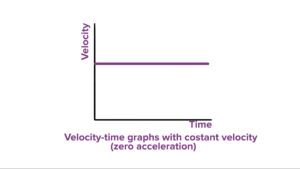
Uniform (constant) velocity: An object is said to undergo (constant) velocity, if the rate of change of displacement is constant, no matter how small the interval may be.
Example 1:
A train moves at a speed of 54km/h for one-quarter minute. Find the distance travelled by the train.
Solution:
Speed = 54km/h = 15m/s
Time = ¼ min = ¼ × 60 = 15s
Distance = speed (m/s) × time (s)
= 15(m/s) × 15(s)
= 225m
ACCELERATION & RETARDATION
Acceleration is defined as the increasing rate of change of velocity. It is measured in m/s2.
Acceleration (a) = Increasing Velocity change ÷ Time taken
When the velocity of a moving body increases by an equal amount in equal intervals of time, no matter how small the time intervals may be, it is said to move with uniform acceleration.
Retardation is defined as the decreasing rate of change of velocity. It is measured in m/s2.It is also known as deceleration or negative acceleration
Retardation (ar) = Decreasing Velocity Change ÷ Time Taken
EQUATION OF UNIFORMLY ACCELERATED MOTION
S = (v+u) t …………. i
2
v = u + at ..………… ii
v2 = u2 + 2 aS ………. iii
S = ut + ½ at2 ……….. iv
Equations (i) to (iv) are called equations of uniformly accelerated motion and could be used to solve problems associated with uniformly accelerated motion where u- initial velocity( m/s), v final velocity (m/s), an acceleration (m/s2), s distance covered and t time (m).
Example
A car moves from rest with an acceleration of 0.2mls2. Find its velocity when it has moved a distance of 50m.
Solution:
a = 0.2mls2 , S = 50m, u = 0m/s , v = ?
v2 = u2 + 2 as
v2 = 02 + (2×0.2×50) = 20
v = √20 m/s
GRAPHS
The motion of an object is best represented or described with graphs. These graphs are:
- Distance- time
- Displacement time
- Velocity time
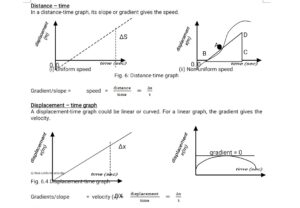
Velocity Time Graph
The velocity-time graph is more useful than any of the two graphs described above because it gives more useful information concerning the motion of objects. The following information can be obtained from the graphs (i) acceleration (ii) retardation (iii) distance (iv) average speed.
The motion of objects can form shapes such as square, triangle, trapezium, rectangle or a combination of two or more shapes. Thus, the sum of the areas of the shapes formed corresponds to the distance moved, covered or travelled by the objects.

First Term Physics Lesson Notes for Other Topics
Scalars And Vectors
Explore lesson notes covering all topics.
Rectilinear Acceleration
Explore lesson notes covering all topics.
Motion
Explore lesson notes covering all topics.
Time
Explore lesson notes covering all topics.
Position, Distance, Displacement
Explore lesson notes covering all topics.

Fundamentals And Derived Quantities And Units
Explore lesson notes covering all topics.
Magnet and Magnetic Field
Explore lesson notes covering all topics.

Energy and Society
Explore lesson notes covering all topics.
Introduction to Lasers
Explore lesson notes covering all topics.

Fibre Optics
Explore lesson notes covering all topics.
Semiconductor(Electronics) Electrical Conduction through Solid Materials
Explore lesson notes covering all topics.

Electric Field, Laws of Electrostatics, Capacitor & Capacitance
Explore lesson notes covering all topics.
Electrolysis: Electrical Conduction through Liquid, and Gases.
Explore lesson notes covering all topics.
Electromagnetic Wave and Capacitance
Explore lesson notes covering all topics.
Gravitational Field
Explore lesson notes covering all topics.


Lesson Notes for Other Classes

JSS1 Lesson Note
The complete lesson note to guide your studies.

JSS2 Lesson Note
The complete lesson note to guide your studies.

SS2 Lesson Note
The complete lesson note to guide your studies.

SS3 Lesson Note
The complete lesson note to guide your studies.