
Scalars And Vectors SS1 Physics Lesson Note
Download Lesson NoteTopic: Scalars And Vectors
CONCEPT OF SCALAR AND VECTOR QUANTITIES
Physical quantities are divided into scalar and vector quantities.
A scalar has only magnitude (size) e.g. distance, speed, temperature, volume, work, energy, power, mass etc.
A vector quantity has both magnitude and direction e.g. force, weight, magnetic flux, electric fields, gravitational fields etc.
VECTOR REPRESENTATION
A vector quantity can be graphically represented by a line drawn so that the length of the line denotes the magnitude of the quantity. The direction of the vector is shown by the arrowhead.
Addition And Subtraction Of Vectors
Two or more vectors acting on a body in a specified direction can be combined to produce a single vector having the same effect. The single vector is called the resultant.
For example:
(a) Two forces Y and X with magnitudes of 3N and 4N respectively acting along the same direction will produce a resultant of 7N (algebraic sum of the two vectors).
(b) If Y and X act in opposite directions, the resultant will be 1N.
(c) If the two vectors are inclined at 900 to each other, Pythagoras theorem is used.
R2 = X2 + Y2
R2 = 42 + 32
R2 =16 + 9
R2 = 25
R = √ 25
R = 5N
Tan θ = Y/X
θ = tan-1(Y /X)
θ = tan-1(3/4)
θ = tan-1(0.75)
θ = 36.90
(d) If the two vectors are inclined at an angle less than 900 or more than 900, the resultant is obtained by using the Parallelogram law of vector addition.
Parallelogram law of vector addition states that if two vectors are represented in magnitude and direction by adjacent sides of a parallelogram, the resultant is represented in magnitude and direction by the diagonal of the parallelogram drawn from the common point
Resolution Of Vectors
A single vector can be resolved into two vectors called components. A vector F represented as the diagonal of the parallelogram can be resolved into its component and later taken as the adjacent sides of the parallelogram.
Sinθ = y /F
y = f sin θ (vertical component)
Cosθ = x /F
x = F cos θ (horizontal component)
The direction of F is given by
Tan θ = y/x
θ = tan-1 (y/x)
The Resultant Of More Than Two Vectors
To find the resultant of more than two vectors, we resolve each vector in two perpendicular directions and add all the horizontal components X, and all the vertical components, Y.
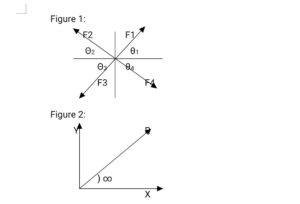
For example, consider four forces acting on a body as shown below
Add all the resolved horizontal components
Figure 1:
X = F1 cos θ1 + (-F2 cos θ2 ) + (-F3 cos θ3 ) + F4 cos θ4
Y= F1 sin θ1 + F2 sinθ2 + (-F3 sinθ3) + (-F4 sinθ4)
Figure 2:
R2 = X2 + Y2
R = √X2+ Y2
The direction ∞ is given by
Tan ∞ = y/x
ASSIGNMENT
- Define vector
- What is the difference between scalar and vector
- Find the vertical and horizontal components of 500N force when it is inclined at (i) 600 (ii) 900 (iii) 1500 to the ground level

First Term Physics Lesson Notes for Other Topics
Rectilinear Acceleration
Explore lesson notes covering all topics.
Speed And Velocity
Explore lesson notes covering all topics.
Motion
Explore lesson notes covering all topics.
Time
Explore lesson notes covering all topics.
Position, Distance, Displacement
Explore lesson notes covering all topics.
Fundamentals And Derived Quantities And Units
Explore lesson notes covering all topics.
Magnet and Magnetic Field
Explore lesson notes covering all topics.

Energy and Society
Explore lesson notes covering all topics.
Introduction to Lasers
Explore lesson notes covering all topics.
Fibre Optics
Explore lesson notes covering all topics.
Semiconductor(Electronics) Electrical Conduction through Solid Materials
Explore lesson notes covering all topics.
Electric Field, Laws of Electrostatics, Capacitor & Capacitance
Explore lesson notes covering all topics.
Electrolysis: Electrical Conduction through Liquid, and Gases.
Explore lesson notes covering all topics.
Electromagnetic Wave and Capacitance
Explore lesson notes covering all topics.
Gravitational Field
Explore lesson notes covering all topics.


Lesson Notes for Other Classes

JSS1 Lesson Note
The complete lesson note to guide your studies.
JSS2 Lesson Note
The complete lesson note to guide your studies.

SS2 Lesson Note
The complete lesson note to guide your studies.

SS3 Lesson Note
The complete lesson note to guide your studies.