
Motion SS1 Physics Lesson Note
Download Lesson NoteTopic: Motion
FUNDAMENTALS OF MOTION
Many scientists have studied motion and its properties because of its importance to life. The Italian, Galileo Galilei, who lived from 1564 to 1642, did the first systematic study of motion. The science of the study of motion done by Galileo is known as kinematics. Isaac Newton was another scientist who did detailed work on the study of motion.
Motion involves a change of position of a body with time. It also involves how things move and what makes them move. Kinematics is the description of how objects move without regard to forces causing their motion, and dynamics deals with why objects move as they do.
TYPES OF MOTION
There are four basic types of motion. There are as follows:
- Translational Motion:– When a body moves from a point A, along the line AB to another point B (see Fig. 4.1), we say that the body is translated from A to B, and the motion performed is known as translational motion. For example, when an aeroplane flies from Abuja to Lagos or a car travels from Lagos to Enugu
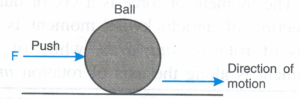
Diagram showing translational motion
- Oscillatory Motion: In this type of motion, a body moves to and fro, about a fixed point. Examples are the vibration of a plucked guitar string, the motion of a pendulum as it swings back and forth, and the vibration of the molecules of a solid.
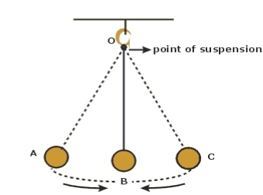
Diagram showing oscillatory motion
- Random Motion: In this type of motion, the body moves in a zigzag direction continuously so that they do not trace a definite path. This type of motion is exhibited by molecules in gases. Another example of random motion is the Brownian motion an irregular motion of particles of various kinds suspended in water or smoke particles suspended in air e.t.c
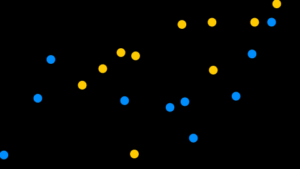
An illustration of random motion
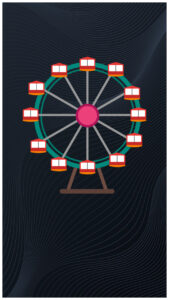
- Rotational Motion: This is the motion of a body which travels in a circle or ellipse and rotates about an axis. Examples are
(i) the rotation of the earth about its axis
(ii) the rotation of blades of an electric fan about its axis
(iii) the rotation of a tap about a central axis.
RELATIVE MOTION
If two bodies, A and B are moving on a straight line, the velocity of A relative to B is found by adding the Velocity of B revered to the velocity of A. For instance, if a car travelling on a straight road at 100km/hr passes a bus going in the same direction at 60km/hr, the velocity of the car relative to the bus is (-60+100) = 40km/hr. If the car and the bus are travelling in opposite directions with the same velocities of 100km/r and 60km/hr respectively, the velocity of the car relative to the bus is ( -(-60) + 100) = (60 +100) = 160 km/hr.
NB: When the velocities are not in the same straight line, the parallelogram law should be used to add this since velocities are vectors, and their magnitudes and directions must be taken into consideration.
CAUSES OF MOTION
We have been describing the motion of a body without regard to what causes the motion. A block of wood resting on a table will remain at rest until it is pushed or pulled by an agent. Such an agent that changes or tends to change the state of rest or uniform motion in a straight line of a body is called force.
TYPES OF FORCE
There are two main types of forces, contact force and force field.
- Contact Force: This may be regarded as a force which exists between surfaces in contact. It includes pushing and pulling forces, frictional forces, and reaction and tension forces in strings and wires.
- Force Fields: These are forces whose sources do not require contact with the body to which they are applied. Examples are gravitational force, electrostatic and magnetic forces
SIMPLE IDEA OF CIRCULAR MOTION
An object moving with a constant speed along a circular path is said to have a uniform circular motion. Examples are the moon circling the earth, the planets moving around the sun, the earth moving around the sun, and a stone tied to a string which is whirled in a horizontal vertical circle.
Circular motion has three characteristics:
(1) constant speed
(2) changing or variable velocity
(3) centripetal acceleration.
The acceleration that is directed towards the centre of the circular path is known as centripetal acceleration. Its magnitude a is given by v2/r
Where V is the uniform speed and r is the radius of the circular path.
Centripetal force FT is defined as the inward force required to keep an object moving with a constant speed in a circular path
The centripetal force is given by FT = mv2/r where m is the mass of the object moving with a uniform velocity v in a circular path or radius r.
Centrifugal force: The centrifugal force is the reaction force that tends to move a body away from the centre. In other words, it acts in the opposite direction to the centripetal force
Centrifuge: A centrifuge is a device used to separate particles in suspension from the liquid in which they are contained.
ASSIGNMENT
- Mention and describe two practical situations where centripetal force must be taken into account.
- A body weighing 100N with a speed of 5ms-1 in a horizontal circular path of radius 5m. Calculate the magnitude of the centripetal force acting on the body (g= 10ms-2). (WAEC, 1999)
- A piece of stone attached to one end of the spring is whirled round in a horizontal circle of radius 7m. When the constant speed of the stone is 40ms-1, calculate the centripetal acceleration.
- A keke (tricycle) moves around Mary Slessor roundabout of radius 50m, at a constant speed of 20ms-1, find (a) Centripetal acceleration (b) Centripetal force
- A particle of mass 100kg is fixed to the tip of a fan blade which rotates with an angular velocity of 100rads-1. If the radius of the blade is 0.2m, find the centripetal force.
- A body of mass 5kg moving in a circular path with a velocity of 5m/s for 10 complete revolutions within 4s. If the radius of the circular path is 30m. Find (a) the centripetal force (b) the centripetal acceleration © the angle subtended in radians (d) the angular velocity

First Term Physics Lesson Notes for Other Topics
Scalars And Vectors
Explore lesson notes covering all topics.
Rectilinear Acceleration
Explore lesson notes covering all topics.
Speed And Velocity
Explore lesson notes covering all topics.
Time
Explore lesson notes covering all topics.
Position, Distance, Displacement
Explore lesson notes covering all topics.
Fundamentals And Derived Quantities And Units
Explore lesson notes covering all topics.
Magnet and Magnetic Field
Explore lesson notes covering all topics.

Energy and Society
Explore lesson notes covering all topics.
Introduction to Lasers
Explore lesson notes covering all topics.

Fibre Optics
Explore lesson notes covering all topics.
Semiconductor(Electronics) Electrical Conduction through Solid Materials
Explore lesson notes covering all topics.
Electric Field, Laws of Electrostatics, Capacitor & Capacitance
Explore lesson notes covering all topics.
Electrolysis: Electrical Conduction through Liquid, and Gases.
Explore lesson notes covering all topics.
Electromagnetic Wave and Capacitance
Explore lesson notes covering all topics.
Gravitational Field
Explore lesson notes covering all topics.


Lesson Notes for Other Classes

JSS1 Lesson Note
The complete lesson note to guide your studies.

JSS2 Lesson Note
The complete lesson note to guide your studies.

SS2 Lesson Note
The complete lesson note to guide your studies.

SS3 Lesson Note
The complete lesson note to guide your studies.