
Surface Area And Volume Of Solid Shapes SS1 Mathematics Lesson Note
Download Lesson NoteTopic: Surface Area And Volume Of Solid Shapes
MENSURATION OF SOLID SHAPES
Properties Of Solid Shapes
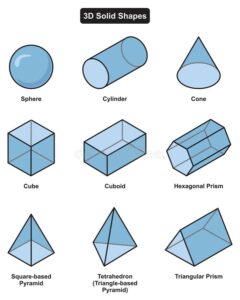
a) A Cube
A cube has the following properties.
i. It has 12 straight edges
ii. It has 8 vertices
iii. It also has 6 square faces
iv. Its net consists of 6 square faces joined together
b) A Cuboid
A cuboid has the following properties.
i.It has 12 straight edges
ii It has 8 vertices
iii. It also has 6 rectangular faces
iv. Its net consist of 6 rectangular faces
c) A Triangular Prism
A triangular prism has the following properties:
i. It has 6 vertices
ii. It has 9 straight edges
iii. It also has 3 rectangular faces and two triangular faces which are the end faces
iv. Its net consist of 3 rectangles and 2 triangles joined together
d) A Cylinder
Properties:
i. A cylinder has 2 circular faces
ii.It has 1 curved surface
iii. It has 2 curved edges
iv. Its net consists of two circular faces and 1 rectangular face i.e. its net consist of 2 circles and 1 rectangle.
e) A Cone
A cone has the following properties:
i. It has one vertex
ii. It has 2 curved edges
iii. It has 1 curved surface
iv. It also has 1 circular face
v. Its net consists of a sector of a circle and a circle
f) Rectangular based pyramids
A rectangular-based pyramid has the following properties:
i. It has 8 straight edges
ii. It has 5 vertices
iii. It has 4 triangular faces
iv. It has 1 rectangular face
v. Its net consists of 4 triangles and 1 rectangle
SURFACE AREA AND VOLUME OF COMMON SOLID SHAPES
A prism is a solid which has a uniform cross-section. Cubes, cuboids, and cylinders are examples of prisms. In general,
Volume of prism = area of uniform cross-section X perpendicular height = area of base x height
NOTE: The general formula for solid shapes is as follows:
- a) Cube
Volume = l3
Surface area = 6l^2
- b) Cuboid
Volume =lbh
Surface area = 2 (lb + lh + bh)
- c) Cylinder
Volume = πr^2 h
Curved surface area = 2πrh
Total surface area = 2πrh + 2π r^2
= 2πr ( h + r)
SURFACE AREA OF A CONE
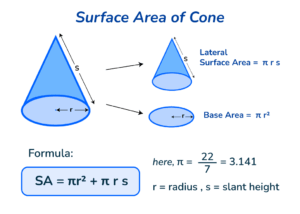
A sector of a circle can be bent to form the curved surface of an open cone. In the figure below, the sector OA x B is of radius l and arc A X B subtends angle θ at O. This sector is bent to form a cone of base radius r and slant height
The following points should be noted
The area of the sector is equal to the area of the curved surface of the cone.
The length of arc A x B is the same as the circumference of the circular base of the cone.
Curved surface area of cone =θ x πl2 ÷ 360°
Also,
θ x 2πl = 2 πr
360
Divide both sides by 2π
θ x 2πl = 2 πr
360 2π 2π
θ x l =r
360
divide both sides by l
θ = r
360 l
substitute r/l for θ in equation i) above:
360
Curve surface area of cone =r x πl2
l
= Πrl
Hence,
Total surface area = curved surface area of a cone + area of circular base
= πr l +π r2
= πr ( l + r)
Example:
- A paper cone has a diameter of 8cm and a height of 3cm
a). Sketch the cone and hence use Pythagoras theorem to calculate its slant height.
b). Calculate the curved surface area of the cone in terms of π
- c) If the cone is cut and opened out into the sector of a circle. What is the angle of
the sector?
- d) Assuming that the paper cone is closed at its base, what will be the total surface area of the closed paper cone?
Solution:
From the given information about the paper cone,
Diameter = 8cm
:. Radius = diameter ÷ 2
= 8cm = 4cm
2
using Pythagoras’ theorem in the right-angled triangle OBC
l2 = /OB/2 + /BC/ 2
l2 = 32 + 42
l2 = 9 + 16
l2 = 25
Take the square root of both sides
√ l2 =√ 25
l = 5cm
: The slant height of the paper cone is 5cm
- b) Curve surface area of the cone = πrl
= π x 4 x 5 cm
= 20 πcm2
- c) If the paper cone is cut and opened out into the sector of a circle as shown in the figure above, then
area of sector of circle = curved surface area of the cone
i.e θx π x (5) 2 = 20 x π
360
5
θx π x 25 = 20 x π
360
12
5 θ = 72 x 20
Divide both sides by 5
5 θ =72 x 20
5
5 θ = 72 x 4
θ = 288°
Volume of Pyramids and Volume of Cone
In general,
Volume = 1/3 x base area x height
SQUARE-BASED PYRAMID, RECTANGULAR-BASED PYRAMID AND CONE
:. The volume of square based pyramid = 1/3 x b2 x h
volume of the based pyramid = 1/3 x l x b x h
volume of the cone = 1/3 x Πr2 x h
Examples
- A pyramid 8cm high stands on a rectangular base 6cm by 4cm. Calculate the volume of the pyramid.
- A right pyramid on a base 4cm square has a slanted edge of 6cm. Calculate the volume of the pyramid.
- Calculate the volume of a cone 14cm in base diameter and 24cm high.
Solutions:
- Volume of a rectangular based pyramid = 1/3 x l x b x h
= 1/3 x 6 x 4 x 8 cm3
= 8 x8 cm3
= 64cm3
2) Considering the square base ABCD
/DB/ 2= /DC/ 2 + /CB/2
Pythagoras rule:
/DB/2 = 42 + 42
/B/2 = 16 + 16.
:. √/DB/ = √ 32
/DB/ = 4 √2 cm
but
/ EB/ = ½ /DB/
Since t is the midpoint of / DB/
Then /EB/ = ½ X 4 X √ 2
= 2 √2 cm.
Now
Consider right angle OEB
OE 2 + EB 2 = ( OB)2
OE 2+ ( 2√2) 2 = ( 6) 2
OE 2 + 4 x 2 = 36
OE 2 + 8 = 36
OE 2 = 36 – 8
OE2 = 28
OE = √28
OE = √4 x 7
OE = 2 x √ 7 cm
OE = 2 √7cm
But OE =height of the pyramid = 2√7
:.volume of square of based pyramid = 1/3 x b2 x h
1/3 x 42 x 2 x √7 cm3
1/3 x 16 x 2 x √7 cm3
= 32 x √7 cm3
3
32 x 2.646cmm3
3
= 32 x.0.882cm3
= 28. 224cm3
= 28.2cm3 to 1 d.p.
3) Since
Diameter = 14cm
Radius = diameter
2
= 14 cm.=7cm
2
:. Volume of cone = 1/3 πr2 h
= 1/3 x 22/7 x ( 7 ) 2 x 24
= 1/3 x 22/7 x 49 x 24 cm3
= 22 x 56cm3
= 1232 cm3
ASSIGNMENT
- Calculate the volume of a cylinder which has a radius of 21cm and a height of 6cm. A. 8500cm3 B. 8316cm3 C. 7632cm3 D 7500cm3 E. 8000cm3
- Calculate the total surface of the cylinder in question 1.
A, 5346cm2 B, 4653cm3 C. 3000cm2 D. 3564 cm2 E 3800cm2
- Calculate the volume of a cone which has a base diameter of 7cm and a height of 6cm A. 77cm3 B. 70cm3 C. 88cm3 D. 90cm3 E. 65cm3
- Calculate the curved surface area of the cone in question 3 above.
A, 152cm2 B. 150cm2 C. 132cm2 D 142cm2 E. 160cm2
- Calculate the total surface area of a cuboid which is 8cm by 5cm by 3cm.
A.198cm2 B. 178cm2 C 188cm2 D 168cm2 E. 158cm2.
- A water tank is 1.2m square and 1.35m deep. It is half full of water. How many times can a 9-litre bucket be filled from the tank?
- A measuring cylinder of radius 3cm contains water to a height of 49cm. If this water is poured into a similar cylinder of radius 7cm, what will be the height of the water column?
- A solid cone has a circular base of radius 7cm. the vertical height of the cone is 15cm. the cone is melted and recast into a metal cube of side xcm. Calculate correct to 3. s.f. the value of x.
- A cylindrical container with a diameter of 80cm and height 50of cm is full of liquid. The liquid is then poured into another cylinder with a diameter of 90cm. calculate the depth of the water.

Third Term Mathematics Lesson Notes for Other Topics

Longitude and Latitude II
Explore lesson notes covering all topics.
Bearings
Explore lesson notes covering all topics.
Probability
Explore lesson notes covering all topics.

Graph Of Linear Inequality In Two Variables
Explore lesson notes covering all topics.

Application Of Linear Inequality In Real Life
Explore lesson notes covering all topics.

Statistics
Explore lesson notes covering all topics.

Probability
Explore lesson notes covering all topics.

Graphical Presentation of Data & Frequency Distribution
Explore lesson notes covering all topics.

Collection, Tabulation & Presentation of Grouped Data
Explore lesson notes covering all topics.

Area And Volume Of Frustum
Explore lesson notes covering all topics.

Area Of Sector And Segment
Explore lesson notes covering all topics.

Mensuration: Circle and It's Properties
Explore lesson notes covering all topics.
Statistics -Data Representation (Bar Chart And Pie Charts)
Explore lesson notes covering all topics.
Angles of Elevation And Depression
Explore lesson notes covering all topics.
Angles And Polygons
Explore lesson notes covering all topics.


Lesson Notes for Other Classes

JSS1 Lesson Note
The complete lesson note to guide your studies.
JSS2 Lesson Note
The complete lesson note to guide your studies.

SS2 Lesson Note
The complete lesson note to guide your studies.

SS3 Lesson Note
The complete lesson note to guide your studies.