
Literary Devices SS1 Literature-in-English Lesson Note
Download Lesson NoteTopic: Literary Devices
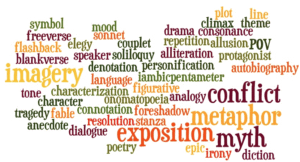
Literary devices, also known as literary terms, are techniques that writers use to create a special and pointed effect in their writing, to convey information, or to help readers understand their writing on a deeper level.
Often, literary terms are used in writing for emphasis or clarity. Authors also use literary terms to get readers to connect more strongly with either a story as a whole or specific characters or themes.
So why is it important to know different literary terms? Aside from helping you get good grades on your literary analysis, there are several benefits to knowing the techniques authors commonly use and some of them include:
- It helps you understand the motivation behind the author’s choices. For example, being able to identify symbols in a story can help you figure out why the author might have chosen to insert these focal points and what these might suggest regarding his/her attitude toward certain characters, plot points, and events.
- It will make a written work’s overall meaning or purpose clearer to you. For instance, let’s say you’re planning to read (or re-read) The Lion and the Jewel by Wole Soyinka. By knowing that this particular book is a satire with references made to the characterization of Lakunle and Baroka, who both represent modernity and traditional ways of life, as well as being portrayed as an idealist and a realist respectively, in their pursuit of the jewel, Sidi. It will be clearer to you why Soyinka uses certain language to describe certain characters and why certain events happen the way they do.
- Finally, literary terms are important to know because they make texts more interesting and more fun to read. If you were to read a novel without knowing any literary devices, chances are you wouldn’t be able to detect many of the layers of meaning interwoven into the story via different techniques.
Now that we’ve gone over why you should spend some time understanding the importance of knowing literary terms, let us take a look at some of the most important literary terms to know.
The following are some of the literary terms/devices/techniques in literature:
- Diction (Language): This is a term that describes the use of words in oral discourse.
It is a simple list of words that make up the vocabulary, the accurate, canny use of these words in discourse makes up good diction.
- Allusion: Allusion is when an author makes an indirect reference to a figure, place, event, or idea originating from outside the text.
Many allusions refer to previous works of literature or art.
- Anaphora: This is when a word or phrase is repeated at the beginning of multiple sentences throughout a piece of writing. It’s used to emphasize the repeated phrase and evoke strong feelings in the audience.
- Asyndeton: This is when the writer leaves out conjunctions (such as “and,” “or,” “but,” and “for”) in a group of words or phrases so that the meaning of the phrase or sentence is emphasized. It is often used for speeches since sentences containing asyndeton can have a powerful, memorable rhythm.
- Epigraph: An epigraph is when an author inserts a famous quotation, poem, song, or other short passage or text at the beginning of a larger text (e.g., a book, chapter, etc.). An epigraph is typically written by a different writer (with credit given) and used as a way to introduce overarching themes or messages in the work.
- Flashback: A flashback is an interruption in a narrative that depicts events that have already occurred, either before the present time or before the time at which the narration takes place. This device is often used to give the reader more background information and details about specific characters.
- Foreshadowing: Foreshadowing is when an author indirectly hints at things such as dialogue, description, or characters’ actions and what’s to come later on in the story. This device is often used to introduce tension to a narrative.
- Malapropism: Malapropism happens when an incorrect word is used in place of a word that has a similar sound. This misuse of the word typically results in a statement that is both nonsensical and humorous; as a result, this device is commonly used in comedic writing.
- Soliloquy: A type of monologue that’s often used in dramas, a soliloquy is when a character speaks aloud to himself (and to the audience), thereby revealing his inner thoughts and feelings.
- Symbolism: Symbolism refers to the use of an object, figure, event, situation, or other ideas in a written work to represent something else, typically a broader message or deeper meaning that differs from its literal meaning. The things used for symbolism are called “symbols,” and they’ll often appear multiple times throughout a text, sometimes changing in meaning as the plot progresses.
- Tone: While the mood is what the audience is supposed to feel, the tone is the writer or narrator’s attitude towards a subject. A good writer will always want the audience to feel the mood they’re trying to evoke, but the audience may not always agree with the narrator’s tone, especially if the narrator is an unsympathetic character or has viewpoints that differ from those of the reader.
Other literary terms include:
- Free Verse: This is poetry that is based on the irregular rhythmic cadence of the recurrence, with variations of phrases, images, and syntactical patterns rather than the conventional use of a meter. Rhyme may or may not be present in free verse, but when it is, it is used with great freedom.
- Innuendo: This is an insinuation or indirect suggestion often with harmful or sinister connotations.
- Interior Monologue: This is one of the techniques by which the stream of consciousness of a character in a novel or a short story is presented. It records the internal, emotional experience of the character on any level or combinations of several levels of consciousness, reaching down to the non-verbalized level where images must be used to represent non-verbal sensations or emotions.
- Motif: This is the simple element which serves as a basis for an expanded narrative; or strictly, a conventional situation, device, interest, or incident, employed in Folklore, Fiction, or Drama
- Tragic Flaw: This is the flaw, error, defect or weakness in the tragic hero, which leads to the hero’s downfall.
- Trilogy: This refers to a literary composition more usually a novel or a play, written in three parts, each of which is in itself a complete unit. The trilogy is usually written against a large background which may be historical, philosophical or social in its interests.
- Comic Relief: This is a humorous scene in tragic drama or fiction that has the effect of temporarily altering the mood of the play and thereby relieving tension.
- Conceit: A term for a particularly fanciful metaphor. It is a term that carries the general notion of a clever, witty expression. It was used by metaphysical poets of the 17th century such as John Donne, Richard Crashaw, Andrew Marvell, Henry Vaughan, Abraham Cowley, and George Hebert, among others.
- Hubris: A Greek word for excessive pride, and arrogance that invites the retribution of the gods. The term is frequently employed in Greek tragedies. It is related to, but distinct from another term, “Hamartia”.
- Monologue: A long speech by one speaker. If the speaker is alone such a speech is called a Soliloquy. If the speaker addresses someone absent or an abstract idea, it is an Apostrophe. If the speech is addressed to someone present, it is a Dramatic Monologue. An Interior Monologue represents a character’s fleeting thoughts and impressions, or inner speech.
- Parallelism: The principle of representing equal ideas in the same grammatical form, for example, “government of the people, by the people, and for the people”. Parallelism produces a sense of balance and order and is frequently employed as a feature of the periodic sentence.
- Quatrain: A four-line stanza of verse, generally exhibiting a rhyme scheme. The traditional ballad was usually composed in quatrains, in which the second and fourth lines rhyme.
- Rhyme: The duplication of sounds, usually at the end of a line of the verse.
- Stanza: In the verse, the basic division of a poem, the equivalent of a paragraph in prose. Stanzas are designated according to the number of lines they contain: Couplet (2 lines); Tercet (3 lines); Quatrain (4 lines); Quintain (5 lines); Sestet (6 lines); Septet (7 lines); Octet (8 lines); and Nonet (9 lines).
- Stereotype: A highly generalized idea, situation, or character, derived from an oversimplified treatment in a work. More commonly, it refers to the reliance on generalizations about racial, national, or sexual groups in the depiction of certain characters.
- Sub-plot: A subordinate sequence of events in a play or novel. A given sub-plot may be designed to mirror, intensify, or enhance the main plot.

First Term Literature-in-English Lesson Notes for Other Topics
Drama
Explore lesson notes covering all topics.
Introduction To Literature
Explore lesson notes covering all topics.


Lesson Notes for Other Classes
JSS1 Lesson Note
The complete lesson note to guide your studies.
JSS2 Lesson Note
The complete lesson note to guide your studies.

SS2 Lesson Note
The complete lesson note to guide your studies.
SS3 Lesson Note
The complete lesson note to guide your studies.