
Democracy SS1 Government Lesson Note
Download Lesson NoteTopic: Democracy
This is a system of government based on popular consent. The electorates freely choose their government; that is to say, it is the government with the approval of the people. Democracy is a fusion of two Greek words, Demos (people) and Kratia (rule or government). Its origin is traced to ancient Greek city-states because they permitted freedom of speech and ideas.
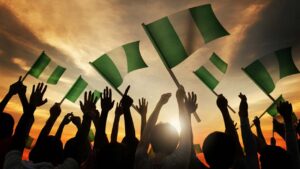
According to Abraham Lincoln, Democracy is the government of the people by the people and for the people. Democracy allows the people to choose or reject their leaders. It is regarded as the best form of government that can be adopted in a country.
Types of Democracy
- Direct/Classical Democracy: this is a form of democracy where all political decisions are made directly by all the citizens. The procedure of majority rule is adopted. This type of democracy was practised in ancient Greek states and pre-colonial Igbo village republics.
- Modern/Representative/Indirect Democracy: In this form of democracy, citizens exercise their political rights by electing representatives who periodically represent them in political office.
Features of Democracy
- Democracy implies periodic free and fair elections to elect political officeholders.
- Fundamental human rights are recognized and protected.
- Majority rule i.e. the will of the people through the ballot prevails.
- There is equality before the law; nobody is above the law
- Opposition parties are allowed to exist and there is the presence of a party system.
- Public opinions on government policies and programs are allowed.
- The Judiciary must be independent without any form of influence.
- The principle of separation of power must be maintained.
- There should be freedom of the press against intimidation.
- There should be an effective process of changing government to prevent dictatorship.
- The Rule of Law must be applied. Government rule is based on the laid down laws.
- Political equality is an important attribute of democracy: one man, one vote.
Demerits of Democracy
- Democracy in an illiterate society could be very dangerous
- Decision-making is slow due to lay down procedures to be followed.
- The votes are counted based on quantity and not quality
- Elections bring about thuggery, violence, arson, bribery and corruption.
- The poor can sell their votes at paltry sums and this promotes corrupt leadership
- It is expensive to run due to the large political parties involved.
ASSIGNMENT
- The concept of democracy originated in ________a) Britain b) France c) Greece
- Which of these is not a characteristic of sovereigntya) Permanence b) Indivisibility c) Incapability
- Legitimacy can be determined by which of the following?a) Common symbols b) Equal rights c) Common Heritage
- A government is considered to be legitimate if it ______a) wins an election b) becomes autocratic c) has no good plans
- A form of sovereignty derived through force is called ____ sovereignty a) de-facto b) de-jure c) legal

First Term Government Lesson Notes for Other Topics
Introduction To Government
Explore lesson notes covering all topics.
Basic Concepts Of Power And Authority
Explore lesson notes covering all topics.
Legitimacy And Sovereignty
Explore lesson notes covering all topics.
Communalism And Feudalism
Explore lesson notes covering all topics.

Socialism And Capitalism
Explore lesson notes covering all topics.
Fascism And Totalitarianism
Explore lesson notes covering all topics.
Military In Nigeria
Explore lesson notes covering all topics.
Conflict Resolution And Management
Explore lesson notes covering all topics.
Peace Education
Explore lesson notes covering all topics.
The Interdependence Of Nations And Globalisation
Explore lesson notes covering all topics.
Nigeria’s Foreign Policy
Explore lesson notes covering all topics.
International Organisation - United Nations
Explore lesson notes covering all topics.
International Organisation II - African Union
Explore lesson notes covering all topics.
International Organisation III - Commonwealth of Nations:
Explore lesson notes covering all topics.


Lesson Notes for Other Classes

JSS1 Lesson Note
The complete lesson note to guide your studies.
JSS2 Lesson Note
The complete lesson note to guide your studies.

SS2 Lesson Note
The complete lesson note to guide your studies.

SS3 Lesson Note
The complete lesson note to guide your studies.