
Rocks SS1 Geography Lesson Note
Download Lesson NoteTopic: Rocks
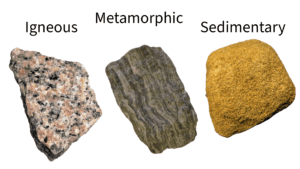
The earth’s crust consists of rocks. A rock is any mineral material of the earth. It may be a combination of different mineral elements such as silica which contains silicon and oxygen. All the rocks differ from one another in texture, structure, colour, permeability, mode of occurrence and degree of resistance to denudation.
Types of Rocks
Rocks are classified into the following; Igneous rocks, Sedimentary rocks and Metamorphic rocks.
- IGNEOUS ROCKS
Characteristics of Igneous rocks
- They are crystalline in structure i.e. they contain crystals.
- They do not occur in layers.
- They do not contain fossils.
- They are usually hard and impervious.
- They are resistant to erosion and elements of weather.
Mode of Formation
They are formed by the cooling and solidification of molten magma, ejected from beneath the earth’s crust.
As the magma moves towards the surface, it comes in contact with lower temperatures, hence cooling and solidifying to form igneous rock.
There are two major types of Igneous rock. These are:
a) Plutonic (Intrusive) Igneous rocks: These are Igneous rocks formed inside the earth’s crust as a result of the cooling and solidification of the molten magma inside the crust i.e. before it gets to the surface. This results in rocks with large crystals. Examples include granite, gabbro and diorite.
b) Volcanic (Extrusive) Igneous rocks: These rocks form outside the earth’s crust due to the cooling and solidification of molten magma on the surface of the earth. This results in rocks with small crystals. Examples include basalt.
- SEDIMENTARY ROCKS
Characteristics of Sedimentary Rocks
- They occur in layers or strata.
- The rocks may be coarse, fine, soft or hard.
- They do not exist in crystals i.e. they are not crystalline.
- They do not contain fossils
- They are not resistant to erosion
Mode of Formation
Sedimentary rocks are formed from sediments deposited by water, wind, or ice. These sediments are deposited in layers or strata one on top of another, and after a long period, they become hardened by compression to form Sedimentary rocks. Sedimentary rocks are therefore said to be stratified or layered.
There are three main types of Sedimentary rocks. This classification is based on their mode of formation.
a) Mechanically formed Sedimentary rocks: These are formed from sediments of other rocks that have accumulated over some time. Examples include sandstone, breccia, shale, clay and conglomerates.
b) Organically formed Sedimentary rocks: These are rocks formed from the remains of living organisms eg plants and animals. Those formed from plant remains are known as CARBONACEOUS Rocks e.g. Coal, Peat, Lignite, Petroleum, etc while those formed from animal remains are known as CALCAREOUS Rocks e.g. Limestone and Chalk.
c) Chemically formed Sedimentary rocks: These are rocks precipitated chemically from solutions. Examples include Potash, Sodium Chloride(Common Salt), Nitrate, Gypsum and Dolomite.

First Term Geography Lesson Notes for Other Topics

Mountains
Explore lesson notes covering all topics.

Lowlands
Explore lesson notes covering all topics.

The Environment - Ecosystem & Its Component
Explore lesson notes covering all topics.

Geography: An Introduction
Explore lesson notes covering all topics.
The Earth's Structure
Explore lesson notes covering all topics.

Latitude & Longitude
Explore lesson notes covering all topics.

The Earth's Revolution
Explore lesson notes covering all topics.

The Earth's Rotation
Explore lesson notes covering all topics.

Satellite Remote Sensing
Explore lesson notes covering all topics.

Tourism
Explore lesson notes covering all topics.

World Trade
Explore lesson notes covering all topics.

ECOWAS
Explore lesson notes covering all topics.

Climatic Change
Explore lesson notes covering all topics.

Mass Movements
Explore lesson notes covering all topics.

Weathering
Explore lesson notes covering all topics.


Lesson Notes for Other Classes

JSS1 Lesson Note
The complete lesson note to guide your studies.

JSS2 Lesson Note
The complete lesson note to guide your studies.

SS2 Lesson Note
The complete lesson note to guide your studies.

SS3 Lesson Note
The complete lesson note to guide your studies.