
Mountains SS1 Geography Lesson Note
Download Lesson NoteTopic: Mountains
Mountains are greatly elevated land surfaces resulting from the intense action of internal forces. They have steep slopes and show distinct peaks. Mountains are classified according to their mode of formation, resulting in four major types of mountains. These are:
- Fold mountains
- Block Mountains
- Volcanic Mountains and
- Residual mountain
- Fold Mountains
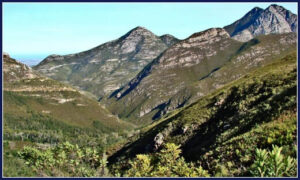
Characteristics:
- They contain old hard rocks with steep sides.
- They have a wrinkling or folding appearance and show distinct peaks of great heights.
- Fold Mountains exist in layered form. iv. They are soft and have anticlines and synclines.
Folding shortens the earth’s crust. They form the most widespread type of Mountains and are noted for active volcanoes. They form the highest Mountain ranges. Examples of Fold Mountains include the Himalayas, Rockies, Andes Alps and the Atlas Mountains
Mode of Formation:
They are formed by large-scale horizontal earth movement as a result of stress and compressional forces which cause expansion or contraction of some parts of the earth. Such stresses therefore subject the rocks to compressional forces.
The compressional forces produce wrinkling or folding of the crust of the earth. The up folds of the wrinkles are anticlines while the down folds are called syncline.
A fold may be simple, but where the compressional forces are complex, it results in asymmetrical folding. When pushed further, it forms an overfold, and an overfold later forms a recumbent fold. In some cases, faults or cracks result in extreme folding to form an overthrust fold.
- Block Mountains
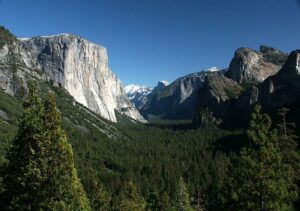
Characteristics:
- Block Mountains are made up of old hard rocks with flat or slightly sloping surfaces.
- They have steep sides.
- They are associated with rift valleys.
- Examples of Block Mountains include Hunsruck Mountain, Vosges Mountain and the Black Forest of the Rhineland.
- An example of a rift valley is the East African rift valley system which is about 4.800km
Mode of Formation:
Block Mountains are formed when the earth cracks due to faulting. Faulting may result from tensional forces or compressional forces. Tensional forces are those that tend to pull the earth’s crust apart and they result in a normal fault while the Compressional forces are those that shorten the crust to produce a reverse or thrust fault.
Therefore, if a block of rock between two normal faults rises or the land on either side of the block subsides, a block mountain or Horst is formed. At times, a block in between two faults may subside so that a rift valley or graben is formed. The slopes and height of Block Mountains are modified by agents of denudation.
- Volcanic Mountain
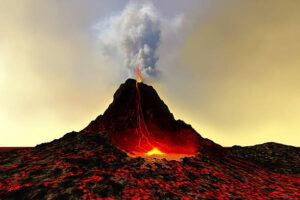
Characteristics:
- Volcanic Mountains are made up of lava.
- They have irregular sides with conical shapes.
- Materials that make up volcanic mountains include ash, volcanic bombs, cinders etc which are arranged in layers.
- Examples include Mt. Fuji (Japan), Mt. Mayon (Philippines), Mts Kilimanjaro, Kenya, Elgon, Ruwenzori and Cameroon (all in Africa)
Mode of Formation:
Volcanic Mountains are formed from volcanoes which are built from materials (molten magma) ejected through fissures or vents in the earth’s crust. The material also includes molten lava, volcanic bombs, cinders, ash, dust and liquid mud.
They fall around the vent in successive layers, building up an extensive volcanic cone. A Volcanic Mountain is also called a Mountain of accumulation
- Residual Mountain
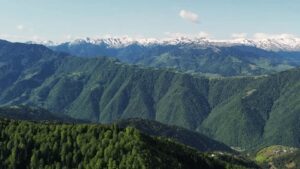
Characteristics:
- Residual Mountains are formed from the remains of already existing mountains.
- They have irregular surfaces with steep sides.
- They occur in varying heights and sizes and are caused by agents of denudation.
- Examples include Mt Monadnock (U.S.A), the Highlands of Scotland, the Highlands of Scandinavia and the Deccan Plateau.
Mode of Formation
Residual Mountains are formed from already existing mountains which are lowered or reduced by agents of denudation such as running water, ice and wind. Residual mountains are, therefore, the remains of the existing mountains.
Some hard and very resistant parts of the existing mountains remain after the lowering of the upper part. These remaining parts are called residual mountains which are also called mountains of denudation
Importance/Uses Of Mountains
- Sources of Minerals
- Formation of Rainfall
- For Transhumance
- Climatic Barriers
- For Defence 6. As Tourist Centers
- Construction of Hydro-electric Power
- As Wind-breaks
Disadvantages Of Mountains
- It causes barriers to communication
- It prevents human habitation
- Mountains promote soil erosion
- Mountains occupy good land that could have been used for other useful things
- Mountain soil is poor in nutrients.

First Term Geography Lesson Notes for Other Topics

Rocks
Explore lesson notes covering all topics.

Lowlands
Explore lesson notes covering all topics.

The Environment - Ecosystem & Its Component
Explore lesson notes covering all topics.

Geography: An Introduction
Explore lesson notes covering all topics.
The Earth's Structure
Explore lesson notes covering all topics.

Latitude & Longitude
Explore lesson notes covering all topics.

The Earth's Revolution
Explore lesson notes covering all topics.
The Earth's Rotation
Explore lesson notes covering all topics.

Satellite Remote Sensing
Explore lesson notes covering all topics.

Tourism
Explore lesson notes covering all topics.

World Trade
Explore lesson notes covering all topics.

ECOWAS
Explore lesson notes covering all topics.

Climatic Change
Explore lesson notes covering all topics.

Mass Movements
Explore lesson notes covering all topics.

Weathering
Explore lesson notes covering all topics.


Lesson Notes for Other Classes

JSS1 Lesson Note
The complete lesson note to guide your studies.

JSS2 Lesson Note
The complete lesson note to guide your studies.

SS2 Lesson Note
The complete lesson note to guide your studies.

SS3 Lesson Note
The complete lesson note to guide your studies.