
The Earth’s Structure SS1 Geography Lesson Note
Download Lesson NoteTopic: The Earth’s Structure
The structure of the earth is grouped into two zones: The outer structure and the internal structure.
- THE OUTER STRUCTURE OF THE EARTH
The outer structure of the earth is made up of four zones or layers:
- Lithosphere
- Hydrosphere
- Atmosphere
- Biosphere
i. Lithosphere: This is the solid portion of the earth. It is the outermost zone of the earth which is made up of rocks and mineral materials. It represents 30% of the earth’s surface.
Importance:
a) It forms the basis for all human settlement.
b) All mineral resources are derived here.
c) It aids transportation through the construction of roads, railways, airports, etc.
d) It aids farming activities.
e) Most human activities like mining, trading, etc are done here.
ii. Hydrosphere: This refers to the liquid portion of the earth. It includes the oceans, sea, rivers, streams and springs, lakes, etc. It covers 70% of the earth’s crust.
Importance:
a) Provides water for domestic uses.
b) Provides medium for transportation.
c) Provides water for industrial uses.
d) Provision of food(fishes, prawns, etc)
e) Provision of employment.
f) Serves as a tourist centre.
g) Generation of hydro-electric power(HEP)
iii. Atmosphere: this is the gaseous portion of the earth. It contains 78% nitrogen, 21% oxygen, 0.03% carbon dioxide and 0.097% rare gasses.
Importance:
a) It is the habitat of some living organisms.
b) It provides oxygen for respiration.
c) It provides carbon dioxide for photosynthesis.
d) It provides oxygen for combustion.
e) It provides a medium of transportation.
f) It provides nitrogen for protein synthesis in plants.
iv. Biosphere: This is the zone of the earth where living things are found.
Importance:
a) Plants provide food for man.
b) Provision of employment.
c) Provision of raw materials.
d) Balancing and purification of the atmosphere.
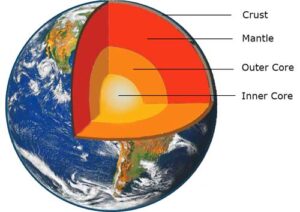
- INTERNAL STRUCTURE OF THE EARTH
The internal structure of the earth is made up of three concentric layers which are:
- The crust (Lithosphere)
- The mantle (Mesosphere)
- The core (Barysphere)
i. The Crust: This is subdivided into upper and lower crust. The upper crust consists of granite rocks and forms the continent. The main minerals here are silica and aluminium, collectively referred to as SIAL. It has an average density of 2.7
The lower part of the earth’s crust consists of basalt rocks and forms the ocean floor. It contains minerals like silica, iron and magnesium, collectively referred to as SIMA. It has an average density of 3.0
ii. The Mantle: This zone is found just beneath the crust. It is about 290 km thick with a density of 3.3 Its main mineral is olivine. It is plastic and in semi-liquid form.
iii. The Core: This is the innermost part of the earth. It is about 3500 km in radius. It contains two minerals, iron and nickel, collectively referred to as NIFE. The temperature of the core is estimated to be as high as 2000 C. It is in a molten state.
ASSIGNMENT
- Draw the inner structure of the earth.

First Term Geography Lesson Notes for Other Topics

Rocks
Explore lesson notes covering all topics.

Mountains
Explore lesson notes covering all topics.

Lowlands
Explore lesson notes covering all topics.

The Environment - Ecosystem & Its Component
Explore lesson notes covering all topics.
Geography: An Introduction
Explore lesson notes covering all topics.
Latitude & Longitude
Explore lesson notes covering all topics.

The Earth's Revolution
Explore lesson notes covering all topics.
The Earth's Rotation
Explore lesson notes covering all topics.

Satellite Remote Sensing
Explore lesson notes covering all topics.

Tourism
Explore lesson notes covering all topics.

World Trade
Explore lesson notes covering all topics.

ECOWAS
Explore lesson notes covering all topics.

Climatic Change
Explore lesson notes covering all topics.

Mass Movements
Explore lesson notes covering all topics.

Weathering
Explore lesson notes covering all topics.


Lesson Notes for Other Classes

JSS1 Lesson Note
The complete lesson note to guide your studies.
JSS2 Lesson Note
The complete lesson note to guide your studies.

SS2 Lesson Note
The complete lesson note to guide your studies.

SS3 Lesson Note
The complete lesson note to guide your studies.