
Meaning And Importance Of Agriculture SS1 Agricultural Science Lesson Note
Download Lesson NoteTopic: Meaning And Importance Of Agriculture
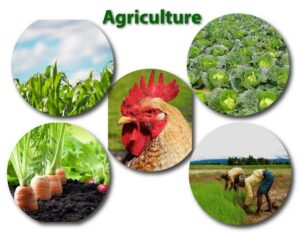
MEANING OF AGRICULTURE
Agriculture is the art and science (or management) that deals with the cultivation of crops and the rearing of animals for man’s use. This means it refers to all the activities involving the cultivation of the soil for the production of crops and livestock management to the distribution and marketing of plant and animal products.
The term, agriculture, is derived from two Latin words which are:
“Ager” which means field/farm/land.
“Culture” which means cultivation.
By this, agriculture means field cultivation. However, this is not a complete definition of agriculture since agriculture also has to do with animal production.
BRANCHES OF AGRICULTURE
The branches of Agriculture include the following:
- Animal Science/Animal Husbandry/Animal Production: Animal Science ensures the efficient and effective management of farm animals. It ensures better animal productivity.
- Veterinary Medicine/Animal Health: Veterinary medicine provides better
health management for farm animals. It ensures the control of pests, parasites and
diseases of farm animals.
- Soil Science: Soil science ensures the maintenance of soil fertility, and better soil
classification and mapping. It also helps in erosion control, soil moisture conservation
and application of appropriate fertilizer for different soil types.
- Crop Production/Crop Science: Crop production helps in effective crop
management practices, development of better planting materials, correct crop spacing, etc. The aspects of crop production include Agronomy, Crop Pathology and Entomology.
- Agricultural Economics and Farm Management: It ensures the effective management of agricultural resources, and promotes agricultural marketing and good farm accounting.
- Agricultural Engineering: It promotes the mechanization of farm operations, development of processing and storage equipment and also maintenance of farm tools and equipment.
- Agricultural Extension and Education: It promotes the training and dissemination
of agricultural information to farmers, and also link farmers to researchers.
- Forestry and Wildlife Conservation: It promotes the conservation of forest products, and wildlife and also the creation of microclimate
- Fishery: It promotes the production of fish, its management, processing and other fishing practices.
- Apiculture/Bee Farming: It promotes the production of honey for local consumption/uses.
- Heliculture/Snailry: It involves the production of snails for consumption as a source of protein and minerals.
IMPORTANCE OF AGRICULTURE
- PROVISION OF FOOD: – Agriculture provides food such as maize, rice, yam, vegetables, fruits, meat, and milk, either in fresh form or processed form for man and farm animals.
- SOURCE OF MATERIALS FOR CLOTHING: Agriculture provides fibre and cotton for textile production. It also provides hides and skin for clothing, shoes, belts, caps, and bags.
- PROVISION OF MATERIALS FOR SHELTER AND FURNITURE: – Agriculture provides timber for making building materials such as doors, windows, roofs, poles e. t. c. Timber is also used for making furniture such as shelves, cabinets, tables, chairs e. t. c.
- PROVISION OF INCOME: – Agriculture generates income for farmers and farm labour through sales of plants and animal produce and wages or salaries.
- EMPLOYMENT FOR THE WORKING POPULATION: – Agriculture and other agro-based industries employ farmers, farm workers and other people who engage in agricultural finance and marketing.
- PROVISION OF RAW MATERIALS FOR INDUSTRIES: – Agriculture provides raw materials for agro-based industries (industries which depend on agriculture for their raw materials). It provides cotton and wool for textile industries, cocoa, coffee, tea and kola nut for beverage industries, rubber latex for tyres and foams industries etc.
- SOURCES OF FOREIGN EXCHANGE: – Agriculture contributes significantly to foreign exchange earnings in Nigeria through the export of cocoa, coffee, groundnut, cotton, palm produce, and timber e. t. c. to other countries.
- PROVISION OF MARKET FOR INDUSTRIAL GOODS: – Finished products from agro-allied industries such as fertilizers, pesticides, herbicides, agro-pharmaceutical drugs, farm tools, machines as well as storage and processing facilities are used in the agricultural sector.
- DEVELOPMENT OF RURAL AREAS: – Agriculture brings about development in rural areas as social amenities such as good roads, electricity, pipe-borne water, schools and hospitals are provided where commercial agriculture exists.
- PROVISION OF FACILITIES FOF RECREATION AND TOURISM: – Agriculture leads to the establishment of game reserves. It also provides horses for horse racing and polo.
ASSIGNMENT:
- What is Agriculture?
- List and define eight branches of Agriculture.
- What are agro-allied industries? State five examples of them.
- State five Agricultural raw materials and the industries that use them.
- State ten relevance of agriculture.
- Define these aspects of crop science:
(a) Agronomy (b) Crop Pathology (c) Enthomology

First Term Agricultural Science Lesson Notes for Other Topics
Agro-Allied Industry
Explore lesson notes covering all topics.
Factors Affecting Availability For Agricultural Purposes
Explore lesson notes covering all topics.

Land And It's Uses
Explore lesson notes covering all topics.
Meaning And Importance Of Agricultural Ecology
Explore lesson notes covering all topics.
Agricultural Laws And Reforms
Explore lesson notes covering all topics.
Role Of Non-Governmental Organizations In Agricultural Development
Explore lesson notes covering all topics.
Role Of Government In Agricultural Development
Explore lesson notes covering all topics.
Meaning And Differences Between Subsistence And Commercial Agriculture
Explore lesson notes covering all topics.
Problems Of Agricultural Development And Possible Solutions
Explore lesson notes covering all topics.

Agricultural Extension
Explore lesson notes covering all topics.

Agricultural Extension II
Explore lesson notes covering all topics.
Aquaculture II - Fishing Gear & Crafts
Explore lesson notes covering all topics.
Aquaculture
Explore lesson notes covering all topics.

Animal Improvement
Explore lesson notes covering all topics.
Artificial Insemination
Explore lesson notes covering all topics.


Lesson Notes for Other Classes

JSS1 Lesson Note
The complete lesson note to guide your studies.

JSS2 Lesson Note
The complete lesson note to guide your studies.

SS2 Lesson Note
The complete lesson note to guide your studies.

SS3 Lesson Note
The complete lesson note to guide your studies.