Balance Sheet – JSS3 Business Studies Lesson Note (Second Term)
Download Lesson NoteLesson note at a glance
- Subject
- Business Studies
- Class
- JSS3
- Term
- Second Term
- Topic
- Balance Sheet
- Order
- Topic 7 of 8 this term
- Reading time
- 2 min
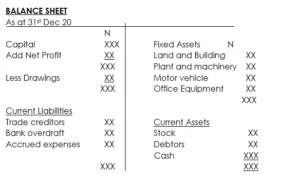
A balance sheet can be defined as a statement showing the business’s assets and liabilities as of a given date. A balance sheet is not an account, so it does not have a debit or credit side. Also, it does not have balance brought down or balance carried down.
Classification of assets and liabilities
Assets: These are the valuable resources of a business. Among these resources, we have the ones that are more permanent in nature and others less permanent. The more permanent assets e.g. land and buildings, office equipment, plant and machinery, furniture and fittings, motor vehicles, etc. are referred to as fixed assets. The less permanent ones are referred to as current assets. Current assets include stock, trade debtors, bills receivable, cash at the bank, cash in hand, etc.
Capital: This is worth the business owes the owner of the business. In other words, capital is the amount used to establish a business.
Current Liabilities: These are the debts a business owes outsiders which should be repaid within one year. Examples are trade creditors, bank overdrafts, accrued expenses, bill payables, etc. The format of a balance sheet is as follows:
EVALUATION
- Define a balance sheet.
- List four examples of fixed assets.
Reading Assignment
Read Business Studies for JSS 3 by O. A. Lawal pages 86 to 90.
GENERAL REVISION QUESTIONS
- What is a trial balance?
- Where do you prove the accuracy of double-entry bookkeeping?
- Define balance sheet.
- State three current liabilities.
- List three current assets.
WEEKEND ASSIGNMENT
- Balance Sheet is ____
- Assets and liabilities
- Income and expenditure of a business
- The principal book of account where all entries in the subsidiary books are posted to
- A statement showing the business’s assets and liabilities as of a given date.
- An example of a fixed asset is
- Debtors
- Creditors
- Motor van
- Bills receivable.
- ______ is a current asset
- Stock
- Furniture
- Drawings
- Bills payable.
- ______ is a current liability
- Stock
- Machinery
- Drawings
- Bills payable.
- The amount a business owes the owner(s) is called
- Assets
- Liabilities
- Capital
- Drawings.
THEORY
- Write short notes on
(a) Assets
(b) Liabilities
(c) Drawings.
- Prepare a balance sheet format with at least ten items.
This term's Business Studies topics
JSS3 Second Term · 8 topics
Second Term Business Studies Lesson Notes for Other Topics

Need For Monitoring And Control Of Chemicals
Read the full lesson note.
Consumer, Market, And Society
Read the full lesson note.
Factors Of Production
Read the full lesson note.
Types Of Occupation
Read the full lesson note.

Honesty In Business
Read the full lesson note.
Ethics In Sourcing Chemicals
Read the full lesson note.
Entrepreneurship
Read the full lesson note.
Importance Of Entrepreneurship
Read the full lesson note.

Forms Of Business Organization
Read the full lesson note.
Bookkeeping Ethics
Read the full lesson note.
How To Make Complaints
Read the full lesson note.

Personal Finance
Read the full lesson note.
Trial Balance
Read the full lesson note.
Balancing The Ledger Account
Read the full lesson note.
Trading Profit And Loss Account
Read the full lesson note.
Lesson Notes for Other Classes

Basic 1 Lesson Note
The complete lesson note to guide your studies.

Basic 2 Lesson Note
The complete lesson note to guide your studies.

Basic 3 Lesson Note
The complete lesson note to guide your studies.

Basic 4 Lesson Note
The complete lesson note to guide your studies.

Basic 5 Lesson Note
The complete lesson note to guide your studies.

Basic 6 Lesson Note
The complete lesson note to guide your studies.