
Ghana Empire JSS2 Nigerian History Lesson Note
Download Lesson NoteTopic: Ghana Empire
Ghana Empire
The Ghana Empire was one of Africa’s first great kingdoms. It existed long before Europeans came to Africa, from around 300 CE to 1200 CE. This powerful state controlled lands that are now part of modern Mali, Mauritania, and Senegal in West Africa. The Ghana Empire was not related to the modern country called Ghana, which is located further east along Africa’s coast.
Ghana became wealthy and powerful by controlling important trade routes across the Sahara Desert. The kingdom connected the gold-producing regions of West Africa with North African traders who brought salt and other goods from across the desert. This control of trade made Ghana rich and famous throughout the ancient world.
At its height, Ghana was known as the “Land of Gold” because it had access to so much gold. The empire’s wealth, organized government, and strong army made it one of the most advanced states of its time. Kings of Ghana could command thousands of soldiers and ruled over many different peoples and tribes who paid taxes and tribute to the empire.
Origins and Foundation
Early Beginnings
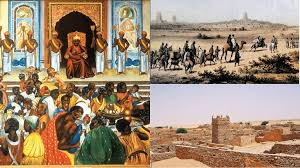
The Ghana Empire began as a smaller kingdom founded by the Soninke people. The Soninke were farmers and traders who spoke a Mande language. They lived in villages along the upper parts of the Niger and Senegal rivers in West Africa.
According to oral traditions, a leader named Dinga Cisse united several Soninke clans and established the Wagadou kingdom (which later became known as Ghana) around 300 CE. Over time, this small kingdom grew more powerful as it gained control over local gold mines and trade routes.
The name “Ghana” actually comes from the title of the king, who was called the “Ghana.” Arab and North African writers later used this title to refer to the entire kingdom, calling it “Ghana.” The people themselves called their country “Wagadou.”
Geographic Advantages
The Ghana Empire developed in a perfect location for controlling trade:
- It was situated between the gold-producing regions to the south and the salt mines in the Sahara Desert to the north
- It controlled parts of the Senegal and Niger rivers, which were important for transportation and communication
- The empire lay in the Sahel region, a transition zone between the Sahara Desert and the forests further south
- This position allowed Ghana to control the movement of goods and people between these different regions
- Rivers provided water for farming in an otherwise dry region
This strategic location gave Ghana natural advantages for building a trading empire.
Political Organization
The Ghana King and Royal Court
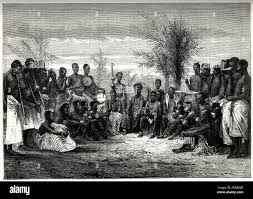
At the center of the Ghana Empire was the king, who had both political and religious power. The king was believed to have divine connections and was responsible for maintaining harmony between the people and the spirit world.
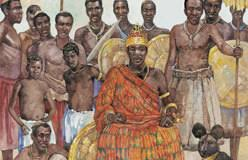
The royal court of Ghana was impressive to foreign visitors:
- The king lived in a palace complex built of stone
- He wore fine clothes decorated with gold and sat on a raised platform
- When giving audiences, he was surrounded by counselors, guards, and court officials
- Royal musicians and praise-singers announced the king’s appearance
- The king kept elephants and other wild animals in his court to show his power
Royal symbols included special stools, swords, and gold ornaments that were passed down from king to king. These items represented the authority and legitimacy of the ruler.
Government Administration
The Ghana Empire had a well-organized government system:
- The king appointed governors to rule provinces within the empire
- A council of ministers advised the king on important matters
- Tax collectors gathered wealth from traders and subjects
- The royal court included judges who settled disputes according to traditional law
- A system of messengers carried the king’s orders throughout the kingdom
In conquered territories, the Ghana kings often allowed local chiefs to continue ruling their people as long as they paid tribute and remained loyal to the empire. This approach helped Ghana control a large area without needing to replace all local leaders.
Military Organization
The Ghana Empire maintained a strong army that protected trade routes and conquered neighboring peoples:
- At its height, the king could gather an army of 200,000 men according to some accounts
- The core of the army consisted of full-time soldiers loyal to the king
- When needed, additional warriors were called up from throughout the empire
- The army included both infantry soldiers and cavalry riding horses
- Bow and arrow, spears, and swords were their main weapons
- Some elite soldiers wore metal armor and carried shields
This powerful military force allowed Ghana to expand its territory, defend against attackers, and protect valuable trade caravans crossing the desert.
Economy and Trade
Trans-Saharan Trade
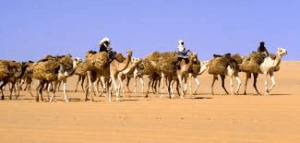
The main source of Ghana’s wealth and power was its control of the trans-Saharan trade routes:
- Gold came from mines in regions south of Ghana (in modern Ghana and Ivory Coast)
- Salt came from mines in the Sahara Desert, especially Taghaza
- North African traders brought copper, cloth, tools, weapons, and luxury goods
- Ghana controlled the points where trade routes crossed the Niger and Senegal rivers
- The empire served as a middleman, taxing goods moving in all directions
Salt was extremely valuable in West Africa because of the hot climate. It was needed to preserve food and replace salt lost through sweating. In some places, salt was so valuable it was traded for equal amounts of gold.
Taxation and Wealth Collection
The Ghana kings became rich by carefully controlling and taxing trade:
- All traders passing through Ghana had to pay taxes on their goods
- The king claimed ownership of all gold nuggets found in the empire (although gold dust could be traded freely)
- Conquered peoples paid tribute in the form of food, livestock, and luxury goods
- Royal officials collected taxes at major markets and border crossings
- Special officials weighed gold dust and measured other trade goods
These taxes provided enormous wealth that supported the royal court, government officials, and the army. The king’s treasury stored gold, salt, ivory, and other valuable items.
Agriculture and Local Production
While trade brought great wealth, most people in the Ghana Empire were farmers:
- They grew crops like millet, sorghum, rice, and vegetables
- Livestock included cattle, sheep, and goats
- Some communities specialized in crafts like pottery, leather working, and weaving
- Iron smelting and blacksmithing were important technologies
- Fishing was common along the rivers
Agricultural production was vital because it fed the empire’s growing population, including traders, officials, soldiers, and craft workers who did not produce their own food.
Social Structure and Culture
Social Classes
The Ghana Empire had distinct social classes:
- The royal family and nobles formed the highest class
- Religious leaders and important traders made up a wealthy merchant class
- Craftspeople and skilled workers formed a middle class
- Farmers made up the largest group in society
- Slaves (often captured in wars) worked for the upper classes
A person’s position in society was usually determined by their birth family, though skilled traders or warriors could sometimes improve their status through service to the king.
Religious Practices
The original religion of the Ghana Empire involved worship of ancestors and nature spirits:
- The king served as the chief religious leader
- Sacred groves and shrines were maintained throughout the kingdom
- Religious ceremonies included music, dance, and animal sacrifices
- Spiritual practitioners used divination to communicate with the spirit world
- Ancestor worship was an important practice in family life
As trade increased with North Africa, Islam began to influence Ghana. Muslim traders built mosques in trading cities, and some members of the royal court studied Islamic learning. However, most ordinary people continued following traditional religious practices.
Towns and Architecture
The Ghana Empire included both large cities and small villages:
- Koumbi Saleh was the capital city with an estimated population of 15,000-20,000 people
- The capital had two distinct sections: the royal town where the king lived and the Muslim traders’ quarter
- Buildings were made of stone or sun-dried brick with some having multiple stories
- Homes of common people were round huts with thatched roofs
- Markets, mosques, and shrines were important public spaces
Archaeological excavations have revealed sophisticated urban planning, including straight streets and drainage systems in the major cities.
Decline and Legacy
Factors in Ghana’s Decline
The powerful Ghana Empire began to decline around 1100 CE for several reasons:
- A series of droughts weakened agriculture and trade
- The Almoravids (a North African Muslim dynasty) attacked Ghana around 1076 CE
- Internal rebellions broke out as conquered peoples sought independence
- New trade routes developed that bypassed Ghana’s territory
- Competition from rising states like Mali increased
- Overuse of land may have caused environmental damage
By 1200 CE, the once-mighty Ghana Empire had lost most of its power and territory.
Impact and Historical Significance
Despite its eventual decline, the Ghana Empire left an important legacy:
- It established patterns of trade across the Sahara that lasted for centuries
- Its government system influenced later West African kingdoms like Mali and Songhai
- The Ghana Empire demonstrated that African states could build sophisticated civilisations
- Stories of Ghana’s wealth inspired later explorers and traders
- Cultural practices and social structures continued in successor states
The Ghana Empire’s achievements showed the world that Africa had complex, organised societies with advanced political systems and successful international trade networks long before European colonisation.
Conclusion
The Ghana Empire stands as one of Africa’s greatest early kingdoms. For nearly 800 years, it controlled vital trade routes, built impressive cities, maintained a complex government, and managed relations between diverse peoples across West Africa. Its wealth became legendary throughout the ancient world, with Arab writers describing its kings as among the richest on Earth.
By studying Ghana, we learn that Africa had a long history of sophisticated state-building before Europeans arrived on the continent. The empire’s control of trade, its military organisation, and its political system demonstrated advanced social organisation and strategic thinking. Even after its decline, Ghana’s legacy lived on in the kingdoms that followed, particularly the Mali Empire, which built upon many of Ghana’s achievements.
The story of Ghana reminds us that African history includes powerful states with far-reaching influence and remarkable accomplishments that deserve recognition alongside other great civilizations of the ancient world.

Third Term Nigerian History Lesson Notes for Other Topics
Songhai Empire
Explore lesson notes covering all topics.
Mali Empire
Explore lesson notes covering all topics.
Muslim States In The Face Of Colonization In West Africa
Explore lesson notes covering all topics.
Christian Missionary Activities In West Africa
Explore lesson notes covering all topics.
Empire In Western Sudan: Old Ghana, Mali And Songhai Empire In Africa
Explore lesson notes covering all topics.
Great Empires And Kingdoms In West Africa
Explore lesson notes covering all topics.
Factors Responsible For The Decline Of Great Empires In Western Sudan
Explore lesson notes covering all topics.
Non-Centralized States
Explore lesson notes covering all topics.
Trans-Atlantic Slave Trade
Explore lesson notes covering all topics.
Spread of Islam in Kanem-Bornu Empire
Explore lesson notes covering all topics.

Early European Contacts With The Coastal States
Explore lesson notes covering all topics.
Islam in Hausa Land
Explore lesson notes covering all topics.
Early External Influences: Contact With The North African Trade And Islam
Explore lesson notes covering all topics.
Indigenous Technology: Crafts And Industries
Explore lesson notes covering all topics.


Lesson Notes for Other Classes

JSS1 Lesson Note
The complete lesson note to guide your studies.

SS1 Lesson Note
The complete lesson note to guide your studies.

SS2 Lesson Note
The complete lesson note to guide your studies.

SS3 Lesson Note
The complete lesson note to guide your studies.