
Concept Of Demand And Supply SS1 Economics Lesson Note
Download Lesson NoteTopic: Concept Of Demand And Supply
DEFINITION OF DEMAND
Demand can be defined as the quantity of a commodity (goods and services) that consumers are willing and able to buy at a given price and at a particular place and time. Demand is quite different from wants, needs or desires. Effective Demand’ in economics must meet three conditions which are:
- Ability to pay
- Willingness to pay
- Authority to buy a commodity
Demand must be related to price because, to a great extent, price determines the quantity which consumers are willing to buy.
LAW OF DEMAND
The law of demand states that, all things being equal (Ceteris Paribus), The higher the price, the lower the quantity of goods that will be demanded, or the lower the price, the higher the quantity of goods that will be demanded. This law is often regarded as the first law of demand and supply. It simply means that when the price of a commodity, like yam for instance, is high in the market, very few quantities of it will be demanded by the consumers and vice-versa.
DEMAND SCHEDULE
It is a table of values showing the relationship between prices and quantity of that commodity demanded. That is, the different quantities of a commodity, which would be bought at various prices, at a particular time.
DEMAND CURVE
The demand curve is the graphical representation of the information contained in the demand schedule. The price is plotted on the vertical axis and the quantity demanded is plotted on the horizontal axis. The normal demand curve slopes downwards from left to right.
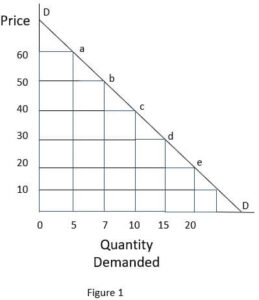
A typical demand curve
NOTE: Both the demand schedule and the demand curve illustrate the law of demand which states that the higher the price of a commodity, the lower the quantity demanded and vice versa.
TYPES OF DEMAND
- Complementary (Joint) Demand: This is the demand that occurs when two or more goods are needed or required together at the same time by a consumer, e.g. tea and sugar, car and petrol. An increase in the demand for cars will lead to an increase in demand for petrol, and vice-versa.
- Competitive (Substitute) Demand: This is the demand that occurs when two goods are close substitutes and serve the same purpose. In this case, when there is an increase in the price of one commodity that has a close substitute to another, its demand will fall as consumers will shift to the other close substitute goods with lower prices and the demand for the close substitute goods will increase, eg fish and meat, tea and coffee, butter and margarine, pen and biro.
- Composite Demand: This is the demand that occurs when the total demand for a single commodity will serve many useful purposes. For example, cocoa beans are demanded for making cocoa beverages, cocoa bread, cocoa wine and chocolate. Cassava is demanded for making foofoo, garri, starch and cassava powder (Elubo)
- Derived Demand: This is the demand that occurs when the demand for a commodity is not for its immediate consumption but for the demand for another commodity. For example, there is a demand (derived) for flour to satisfy the demand for bread and cake.
FACTORS AFFECTING THE DEMAND FOR A COMMODITY
- The higher the price of the commodity the lower the quantity demanded and vice-versa.
- Price of other commodities: This applies to commodities, which are complementary or are close substitutes. If the price of a commodity is high, consumers may demand close substitutes.
- Income of the consumer: As the income of the consumer increases, his demand for goods and services will also increase
- Change in taste and fashion: The demand of people changes according to the reigning fashion of the day and their differing tastes.
- Distribution of income: The pattern of demand of a population where income is evenly distributed will be different from that of a population where income is concentrated in the hands of a few
- Size of the population: – The level/size of the population determines the level of demand. The structure of the population i.e. age distribution, sex distribution etc also determines the level of demand for particular commodities
- Weather: The weather condition prevailing at a particular time influences the demand for particular commodities e.g. umbrellas have a high demand during the rainy season.
- Expectation of future price changes: – If consumers expect that there will be a high or low price of goods in future, demand will increase or decrease.
- Advertising:- A well-packaged and convincing advertisement specifically targeting a product will lead to an increase in demand
- Availability of credit facilities:- When there are avenues for consumers to buy goods and defer the payment for the goods to a later time, demand will increase
The introduction of new commodities to replace old ones. This will increase the demand for the new commodities and reduce the demand for the old commodities
- Taxation on commodities: An increase in taxes levied on goods will reduce their demand because the goods will cost more. A decrease in tax levied on goods will have the opposite effect.
EXCEPTION TO THE LAW OF DEMAND
Exceptional or Abnormal Demand- is a demand pattern which does not abide by the law of demand, and therefore gives rise to the reverse of the basic law of demand which states that the higher the price, the lower the quantity demanded of a commodity, and vice-versa. In the case of abnormal demand, a higher price may mean a higher demand or no change in demand, while a lower price may mean a lower demand or no change in demand.
Conditions for these exceptional cases are:
- Goods of Ostentation (Prestigious Goods)
- Necessary but Cheap Commodity
- Inferior (Giffen) Goods
- Expectation of Future Change in Price
First Term Economics Lesson Notes for Other Topics

Price Control
Explore lesson notes covering all topics.

Rationing And Hoarding
Explore lesson notes covering all topics.

Basic Tools For Economic Analysis
Explore lesson notes covering all topics.

Measures Of Dispersion
Explore lesson notes covering all topics.

Theory Of Consumer Behaviour
Explore lesson notes covering all topics.

Demand And Supply
Explore lesson notes covering all topics.

Elasticity Of Demand
Explore lesson notes covering all topics.

Income Elasticity Of Demand
Explore lesson notes covering all topics.

Cross Elasticity Of Demand
Explore lesson notes covering all topics.
Scale Of Production
Explore lesson notes covering all topics.

Division Of Labour And Specialization
Explore lesson notes covering all topics.
Theory Of Production II
Explore lesson notes covering all topics.
Theory of Production
Explore lesson notes covering all topics.
Concept Of Demand And Supply II
Explore lesson notes covering all topics.
Basic Tools Of Economic Analysis II
Explore lesson notes covering all topics.


Lesson Notes for Other Classes
Basic 1 Lesson Note
The complete lesson note to guide your studies.

Basic 2 Lesson Note
The complete lesson note to guide your studies.

Basic 3 Lesson Note
The complete lesson note to guide your studies.

Basic 4 Lesson Note
The complete lesson note to guide your studies.

Basic 5 Lesson Note
The complete lesson note to guide your studies.

Basic 6 Lesson Note
The complete lesson note to guide your studies.