
Optical Instruments SS2 Physics Lesson Note
Download Lesson NoteTopic: Optical Instruments
THE COMPOUND MICROSCOPE
The compound microscope produces a greater magnification than the simple microscope. It has two lenses, the objective lens which has a short focal length and the eyepiece used as the magnifying glass to view an image formed by the objective lens.
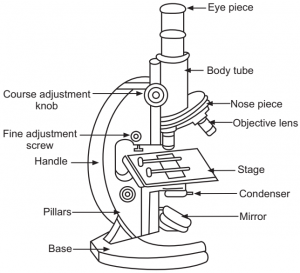
The image formed by the objective lens is within the principal focus of the piece. So a final image is formed at the least distance of distinctive vision from the eye.
THE ASTRONOMICAL TELESCOPE
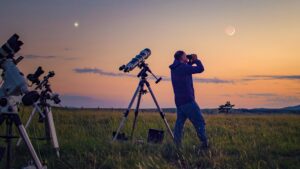
An astronomical telescope is used for viewing distant objects like stars and planets. The astronomical telescope uses two convex lenses; the objective lens and the eyepiece.
The objective lens has a long focal length and forms a real image of a distant object at its focal plane. The position of the eyepiece and the objective lens must coincide with the principal focus so that the final image is at infinity. The astronomical telescope gives an inverted image which can be tolerated when looking at the stars but is at a disadvantage on the Earth.
THE HUMAN EYE
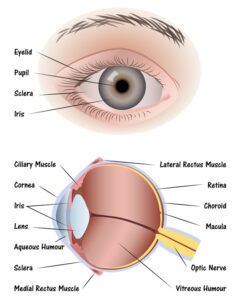
The optical system of the eye consists of the cornea, the aqueous, the vitreous humour and the lens. They form a real and inverted image of an external object on the retina. The retina transmits the impression created on it by the image through the optic nerve to the brain. The brain then interprets the impression. The amount of light entering the eye through the pupil is regulated by the iris.
EYE DEFECTS
- Long Sight (Hypermetropia)
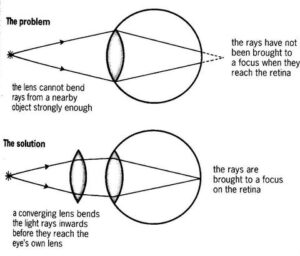
A long-sighted person can see objects at a distance but cannot see close objects. His near point is more than 25cm which is the near point of the normal eye. It is caused by the eyeball being too short so that rays from objects at 25cm from the eye are brought to focus behind the retina. It is corrected by a converging lens placed in front of the eye for near vision.
Short Sight (Myopia)
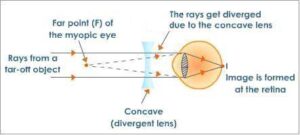
A short-sighted person cannot see distant objects clearly as rays from such objects are focused in front of the retina. His far point is less than the normal far point which is at infinity. It is corrected by the use of a diverging lens. The diverging lens makes the object at infinity appear to be at the person’s far point.
ASSIGNMENT
- For correcting long-sight defects in the human eyes, we require.(a) Converging lens (b) diverging lens (c) microscope (d) periscope.
- Which of the following optical instruments does not make use of a lens?(a) projector (b)periscope (c) eye (d) microscope.
- The ability of the eye to focus on objects at different distances is called …..a) Power (b) accommodations (c) normal vision (d) long sight
- Binocular vision ……..(a) Restricts the field of view (b) Enables a person to see further (c) Enables objects to be seen in relief (d) Enables objects to be seen clearly.

Third Term Physics Lesson Notes for Other Topics
Triangular And Rectangular Prisms
Explore lesson notes covering all topics.
Lenses
Explore lesson notes covering all topics.
Dispersion Of White Light
Explore lesson notes covering all topics.
Sound Waves
Explore lesson notes covering all topics.
Description And Property Of Fields
Explore lesson notes covering all topics.
Electric Field
Explore lesson notes covering all topics.
Particulate Nature Of Matter
Explore lesson notes covering all topics.
Fluids At Rest And In Motion - Surface Tension
Explore lesson notes covering all topics.
Units Of Measurements And Electrical Continuity Testing
Explore lesson notes covering all topics.


Lesson Notes for Other Classes

JSS1 Lesson Note
The complete lesson note to guide your studies.

JSS2 Lesson Note
The complete lesson note to guide your studies.

SS1 Lesson Note
The complete lesson note to guide your studies.

SS3 Lesson Note
The complete lesson note to guide your studies.