
Triangular And Rectangular Prisms SS2 Physics Lesson Note
Download Lesson NoteTopic: Triangular And Rectangular Prisms
REFRACTION
There is a change in the direction and speed of a ray of light when it passes from one medium to another medium of different density. This change in the direction of the light of the light ray which is due to the difference in the speed of light in different media is called refraction.
When a ray of light travels from an optically less dense medium (air) to an optically dense medium (water, glass), it bends towards the normal.
A ray passing from glass or water to air is bent away from the normal
i. When a wave, e.g light wave is refracted:
ii. Its direction of travel changesIts velocity changes.
iii. Its wavelength changes
iv. Its frequency remains the same.
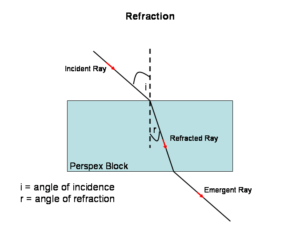
REFRACTION THROUGH RECTANGULAR PRISM
LAWS OF REFRACTION
- The incident and refracted ray are on opposite sides of the normal at the point of incidence, all three are in the same plane.
- The ratio of the sine of the angle of incidence to the sine of the angle of refraction is a constant for a given pair of media.
The second law is known as the Snells law
sini = n
sinr
The constant “n” is known as the refractive index of the second medium concerning is a number which gives a measure of refraction or bending of light as it travels from one medium to another.
ang =
Sine of angle of incidence in air
Sine of angle of refraction in glass
gna =
Sine of angle of incidence in glass
Sine of angle of refraction in air
From the principle of reversibility of light: ang = 1 ÷ gna
Furthermore; the speed of light in glass
speed of light in air
EFFECTS OF REFRACTION
The phenomenon of refraction is responsible for the following:
- The bottom of a clear river or pond appears shallower than it r spoon appears bent or broken when it is partially immersed in water or any liquid.
- Letters in print seem to be nearer when we place a thick block of glass over them.
REFRACTION THROUGH TRIANGULAR PRISM
When a ray of light passes through a triangular prism, it is refracted as shown below:
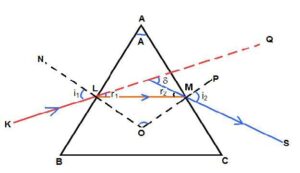
The angle between the incident ray and the emergent ray is known as the angle of deviation. The angle of deviation decreases as the angle of incidence increases
The refractive index,
n = sin(A/2+D/2)/sinA/2
TOTAL INTERNAL REFLECTION
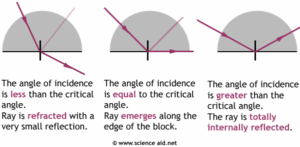
When light passes at a small angle of incidence from a denser to a less dense medium e.g. from glass to air, there is a strong refracted ray. There is also a weak ray reflected into the denser medium.
When the angle of incidence increases, the angle of refraction also increases. At a certain increase in the angle of incidence, the angle of refraction is 900. This angle of incidence in the denser medium for which the angle of refraction in the less dense medium is 90°, is referred to as the critical angle ( c). For the angle of incidence greater than C, the refracted ray disappears and all the incident light is reflected into the denser medium.
At this point, the ray is said to experience total internal reflection. An example of total internal reflection is the mirage on the road, where the refractive density of warm air is less than that of cool air and light meets a layer at a critical angle, it suffers total internal reflection.
REAL AND APPARENT DEPTH
A thick slab of glass appears to be only two-thirds of its real thickness when viewed vertically from above. Similarly, water in a pond appears to be only three-quarters of its real depth. Rays from a coin at the bottom of a bucket of water are refracted away when they leave the water and enter the eyes.
They appear as if coming from a virtual image, which is apparent depth while the actual depth of the bottom remains and is referred to as real depth
Refractive index = real depth
apparent depth
Third Term Physics Lesson Notes for Other Topics
Lenses
Explore lesson notes covering all topics.
Optical Instruments
Explore lesson notes covering all topics.

Dispersion Of White Light
Explore lesson notes covering all topics.
Sound Waves
Explore lesson notes covering all topics.
Description And Property Of Fields
Explore lesson notes covering all topics.
Electric Field
Explore lesson notes covering all topics.

Particulate Nature Of Matter
Explore lesson notes covering all topics.
Fluids At Rest And In Motion - Surface Tension
Explore lesson notes covering all topics.

Units Of Measurements And Electrical Continuity Testing
Explore lesson notes covering all topics.


Lesson Notes for Other Classes

Basic 1 Lesson Note
The complete lesson note to guide your studies.

Basic 2 Lesson Note
The complete lesson note to guide your studies.

Basic 3 Lesson Note
The complete lesson note to guide your studies.

Basic 4 Lesson Note
The complete lesson note to guide your studies.

Basic 5 Lesson Note
The complete lesson note to guide your studies.

Basic 6 Lesson Note
The complete lesson note to guide your studies.