
Electoral Crisis SS2 Government Lesson Note
Download Lesson NoteTopic: Electoral Crisis
-
FEDERAL ELECTION CRISIS OF 1964
Another crisis that shook the foundation of Nigeria and threatened the unity of the country was the crisis that arose from the general election of 1964. The federal election witnessed the formation of alliances by both the major and minor political parties. For instance, factions of A.G. and NCNC together with the Northern progressive front made up of NEPU-Northern Element Progressive United, Middle Belt Congress, joined together to form the United Progressive Grand Alliance (UPGA) under the leadership of Dr. M.I. Okpara on June 3, 1964. On August 20 1964, the NPC, NNDP, the Mid-Western Democratic Front (MDF) and the Dynamic Party formed the Nigeria National Alliance (NNA) under the leadership of the Premier of the Northern Region, Sir Ahmadu Bello.
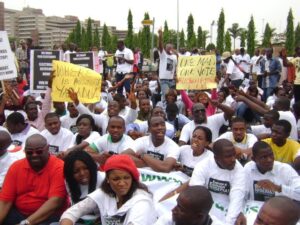
As the electioneering campaign commenced all sorts of crude and obnoxious methods were employed as campaign strategies. UPGA candidates complained of their inability to file nomination papers in the Northern and Western Regions controlled by the NPC and NNDP. Electoral officers were reported to be absent when UPGA candidates wanted to file their nomination papers. A delegation of UPGA met with the president protesting their grievances and that if not redressed, they would boycott the election. President Nnamdi Azikiwe requested the Prime Minister, Tafawa Balewa, to postpone the election. However, the request was rejected by the prime minister. The election was held on December 30, 1964. Members of the UPGA in different parts of the country boycotted the election. Elections took place in Northern and Western Regions, some parts of Mid-West and Lagos, but they did not take place at all in the Eastern Regions.
The outcome of the election was favourable to the NNA. The president declared on January 1, 1965, that he found it awkward to exercise his constitutional duty of calling on the winning party leader to form a new government. There was a deadlock and for three days there was no government at the federal level. This forced some prominent Nigerians like the Chief Justice of the federation to intervene. At last, the president invited the outgoing Prime Minister, Sir Abubakar Tafawa Balewa, a member of NNA who promised to form a broad-based government. The government was made up of members of NCNC but no single member of the Action Group was included in the cabinet.
-
WESTERN NIGERIA ELECTION CRISIS OF 1965
With the emergence of the United Progressive Grand Alliance (UPGA) and the Nigeria National Alliance (NNA) as the two dominant parties through coalitions, the rivalry between them at the national level shifted base to the Western Nigeria election of 1965.
The A.G. represented (UPGA) and NNDP (NNA). Both of them saw this election as very important and should not be underestimated. Before the commencement of the election, the party in power in Western Nigeria, the NNDP imposed a curfew and some other stringent measures aimed at frustrating the efforts of UPGA members in some parts of the regions.
With the dissolution of the Western House of Assembly, preparatory to the elections, the irregularities that featured at the federal elections manifested. For instance, UPGA candidates were not privileged or opportune to collect nomination forms and in most cases, electoral officers would be absent from their duty posts. The electioneering campaign was also characterized by acts of thuggery, hooliganism, killing, arson and looting.
The petition Alhaji D.S. Adegbenro who was the leader of UPGA sent to Governor Sir OdeleyeFadahunsi about the malpractices which did not yield any result. The election took place on October 11, 1965, in an atmosphere characterized by many electoral malpractices such as the smuggling of ballot boxes, burning opponents’ ballot boxes and unfair counting of votes. At the end of the election, it was announced that NNDP won 88 out of the 98 seats contested.
In a counter-reaction, Alhaji Adegbenro summoned a press conference at Ibadan in the house of jailed Chief Awolowo in which he announced that UPGA won 68 out of the 98 seats. He pronounced himself as the premier of the region and appointed eight ministers of his cabinet.
With two governments in the same region, the stage was therefore set for a serious political crisis. At last, Chief Akintola was sworn in as the Premier of the region while AlhajiAdegbenro was arrested. As a result, all these heavens were let loose for violent demonstrations, chaos, rioting and a complete breakdown of law and order in the Western region. It was reported that about 1,000 people lost their lives and about 5,000 houses were burnt down while the newly elected premier took to his heels and went into hiding.
The political crisis continued until the January 15, 1966 coup d’etat that put it to a stop.
-
GENERAL ELECTION CRISIS OF 1979
The 1979 general elections were unique because they took place under the newly introduced federal system of government. The elections ushered in Nigeria’s second republic after 13 solid years of military government. Before the elections, the Federal Electoral Commission (FEDECO) headed by Chief Michael Ani had registered five political parties out of about 52 political associations that emerged when the ban on political associations was lifted.
The registered political parties were, the National Party of Nigeria (NPN), Unity Party of Nigeria (UPN), Nigeria People’s Party (NPP), Great Nigeria People’s Party (GNPP) and People’s Redemption Party (PRP).
The chairman of NPN was Chief A.M.A. Akinloye while AlhajiShehu Shagari was its presidential candidate. Chief Obafemi Awolowo was the national leader and the presidential candidate of UPN. The chairman of NPN was Chief AdeniranOgunsanya and Dr. Nnamdi Azikiwe was the presidential candidate. Alhaji Ibrahim Waziri and Mallam Aminu Kano were the leaders and presidential candidates of GNPP and PRP respectively. Five different elections took place between July 7, and August 18, 1979, on different five Saturdays.
For the senate, July 7, House of Representatives July 14, State Assemblies July 21, Governorship July 28 and the presidential August 11, 1979.
In the election into the senate, out of a total of 95, NPN won 36 seats, UPN 29, NPP 16, GNPP 8 and PRP 7. The most controversial election of all the elections was the presidential election. The controversy arose as a result of the fact that none of the candidates was able to win 25% in two-thirds of the federation. Alhaji Shehu Shagari who was eventually declared the winner won 25% of the votes cast in 12 states of the federation.
The mathematical riddle that arose was what should be 122/3 of 19. The NPN formula of 122/3 was accepted by FEDECO and Alhaji Shehu Shagari was declared the winner. Chief Awolowo who came second took the matter to the Presidential Election Tribunal, headed by Justice B.O. Kazeem and later to the Supreme Court presided over by the then Chief Justice of the federation Justice Atanda Williams and all declared that the election of Alhaji Shehu Shagari was in order.
-
GENERAL ELECTIONS OF 1983
At the end of President Shehu Shagari’s first term in office (4 years), another election was conducted. This was to usher in the third republic. The 1983 general election was to be conducted by the civilian government in place. In 1979, five registered political parties participated in that election, but this time an additional one had been added to the already existing five.
The election commission (FEDECO) before the election, registered the Nigeria Advance party formed by MrTunji Braithwaite, bringing the total number of parties for the elections to six. All the five political parties that contested the 1979 elections did not make much changes in the candidates fielded for the 1983 elections.
The arrangement for this general election by the government-controlled electoral body, FEDECO, under the chairmanship of Justice Ovie Whiskey, took a different shape from what it was in 1979. This time the presidential election was to come up first, followed by governorship, senatorial, House of Representatives and finally state Legislative assemblies.
It was argued that this new arrangement was mainly to favour the party in power. Alhaji Shehu Shagari was declared the winner after the August 6 presidential elections. Massive rigging, and falsification of election figures were alleged in many centres. Similarly, the NPN-controlled states now increased from 7 to 10 states. The party in government was accused of having masterminded the act of rigging, possibly to remain in government. There were reports of rioting, looting, arson, violent demonstrations in some areas etc. The outcome of this ugly scene was the military intervention of December 31, 1983.
-
KADUNA STATE EXECUTIVE/LEGISLATIVE CRISIS OF 1981
Main Feature
i. The PRP won the gubernatorial election in 1979 in Kaduna state and Alhaji Balarabe Musa its flag bearer became governor of the state on October 1, 1979.
ii. PRP as a party did not have the majority seats in the state assembly.
The NPN that won the majority seats in the House had both the speaker of the House and the majority leader.
iii. In adherence to the constitutional provision which required the governor to present his nominated candidates as commissioners to the State House of Assembly.
iv. Alhaji Balarabe Musa presented the list of his nominated commissioners for three good times and the House rejected the lists for three good times.
v. This led to a strained relationship between the executive and the legislatures.
vi. The NPN-controlled legislature was bent on removing the governor through the process known as impeachment.
vii. Different charges and accusations of different proportions were levelled against the governor, to create enough reasons for his impeachment or removal.
viii. Some state assemblies in the country came in to mediate but all to no avail. The legislators were determined to remove the governor.
ix. The report of the committee set up to investigate the allegations was adopted and the speaker of the House, AlhajiMamman Dan Musa served the impeachment notice on the governor as the governor of Kaduna State.
Third Term Government Lesson Notes for Other Topics
Development Of Political Parties
Explore lesson notes covering all topics.
Development Of Political Parties III
Explore lesson notes covering all topics.
The Structure Of Nigerian Federalism
Explore lesson notes covering all topics.
Federalism
Explore lesson notes covering all topics.
Development Of Political Parties II
Explore lesson notes covering all topics.
Minor Political Crisis In Nigeria
Explore lesson notes covering all topics.
Basic Principles Of Government: Rule Of Law
Explore lesson notes covering all topics.
Fundamental Human Rights
Explore lesson notes covering all topics.
Separation Of Power
Explore lesson notes covering all topics.
Intergroup Relations
Explore lesson notes covering all topics.

Pressure Groups
Explore lesson notes covering all topics.
Political Parties And Party System
Explore lesson notes covering all topics.
Citizenship
Explore lesson notes covering all topics.

Centralization And Decentralization
Explore lesson notes covering all topics.
Representative Government & Popular Participation
Explore lesson notes covering all topics.


Lesson Notes for Other Classes
Basic 1 Lesson Note
The complete lesson note to guide your studies.

Basic 2 Lesson Note
The complete lesson note to guide your studies.

Basic 3 Lesson Note
The complete lesson note to guide your studies.

Basic 4 Lesson Note
The complete lesson note to guide your studies.
Basic 5 Lesson Note
The complete lesson note to guide your studies.

Basic 6 Lesson Note
The complete lesson note to guide your studies.