
Theory of Income Determination – SS2 Economics Lesson Note (Third Term)
Download this term · ₦1,000Lesson note at a glance
- Subject
- Economics
- Class
- SS2
- Term
- Third Term
- Topic
- Theory of Income Determination
- Order
- Topic 8 of 9 this term
- Reading time
- 5 min
The theory of income determination explains how income, consumption, savings and investment are related. The circular flow of income shows money moving between households and firms: households supply labour and receive wages, interest and rent, then spend it on goods and services. The economy is in equilibrium when aggregate saving equals aggregate investment.
Behavioural objectives
By the end of the lesson, students should be able to:
- Explain the circular flow of income between households and firms.
- State the factors that bring about changes in the circular flow of income.
- Define savings, investment and consumption, and state the factors that affect each.
- State the types of investment.
- Explain the relationship between income, consumption, savings and investment using the formulae Y = C + S and Y = C + I.
What is the circular flow of income?
Circular flow of income shows the interdependence between households and business enterprises.
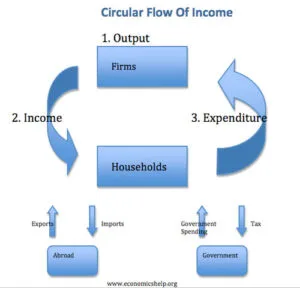
Commodity and money flow between households and firms. It shows the flow of payments from the business sector to households in exchange for labour and other productive services, and the return flow of payments from households to the business sector in exchange for goods and services.
The household or the personal sector offers its labour services to the business sector or firms in the production of goods and services. The household is rewarded in the form of wages, interest and rent, which it spends on the consumption of goods and services produced in the economy.
What factors bring about changes in the circular flow of income?
- Withdrawal: the part of income that is not allowed to pass through the normal channel of the circular flow of income.
- Injection: an increase in the income of households and producers outside their normal processes of selling productive resources and manufactured goods.
- Savings: the part of income that is not consumed immediately. Savings reduce households’ and producers’ expenditure.
- Investment: this reduces and creates additional income either immediately or in future.
- Gifts and grants: they may come from governments to households and firms and help increase their incomes.
- Taxes: they reduce the expenditure of households and firms on goods and factor services.
- Imports: they involve expenditure on foreign-made goods and services and constitute withdrawals from the circular flow of income.
- Exports: they provide money from other countries and act as an injection into the domestic circular flow of income.
What are savings, investment and consumption?
Savings
Savings are made up of disposable income which is not spent on consumer goods and services. Saving involves forgoing some present consumption.
Individuals save for the following reasons:
- To raise capital
- For unforeseen contingencies
- For speculation
- To acquire assets
- For future purposes
- To raise social status
Factors that affect savings
- The size of income
- The rate of interest
- Cultural attitude
- Government policies
- Availability of financial institutions
Investment
Investment may be defined as expenditure on physical assets which are not for immediate consumption but for the production of consumer and capital goods and services.
Types of investment:
- Individual investment: this may be on buildings, motor vehicles and other assets the individual hopes may increase his income and standard of living.
- Investment by firms: this can be on buildings, machines, furniture, raw materials, semi-finished goods and finished goods.
- Government investment in social capital: this is in the areas of roads, electricity, pipe-borne water, hospitals and schools. The purpose is to improve the living conditions of the citizens.
- Government investment in public corporations: the government invests to render essential services and to create more employment opportunities, among other reasons.
Factors that determine investment
- The amount of income earned
- Savings
- Profit
- The amount paid as tax
- The rate of interest
- Expectation
- Business atmosphere
- Political factors
Consumption
Consumption is the sum of current expenditure on goods and services by individuals, firms and government. It also means the part of income that is not saved or invested. The level of consumption of an individual depends largely on his level of current income.
Factors that determine the level of consumption include:
- The level of income
- Savings
- Expectation of price changes
- The rate of taxes paid
- The influence of other households
- Assets owned
- The rate of interest received
- Business profit
How are income, consumption, savings and investment related?
Income, consumption and savings are related. The amount of income earned by a household determines to a large extent the level of consumption of an individual as well as the amount which can be saved. This is represented by the formula Y = C + S, where Y = income, C = consumption expenditure and S = savings.
Income, consumption and investment are also related. The amount of income earned by the business sector determines to a large extent the level of spending on running overhead costs (consumption) as well as the amount spent on further investment. This is represented by the formula Y = C + I, where Y = income, C = consumption expenditure and I = investment expenditure.
In forming an equation with household income and business sector income, we have:
C + S = C + I
S = I
Consumption influences the level of national income. If people consume more, it encourages further production. The economy is at equilibrium when aggregate saving equals aggregate investment and full employment is achieved at this level.
We save to accumulate capital for investment and for many personal reasons. There will be no investment without saving. Investment, in turn, creates employment and income for people. Without income, we shall have nothing to save and nothing to spend on the consumption of goods and services.
Evaluation
- What is the circular flow of income?
- State four factors that affect savings.
- List the four types of investment.
- Show, using Y = C + S and Y = C + I, why saving equals investment at equilibrium.
Assignment
- The part of income that is not spent is known as ____ (a) multiplier (b) saving (c) expenditure (d) depreciation
- All these factors tend to reduce the amount of funds in the circular flow of income except ____ (a) savings (b) grants (c) imports (d) taxes
- The real capital investment of a country is a reflection of its ____ (a) total debts (b) total goods (c) total income (d) total reserve
- An expenditure on physical assets which are not for immediate consumption is known as ____ (a) a consumption (b) an investment (c) a liability (d) a saving
- ____ is the major determinant in the concepts of saving, investment and consumption. (a) cost of living (b) multiplier (c) standard of living (d) income
This term's Economics topics
SS2 Third Term · 9 topics
- Money
- Financial Institutions
- Inflation
- Public Finance
- Budget
- Capital Market
- National Income
- Theory of Income Determination
- Theory of Multiplier
Get Economics as PDF and Word
Every week of SS2 Economics, Third Term, formatted and ready to print. Ad-free, and the copy lock comes off.
Get this term Card, bank transfer, USSD or OPay
Third Term Economics Lesson Notes for Other Topics
Inflation
Read the full lesson note.

Financial Institutions
Read the full lesson note.

Public Finance
Read the full lesson note.

Money
Read the full lesson note.
Budget
Read the full lesson note.

Capital Market
Read the full lesson note.

National Income
Read the full lesson note.
Theory Of Multiplier
Read the full lesson note.

Financial Institutions
Read the full lesson note.

The Nature Of Nigerian Economy
Read the full lesson note.

Agriculture
Read the full lesson note.

Mining
Read the full lesson note.

Channels Of Distribution
Read the full lesson note.
Lesson Notes for Other Classes

Basic 1 Lesson Note
The complete lesson note to guide your studies.

Basic 2 Lesson Note
The complete lesson note to guide your studies.

Basic 3 Lesson Note
The complete lesson note to guide your studies.

Basic 4 Lesson Note
The complete lesson note to guide your studies.

Basic 5 Lesson Note
The complete lesson note to guide your studies.

Basic 6 Lesson Note
The complete lesson note to guide your studies.
