
Animal Nutrition SS2 Agricultural Science Lesson Note
Download Lesson NoteTopic: Animal Nutrition
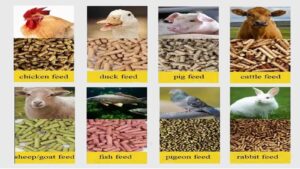
Animal nutrition is the process by which an animal obtains nutrients necessary for its healthy growth and development.
IMPORTANCE OF ANIMAL FEEDS
- Animal feeds are needed for growth.
- Useful for repair of worn-out tissue.
- It provides energy.
- It is useful for the general well-being of the animal.
- It aids animal resistance to diseases.
- It influences maturity in animals.
- It aids optimal production in animals.
DEFINITION OF FEED
Feed refers to the food given to animals. They contain nutrient elements either alone or in combination with other substances which support the healthy growth and development of livestock.
Classification Of Livestock Feeds
Animal feeds can be classified into four main groups according to the digestibility, quantity of fibre, quantity required and moisture in the feed. The four groups of feeds are;
- Concentrates: They are free with a low proportion of fibre and water content. They are easily digested by farm animals. Concentrates can be further subdivided into two groups: Those containing a high proportion of carbohydrates are called carbohydrate concentrates/basal feed/energy feed e.g maize, guinea corn, cassava e.t.c while those with a high proportion of proteins are called protein concentrates e.g beans, peas, cottonseed, sunflower seeds and heads, groundnuts, palm kernel and animal products such as meat, blood meal, bone meal, fishmeal and milk.
- Roughages: Roughages are very low in protein and carbohydrates but high in fibre. They are not easily digested by animals and, therefore are fed together with concentrated foods for young animals and those kept for milk and meat production. Examples are hay, groundnut hulls, straw, bean pods and maize stover.
- Succulents: These have high water content. They are easy to digest. Examples are freshly cut/lush grass and legume plants (soilage), pumpkin, silage, melons and most green crops.
- Supplements (minerals and vitamins): They are required in small quantities, low in energy, protein and fibre but high in vitamins and minerals. They aid digestion and increase animal resistance to diseases. They are available in basal and protein concentrate feeds. Other sources are bone meal, oyster shells, salt licks etc.
- Basal/Energy Feed or Carbohydrate Concentrates
Characteristics
- They are fed with a crude fibre content of less than 18%.
- They are high in energy and starchy food e.g. maize and cassava.
- It is high in carbohydrates or fats.
- It is low in proteins.
- Low in fibre.
- It is highly digestible.
- It is low in minerals.
- Protein Concentrate
Characteristics:
- Their crude fibre content is less than 18%.
- Protein concentrate is high in protein.
- They are low in carbohydrates and fats.
- They are low in fibre.
- They are highly digestible.
- They are low in minerals.
- Mineral and Vitamin Supplements
Characteristics:
- They are required in small quantities in feeds.
- They supplement basal and protein concentrates.
- They are low in energy.
- Low in protein.
- Low in fibre.
- High in vitamins and minerals.
- Necessary for growth and development.
- They aid food digestion.
- They aid resistance to diseases.
- Roughages
Characteristics:
- They are feeding that contain crude fibre that is greater than 18%.
- They are high in fibre.
- They are low in digestible carbohydrates.
- They are low in protein.
- They have poor or low digestibility.
- Pasture grasses and legumes form roughages.
- Roughages exist in different forms which are; hay, straw, silage and salvage.
a) Hay: It refers to the aerial part of a young and succulent grass or herbage cut and dried for feeding animals
b)Straw: This is the aerial part of grass or harvested crops cut and stored for future use. They are difficult to digest. Both hay and straw are called dry roughages
c) Soilage: This refers to the process of cutting fresh or succulent grass or legumes from the field and taking them to the animals in their pens. It is also called zero-grazing
d) Silage: This refers to the preservation of green and succulent forage crops under anaerobic conditions.
ANIMAL FEED INGREDIENTS
These are the raw materials used in the production of animal feeds. These include; blood meal, fish meal, groundnut cake, palm kernel cake, cottonseed meal, bone meal, maize, guinea corn etc.
FOOD NUTRIENTS OF LIVESTOCK
There are six classes of food nutrients. These are;
- Carbohydrate: It is made up of carbon, hydrogen and oxygen.
Sources: Maize, guinea corn, cassava, grasses, wheat, potato, rice, millet, yam, hay, silage, potato, rice millet, yam, hay, silage potatoes etc
Functions Of Carbohydrates
i. Provides energy to farm animals for growth, reproduction, milk production and other activities.
- Protein: It is composed of carbon, hydrogen, oxygen and sometimes sulfur, nitrogen and phosphorus
Sources: The sources of animal proteins are; fish meal, blood meal, meat meal, milk, earthworms, eggs e.t.c. Plant protein sources are; soybean meal, groundnut cake, palm kernel cake, cottonseed meal, sunflower seed meal, cashew nut meal and leguminous forage. Synthetic sources of proteins are; methionine, lysine, cysteine
Functions Of Protein
- Essential for the growth of young animal tissue.
- They are used to repair worn-out tissue.
- They are used in the formation of gametes in reproduction.
- They are needed for the production of enzymes.
- They are necessary for flesh build-up.
- Essential for sustenance of life.
- Help to provide raw materials for building protective covering such as hair, nails roof, wool feathers etc.
- Fats And Oil
Fat is composed of carbon, hydrogen, and oxygen
Sources: These are palm oil, palm kernel cake, groundnut cake, coconut meal, cotton seed cake, milk, lard and fallow.
Functions Of Fats And Oil
- Fats provide more energy than carbohydrates.
- Fat supplies essential fatty acids and fat build-up.
- They provide fat-soluble vitamins
- They improve their diet.
- They help in the maintenance of body temperature.
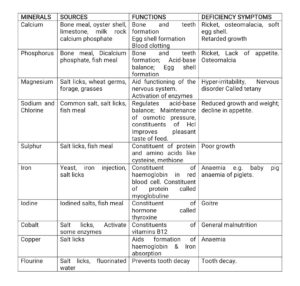
- Minerals: these are essential elements needed by the body but which the body cannot produce. They are grouped into two major classes:
- Structural mineral elements: Carbon, Hydrogen, Oxygen and Nitrogen. Mineral elements are further divided into:
a) Macro-elements or minerals: These are required by animals in large quantities e.g. calcium, phosphorus, magnesium, potassium, sulfur, sodium and chlorine.
b) Trace Elements or microelements: These are required by animals in small quantities e.g. iodine, cobalt, copper, manganese, zinc and fluorine.
Sources are born meal, oyster shell, limestone and salt licks
Functions Of Mineral
- It helps to ensure good health and productivity.
- Present in muscles for muscle contractions.
- Constituent of milk, egg and meat
- Help in the formation of hormones.
- Maintain PH balance of body fluids.
- They prevent diseases.
- Regulate blood clotting.
- Help in bone and teeth formation.
- Prevent tooth decay.
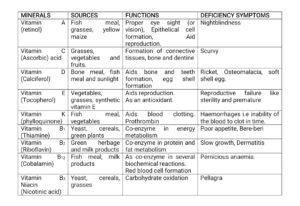
- Vitamins: are organic substances also required by animals for proper growth and body development. The types are;
- Fat Soluble Vitamins: These are vitamins which are soluble in fat e.g. A, D, E and K.
- Water Soluble Vitamins C and B-Complex. Examples of vitamin B-complex are; cobalamin, pantothenic acid and folic acid.
- Water
Sources of water; tap, feed, rain, rivers, ponds and fresh fodder.
Function Of Water
- Water is provided for drinking purposes.
- It is used for the metabolic and digestion of food.
- For dipping/drenching animals against ectoparasites.
- For washing or cleaning of animals.
- For sanitation, cleaning of floor and pens.
- For processing animal products.
- For maintenance of body temperature.
- For irrigation of pasture.
- It helps to get rid of waste products in the body.
- Helps to maintain body turgidity.
TYPES OF RATION/DIET AND THEIR USES
Diet: is defined as the feed formulated to meet the specific needs of an animal. It is also referred to as the amount of feed regularly given to or consumed by animals. It is formulated to meet specific metabolic or physiological functions such as growth, location, maintenance of pregnancy, reproduction or egg laying.
Ration: is the total supply of food given to animals in twenty hours.
Balanced Ration: A balanced ration is a feed containing all essential nutrients in the correct quantity and in adequate proportion for feeding animals.
Types Of Balanced Ration
- Maintenance Ration: This is given to farm animals just to maintain normal functioning of the body system.
- Production Ration: This is the type of ration given to farm animals to enable them to produce.
Factor To Be Considered When Deciding The Type Of Ration To Feed An Animal
- The purpose for which the animal is kept.
- Age of the animal.
- Animals’ condition of health.
- Management System.
- Physiological state of the animal.
Categories of farm animals that require production ration are;
Lactating animal
Weaned animals
Pregnant animals
Fattening animals
BroilerLayers
Steaming up or flushing
ASSIGNMENT
- ____ is essential for bone formation A. iron B. calcium C. carbon D.
- Night blindness is as a result of lack of vitamin ____ A B. B C. C D. D
- Ricket is a result of a deficiency of vitamin ____ A B. B C. C D. D
- Which of these is a micronutrient calcium B. manganese C. magnesium D. sulfur
- Goitre is a result of deficiency of ____ A. iron B. cobalt C. copper D.

Third Term Agricultural Science Lesson Notes for Other Topics

Establishment Of Fish Pond
Explore lesson notes covering all topics.

Forest And Forest Uses
Explore lesson notes covering all topics.

Effect of Forest on The Environment
Explore lesson notes covering all topics.
Common Weeds Found On The Farm
Explore lesson notes covering all topics.
Crop Improvement
Explore lesson notes covering all topics.
Basic Economic Principles - Law of Demand, Supply & Diminishing Returns
Explore lesson notes covering all topics.
Farm Records
Explore lesson notes covering all topics.
Agricultural Pollution
Explore lesson notes covering all topics.
Farm Accounts
Explore lesson notes covering all topics.

Fish Farming & Classification Of Fish
Explore lesson notes covering all topics.
Maintenance Practices And Precautionary Measures
Explore lesson notes covering all topics.
Problems Of Agricultural Mechanization
Explore lesson notes covering all topics.
Sources Of Farm Power
Explore lesson notes covering all topics.
Classification Of Crops
Explore lesson notes covering all topics.
Husbandry Of Selected Crops I - Cereals Cultivation
Explore lesson notes covering all topics.


Lesson Notes for Other Classes

JSS1 Lesson Note
The complete lesson note to guide your studies.
JSS2 Lesson Note
The complete lesson note to guide your studies.

SS1 Lesson Note
The complete lesson note to guide your studies.

SS3 Lesson Note
The complete lesson note to guide your studies.