
Common Weeds Found On The Farm SS2 Agricultural Science Lesson Note
Download Lesson NoteTopic: Common Weeds Found On The Farm
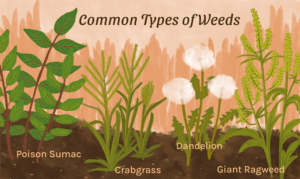
A weed is any plant that grows in a place where it is not (expected to grow) wanted.
ECONOMIC IMPORTANCE OF WEEDS
- They compete with crops for space.
- Weeds compete with crops for sunlight.
- Weeds compete with crops for nutrients.
- Weeds harbor crop pests and pathogens.
- Weeds compete with crops for soil moisture.
- It leads to a loss in crop yields.
- Weeds compete with crops for soil oxygen.
- They reduce the quality of crops.
- They reduce the income of farmers.
- They cause a reduction in the taste of some grasses.
- Some weeds are toxic to farm animals
BENEFITS OF WEEDS TO FARMERS
- Weeds help in checking soil erosion.
- Some weeds are useful as food for humans.
- Some weeds serve as food for animals.
- Certain weeds have medicinal value.
- They can be used as green manure.
- Some are used for making roots, mats and baskets.
- Weeds are used for mulching.
- Weeds are used for compost making.
CHARACTERISTICS AND GROWTH HABITS OF WEEDS
- Production of large quantities of seeds.
- Some weeds are reduced by seeds.
- Some weeds are reduced by vegetative propagation.
- Growth of large leaves within a short time.
- Weed growth is favoured during the rainy season.
- Most weeds are wind-pollinated.
- Production of a large quantity of pollen grains.
DISPERSAL OF WEED SEEDS AND FRUITS
Most seeds and fruits of weeds are generally dispersed by wind and animals. The modes of dispersal are;
- Dispersal Of Seeds By Wind
Such weeds have feathery, winged or powdery seeds e.g. Tridax (pwd weed), goat’s weed, guinea grass, elephant grass and many other species of grasses.
- Dispersal Of Seeds By Animal
Animal-dispersed weeds usually have sticky, hooked, edible or colourful fruits or seeds. The sticky and hooked types of fruits and seeds adhere to the coats of grazing animals and are carried from one place to another. Examples of such animals are; rabbits, rats, squirrels, antelope and man. Pigweed and commelina spp are examples of such weeds.
- Dispersal Of Seeds By Water
Water-dispersed seeds have waterproof cuticles, air spaces within the fruit and a lightweight
- Dispersal Of Seeds By Explosive Mechanism
Few plants and all leguminous seeds are dispersed by explosive mechanisms e.g. water leaf, centro, pueraria, calapo and mucuna.
COMMON WEEDS FOUND ON FARMS
| SN | COMMON NAME | BOTANICAL NAME |
| 1 | Guinea grass | Panicum maximum |
| 2 | Bahama grass | Cynodon dactylon |
| 3 | Carpet grass | Axonopus compressus |
| 4 | Corgon grass | Imperata cylindrica |
| 5 | Speargrass | Heteropogon contortus |
| 6 | Wild sunflower | Aspilia Africana |
| 7 | Centro | Centrosema pubescens |
| 8 | Waterleaf | Talinum triangulare |
| 9 | Wire/sida weed | Sida acuta |
| 10 | Goat weed | Ageratum conyzoides |
| 11 | Elephant grass | Pennisetum purpureum |
| 12 | Giant star grass | Cynodon plectostachyum |
| 13 | Pigweed | Amaranthus spinosus |
| 14 | Tridax | Tridax procumbens |
| 15 | Calapo | Calapogonium mucunoides |
| 16 | Sunhemp | Crotalaria juncea |
| 17 | Mucuna | Mucuna utilis |
| 18 | Stylo | Stylosanthes gracilis |
| 19 | Northern gamba | Andropogon gayanus |
GENERAL CONTROL OF WEEDS
- Mechanical Control: involves the use of machines such as bulldozers, tree pullers, ploughs etc to get rid of unwanted plants.
- Physical Or Manual Control: This can be done in different ways which includes hand pulling, hoeing, slashing with cutlass etc.
- Biological Control: This involves the introduction of some insects and herbivorous animals to farmland to eat up the leaves of the weed and even the entire plant in some cases.
- Cultural Control: This involves the use of a farming system to get rid of weeds. It can be achieved by the practice of crop rotation and the growing of cover crops to suppress the growth of the weeds on the farm. Other types of cultural weed control methods are: flooding, bush burning, mulching
- Chemical Control: This involves the use of chemical solutions called herbicides to control weeds. Some herbicides are selective while some are non-selective or contact herbicides
REASONS WHY WEEDS ARE DIFFICULT TO CONTROL
- They have vigorous growth, they are aggressive and persistent.
- Weeds have high reproductive capacity.
- Their seeds have a long period of viability.
- Weeds have an efficient dispersal method.
- They have efficient means of propagation.
- They have a long period of dormancy.
- They produce many seeds.
- They have a short life cycle.
ASSIGNMENT
- A cowpea growing in a maize plot is a ________ A. plant B. weed C. crop D. animal
- Seed of centro, and calapo are usually dispersed by _____ A. wind B. water C. explosive mechanism D. animals
- Which of the following is not a cultural weed control method A. flooding B. burning C. mulching D. hoeing
- Which of the following is not a physical method of weed control? A. hand pulling B. mulching C. hoeing D. slashing
- Weeds have a _____ lifecycle A. long B. medium C. short D. average
Third Term Agricultural Science Lesson Notes for Other Topics

Farm Records and Types
Explore lesson notes covering all topics.

Marketing Channels for Farm Produce; Co-operative Societies and Marketing Boards
Explore lesson notes covering all topics.

Marketing Channels - Middlemen and Retailers
Explore lesson notes covering all topics.

Marketing Channels for Farm farm Produce; Producers of Farm Produce
Explore lesson notes covering all topics.

Marketing Channels for Farm Produce
Explore lesson notes covering all topics.

Common Pests And Parasites Of Farm Animals
Explore lesson notes covering all topics.
Systems Of Rearing Farm Animals
Explore lesson notes covering all topics.
Management Of Farm Animals
Explore lesson notes covering all topics.
Rearing Of Chicken, Rabbit, Or Snail
Explore lesson notes covering all topics.

Common Disease Of Farm Animals 2
Explore lesson notes covering all topics.

Common Disease Of Farm Animals
Explore lesson notes covering all topics.
Procedures For Rearing Farm Animals
Explore lesson notes covering all topics.
Rearing Of Farm Animals
Explore lesson notes covering all topics.

Common Farm Tools
Explore lesson notes covering all topics.
Description and Uses of Farm Tools
Explore lesson notes covering all topics.


Lesson Notes for Other Classes

Basic 1 Lesson Note
The complete lesson note to guide your studies.

Basic 2 Lesson Note
The complete lesson note to guide your studies.

Basic 3 Lesson Note
The complete lesson note to guide your studies.

Basic 4 Lesson Note
The complete lesson note to guide your studies.

Basic 5 Lesson Note
The complete lesson note to guide your studies.

Basic 6 Lesson Note
The complete lesson note to guide your studies.