
Grassland Habitats – SS2 Biology Lesson Note (Third Term)
Download this term · ₦1,000Lesson note at a glance
- Subject
- Biology
- Class
- SS2
- Term
- Third Term
- Topic
- Grassland Habitats
- Order
- Topic 7 of 9 this term
- Reading time
- 4 min
Grassland (savanna) is a plant community in which grasses dominate, with trees and shrubs sometimes present. It has high temperature, intense sunshine and 60 to 150 cm of annual rainfall. Arid lands, or deserts, are the driest habitats, with less than 25 cm of rainfall a year. Plants and animals in both have features that conserve water.
Behavioural objectives
By the end of the lesson, students should be able to:
- define grassland (savanna) and arid land (desert);
- list the characteristics of grassland and of a desert;
- name the four major types of savanna in Nigeria;
- describe how plants and animals adapt to grassland and desert habitats;
- write food chains found in grassland and arid lands.
What is grassland (savanna)?
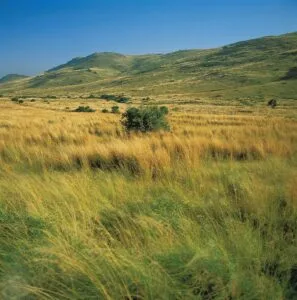
Grassland is a plant community in which grass species are dominant, but trees and shrubs may be present.
Characteristics of grassland
- Temperature is usually high and the sunshine is intense.
- The relative humidity is low and rainfall is scanty (60 to 150 cm annual rainfall).
- Grassland is abundant, with few short trees sparsely distributed.
- Bush fire is frequent and trees are fire resistant.
- Deciduous plants (plants that shed their leaves in dry seasons) are present.
- Plants possess underground stems and deep roots to search for water.
- Trees have modified leaves for adaptation to the environment.
What are the types of savanna in Nigeria?
There are four major types of savanna in Nigeria, namely:
- Southern Guinea savanna
- Northern Guinea savanna
- Sudan savanna
- Sahel savanna
The Southern Guinea savanna is the largest biome in Nigeria.
Plant distribution and adaptation in grasslands
The grassland plants include acacia, elephant grass, guinea grass, spear grass, palms, baobab trees etc. Their adaptive features include:
- Trees have thick corky barks to resist severe fire.
- Grasses have underground stems to escape fire and drought.
- Leaves have a waxy surface in addition to the cuticle covering to reduce transpiration.
- Reduced or small leaves reduce transpiration.
- Curly leaves conserve water.
- Leaves fall (deciduous) in the drying season to conserve water.
- Baobab trees have broad and succulent leaves to conserve water.
Animal distribution and adaptation in grassland
Animals found in grassland include antelopes, elephants, giraffes, zebras, goats, cattle, grasshoppers, lizards, birds, lions, tigers, leopards, rats, snakes, grass cutters, kangaroos etc. They adapt to this habitat in the following ways:
- Termites live in air-conditioned nests called anthills, which keep them cool.
- Rats burrow into the soil to avoid excessive heat and fire.
- Zebras and giraffes can camouflage using their colours.
- Lions, tigers and leopards have powerful claws and teeth for attacking other animals.
- Kangaroos have long legs to help them escape from danger. They also have pouches to shield their young ones from hot weather and attacks.
- Elephants and lions move in groups or herds to achieve strength in numbers.
Food chains in grassland
There are several food chains because of the numerous animals:
Grass → grasshoppers → lizards → snakes
Grass → grasshoppers → toads → birds
Grass → zebras → lions
What are arid lands (deserts)?
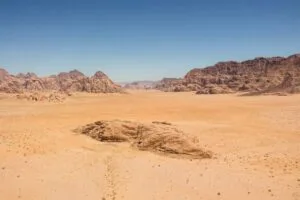
Arid lands are areas of very low rainfall and high evaporation rates. They are the driest habitats, receiving less than 25 cm of annual rainfall. Arid lands are of two types:
- Hot deserts, e.g. Sahara desert (North Africa), Kalahari desert (South Africa)
- Cold deserts, e.g. desert in North America
Characteristics of a desert
- Water is very scarce.
- Temperature is very high during the day and very low at night.
- Vegetation is very scanty.
- The soils are sandy or rocky.
- Strong winds occur frequently and sunshine is very intense.
- Drought-resistant plants (xerophytes) are present.
Plant distribution and adaptation in deserts
Desert plants include thorny bushes, cacti, scattered dwarf acacia, date palms, wiring grasses, baobab trees and euphorbia species. They adapt to this habitat in the following ways:
- Plants have thin leaves to reduce transpiration.
- Cacti are leafless and have thorns to reduce transpiration. They also have thick succulent stems to store water.
- Acacia (drought resistant) has deep roots which absorb underground water.
- Baobab trees have waxy leaves, which can be hairy or needle-shaped, to reduce the rate of transpiration.
- Wiring grass has narrow and slender leaves to reduce transpiration.
Animal distribution and adaptation in deserts
Desert animals include camels, rodents, lizards, snakes, zebras, desert tortoises, grasshoppers, wasps, ants etc. They survive in the following ways:
- Most desert animals excrete solid wastes to conserve water.
- Kangaroos and rats remain in burrows during the day to avoid excessive heat.
- Reptiles have scales to reduce water loss.
- Camels can survive several days without drinking water. They can withstand a wide range of body temperature, up to 40°C.
- Locusts have water-proof bodies and impervious cuticles.
Food chains in arid lands
Plants → desert rats → snakes
Plants → ants → scorpions → snakes
Evaluation
- Define grassland (savanna).
- Name the four major types of savanna in Nigeria.
- State four characteristics of a desert.
- Describe two ways in which grassland plants are adapted to bush fire and dry seasons.
- Write one food chain found in grassland and one found in arid lands.
Assignment
- Describe three adaptations of desert plants and three adaptations of desert animals.
- Write two food chains found in grassland.
This term's Biology topics
SS2 Third Term · 9 topics
Get Biology as PDF and Word
Every week of SS2 Biology, Third Term, formatted and ready to print. Ad-free, and the copy lock comes off.
Get this term Card, bank transfer, USSD or OPay
Third Term Biology Lesson Notes for Other Topics
Terrestrial Habitat
Read the full lesson note.
Estuarine And Freshwater Habitat
Read the full lesson note.
Habitat - Marine Habitat
Read the full lesson note.
Fruits
Read the full lesson note.
Pollination In Plants
Read the full lesson note.
Reproductive System In Flowering Plants
Read the full lesson note.
Ecology Of Population
Read the full lesson note.

Food Storage
Read the full lesson note.
Reproduction In Unicellular Organisms And Invertebrates
Read the full lesson note.
Arid Land/Deserts
Read the full lesson note.
Terrestial Habitat
Read the full lesson note.
Towards Better Health - How to Control Harmful Microorganisms
Read the full lesson note.
Freshwater Habitat
Read the full lesson note.
Aquatic And Estuarine Habibat
Read the full lesson note.
Microoraganisms In Action
Read the full lesson note.
Lesson Notes for Other Classes

Basic 1 Lesson Note
The complete lesson note to guide your studies.
Basic 2 Lesson Note
The complete lesson note to guide your studies.

Basic 3 Lesson Note
The complete lesson note to guide your studies.

Basic 4 Lesson Note
The complete lesson note to guide your studies.

Basic 5 Lesson Note
The complete lesson note to guide your studies.

Basic 6 Lesson Note
The complete lesson note to guide your studies.
