
Fruits SS2 Biology Lesson Note
Download Lesson NoteTopic: Fruits
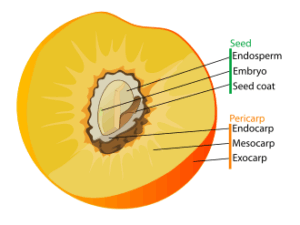
Fruit is the structure that develops from the matured ovary after fertilization which contains the seed. Some fruits do not develop from fertilized ovaries and are called parthenocarpic fruit.
Fruit contains the pericarp (epicarp, mesocarp and endocarp)
TYPES OF FRUITS
Fruits can be classified based on their origin or structure. These include:
- True and false fruit
- Simple, aggregate and composite (multiple) fruit
- Fleshy and dry fruit
- Dehiscent and indehiscent fruits
i. Simple Fruits: Formed from one flower having either a monocarpous or syncarpous pistil.
ii. Aggregate Fruits: Formed from one flower having an apocarpous pistil.
iii. Multiple Fruits: these are fruits formed from many flowers whose ovaries unite together with other parts of the flower after fertilization or one that develops from several flower inflorescences e.g. pineapple, breadfruit etc.
SIMPLE FRUITS
The simple fruits can be divided into dry and fleshy fruits. A dry fruit is a type of fruit in which the pericarp becomes dry, hard and woody or fibrous when the fruit ripens. Dry fruit may be dehiscent or indehiscent.
a) Dry Dehiscent Fruit: These are fruits with hard and dry pericarp which can split to release their seeds. The dry dehiscent fruit can be divided into five namely: the follicle, legumes, schizocarps, capsule and Siliqua
– Follicle: The follicles are fruits that are formed from one carpel and which can split along one side only e.g. kola
– Legume: These are fruits that are formed from one carpel that splits along two sides e.g. cowpea, crotalaria and all bean species
– Capsule: These are fruits formed from fused carpels and split longitudinally along two or more
lines e.g. okra, castor oil and cotton
– Schizocarps: These are many-seeded fruits which break up into one-seeded parts called
mericarp e.g. Mimosa pudica (sensitive plant) and Desmodium
– Siliqua: A long narrow capsule formed from a bicarpellary ovary. It has two chambers separated
by a false septum or rectum. It dehisces by the sutures e.g. Teconia
b) Dry Indehiscent Fruits: These are the fruits that do not split to release their seeds. Dry indehiscent fruits are divided into five.
– Achene: The fruit has a dry pericarp and contains one seed e.g. cashew, nut, sunflower fruit, four O’clock plant, rose and clematis.
– Caryopsis: caryopsis is a one-seeded dry indehiscent fruit in which the pericarp becomes fused with the testa. Examples are rice, maize and millet.
– Cypsela: The cypsela is a one-seeded dry fruit with a hairy pappus and hairy pericarp. Examples are Tridax, Emilia and goat weed.
– Nut: A nut is a dry fruit with a very hard or woody tough pericarp e.g. the hard part of cashew fruit, ground nut, palm nut cola nut, walnut, and almond.
– Samara: A samara has the pericarp extended to form one or more wings e.g. Combretum, Obeche tree and Pterocarpus (African rosewood)
FLESHY FRUITS
Fleshy fruits are juicy, succulent and indehiscent. They store large
quantities of water and carbohydrate in their tissue. There are six main types of fleshy fruits namely:
– Drupe: This is a true simple fruit with a well-developed pericarp. The epicarp is thin, the mesocarp is fleshy or fibrous and the endocarp is hard and stony. The latter encloses one or more seeds. The hard endocarp with its seed is known as the stone of the fruit e.g. mango,
coconut and oil palm fruit.
– Berry: A berry is a true simple fruit with a well-developed pericarp. The endocarp is not stony as in drupe. The endocarp is usually a thin membrane covering which is closely attached to a fleshy mass made up of the mesocarp and endocarp. Sometimes the whole fruit is eaten.
Examples are guava, tomatoes, bananas, lemon grapes, cucumber, and dates.
– Pome: A Pome is a simple false fruit. Examples are apples and pears. In a Pome, the outer covering and the fleshy edible part are formed by the swelling of the receptacle. Only the core is formed from the ovary.
– Hesperidium: A Hesperidium is a true simple fruit made up of chambers separated by a sheet
of endocarp. The epicarp and mesocarp are fused in the form of skin (or rind) e.g. orange,
lemon, etc.
DIFFERENCES BETWEEN FRUIT AND SEED
| FRUIT | SEEDS |
| Formed from ovary | Formed from ovule |
| Has two scars or points:
-the remains of style or stigma -where it was attached to the floral receptacle |
Has one scar or point
-where it was attached to the placenta |
| Consists of seed(s) | Consists of an embryo |
| Has pericarp | Has testa |
DIFFERENCES BETWEEN DRUPE AND BERRY
| SN | DRUPE | BERRY |
| 1 | The pericarp consists of epicarp, fleshy mesocarp and hard endocarp. | The pericarp also consists of three layers but the endocarp is fleshy. |
| 2 | The entire fruit is not eaten | The entire fruit is eaten |
| 3 | Developed from flowers with superior ovaries. | Developed from flowers with either superior or inferior ovaries. |
| 4 | One-seeded | Several seeds |
| 5 | Examples are mango, coconut, and oil palm fruit. | Examples are tomato, guava, banana, and cucumber. |
DISPERSAL OF FRUITS AND SEEDS
After the formation and maturation of fruits and seeds, they sometimes fall from their parents to the ground. The number of seeds produced by a single plant is often very large. Most of them perish while some are eaten by animals. Others may fall on the ground already occupied or unfavourable to the particular plant.
When seedlings develop close to the parent plant, they soon become overcrowded. They compete
among themselves and the parent plant for light, water, mineral salts and other essential soil constituents so that the strongest seedlings finally survive. To prevent this, fruits and seeds of most plants are adapted so that they can be scattered far away from the parents, hence fruits and seeds are dispersed.
Advantages Of Dispersal Of Fruits And Seeds
- Prevent overcrowding.
- Reduce the degree of unhealthy competition between plants.
- Introduction of plant species into new environments where they may be better adapted.
- The dispersal of fruits and seeds also helps to cover barren pieces of land with vegetation.
AGENTS OF DISPERSAL
The common agents that bring about dispersal are:
i. Wind: Fruits/seeds carried by the wind or air current must be light, small and have light membranous wings and also have long hairy or thread-like structures which act as parachutes in the air.
Wind dispersal is a wasteful process because a great number of seeds may be dropped on sterile or unstable ground or may be carried out into the sea e.g. cotton, poppy, clematis, shorea and asana, tridax fruit and also Bouganvillea.
ii. Animal: Animals like birds, fruit bats and monkeys may be agents of dispersal of fruits and seeds. Many animals feed on the soft succulent fruits but they either discard the strong protected seed of berries, the stony endocarp of drupes and achene or they may swallow them.
In the latter case, many of the hardened parts are resistant to enzymes that pass through the gut without harm and when later dropped can germinate successfully e.g. guava, and tomato.
Fruits and seeds may be carried externally on an animal’s body because special hooks or spines catch in the fur or wool (hairy coats of animals e.g. Desmodium)
iii. Water: The seeds of certain water lilies have air spaces in the pericarp which give the buoyancy required in water. Coconut fruit achieves dispersal of its single seed by
floating to a new location.
iv. Man: Dispersal of many fruits and seeds have been aided by the agricultural practices of man e.g. guava, sweet potato and cassava which are native to tropical America
now found in all tropical areas in the world.
Seeds of weeds are accidentally transported from one part of the world to another by man’s activities.
v. Explosive mechanisms or explosion: When the fruit wall dries as in the African oil bean, it splits and twists, throwing the seed out. The legumes of many bean plants
e.g. (Acacia and Ceasalpinia) burst open when ripe. This is by the drying up of the pericarp which causes contraction and splitting e.g. fruit of legumes, pride of Barbados and capsules (fruit of okra-Hibiscus esculentus)
ASSIGNMENT
- Which of the following is not a dry indehiscent fruit? (a) legume (b) cypsela (c) samara (d) caryopsis
- An example of a berry is (a) tomato (b) coconut (c) apple (d) pineapple
- Which of the following is a simple dry dehiscent fruit? (a) berry (b) drupe (c) caryopsis (d) achene
- A dehiscent fruit formed from several fused carpels with many seeds is classified as (a) an achene (b) a follicle (c) a legume (d) a nut
- Air spaces are characteristics of seeds or fruits dispersed by (a) birds (b) water (c) wind (d) explosive mechanism (e) man
Third Term Biology Lesson Notes for Other Topics
Grassland Habitats
Explore lesson notes covering all topics.
Terrestrial Habitat
Explore lesson notes covering all topics.
Estuarine And Freshwater Habitat
Explore lesson notes covering all topics.
Habitat - Marine Habitat
Explore lesson notes covering all topics.
Pollination In Plants
Explore lesson notes covering all topics.
Reproductive System In Flowering Plants
Explore lesson notes covering all topics.
Ecology Of Population
Explore lesson notes covering all topics.
Food Storage
Explore lesson notes covering all topics.
Reproduction In Unicellular Organisms And Invertebrates
Explore lesson notes covering all topics.
Arid Land/Deserts
Explore lesson notes covering all topics.
Terrestial Habitat
Explore lesson notes covering all topics.
Towards Better Health - How to Control Harmful Microorganisms
Explore lesson notes covering all topics.
Freshwater Habitat
Explore lesson notes covering all topics.
Aquatic And Estuarine Habibat
Explore lesson notes covering all topics.
Microoraganisms In Action
Explore lesson notes covering all topics.


Lesson Notes for Other Classes

Basic 1 Lesson Note
The complete lesson note to guide your studies.

Basic 2 Lesson Note
The complete lesson note to guide your studies.

Basic 3 Lesson Note
The complete lesson note to guide your studies.

Basic 4 Lesson Note
The complete lesson note to guide your studies.
Basic 5 Lesson Note
The complete lesson note to guide your studies.

Basic 6 Lesson Note
The complete lesson note to guide your studies.