
Historical Foundation of Nigerian Arts II – SS1 Visual Arts Lesson Note (Third Term)
Download Lesson NoteLesson note at a glance
- Subject
- Visual Arts
- Class
- SS1
- Term
- Third Term
- Topic
- Historical Foundation of Nigerian Arts II
- Order
- Topic 3 of 4 this term
- Reading time
- 5 min
-
Esie soapstone culture
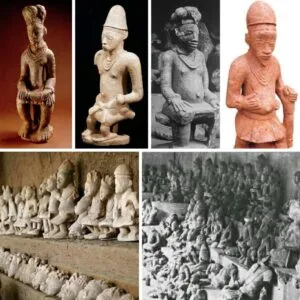
Esie is a Yoruba town in Irepodun Local Government Area of Kwara State, Nigeria and it is about 40 kilometers from Ilorin The state capital. About 800 art pieces were discovered around 1911 by Leo Froberbius, a German archaeologist.
Characteristics Of The Arts
- The sculptures are figures of men and women mostly sitting on stools or some kneeling.
- Most of them wear elaborate coiffures
- The figures have facial marks of three horizontal lines between the eyes and ears. Some have vertical lines or scarification on the face.
- Some figurines wear hats or gorgeous headdresses with beads around the neck or waist.
- The sculptures are mostly made of soapstone.
Benin court arts 1300 AD.
Benin art is famous for its artistic values and tradition has it that the art of bronze casting was taught to the Benin artist by a caster from Ife.
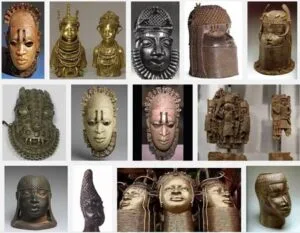
According to the story, the caster was invited to Benin through the Ooni of Ife by Obal Oguola in about AD 1280 to teach Benin craftsmen the art of casting ceremonial heads in bronze and the Benin artists evolved the art into their style.
William Fagg an archaeologist divided the history of Benin arts into
- First or Early period (13-16″ centuries). This period witnessed thin sculptural heads of reigning Obas.
- Second or Middle period 1501-1960. This period was noted for its evolution in style from free-standing sculpture to the relief of plaques for Oba’s use.
- Third or last period (17-18 Centuries) This period was after the 17 century when the standard of craftsmanship started until 1897 when the decline stepped in.
The British punitive expenditure
Benin had contact with the Portuguese in 1473 and in 1897, the Oba of Benin was deposed by the British government due to political upheavals during this period of war over one thousand artworks, mostly bronze artworks, were looted and taken abroad. This war was popularly called British Punitive expenditure.
The Benin art is called Court art because casting alone and bronze casters formed a guild around the Oba palace.
Characteristics Of The Art Works.
- The Benin art is highly technical and memorial heads of Obas, noblemen and warriors.
- The heads of Oba have a high collar of beads extending to the chin.
- The arts have vertical marks on the forehead.
- The size of the head is highly exaggerated and the figures have short legs.
- The upper lips are slightly opened and the lips and nose are broad and thick.
Tsoede bronze arts
Tsoede art is mainly bronze found among Jebba, TadeaGiragi of the Nupe people of Niger state of Nigeria. It dates around the late 13th and 14th century AD.
These works were brought down by Tsoede, the brother of the Atta of Idan who travelled along the river Niger to found the Nupe kingdom.
The uses are for fertility and good fortune and are bathed by villages in the river to ensure this effect.

Characteristic Of Tsoede Bronze Arts
- They are large figures of men and animals
- They are naturalistic and life-size.
- They are the largest bronze cast and copper found in sub-Saharan Africa from antiquity
WOODCARVING
- Epa wood carving: Epa masks are made in the Ekiti State of Yoruba land.
During the cult festivals, young men who are being initiated to adulthood wear these masks to test endurance. These masks are used in cults to honour heroes and ancestors. The masks weigh up to 30 kilogrammes.
- Ekpo mask of Ibibio and Anang: The Ibibio tribes are in the Akwa Ibom state of Nigeria. Their belief in deities made them great at mask carving
Characteristic of the arts
- Their masks are usually decorative with abstract lines, cones and cylindrical motifs in wood.
- The mask faces are fiery, bearded and attached to the body by a thick neck.
- The mask is used at the outing of the Ekpo society from Ikot Ekpene.
- The masks symbolize a special spirit
-
Ekoi monolith stones at ikom local government area cross the river state
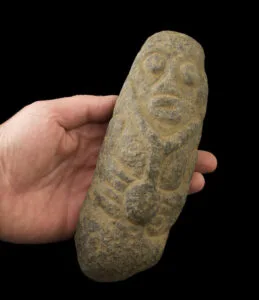
The Ikom monoliths are from the Cross River state of Nigeria. The works are traditionally known as “Akwanshi” dated between 1620 century. Ikom monoliths are stone-made sculptures. They represent the ancestors of the Ekoi people.
Characteristics Of The Arts
- The artworks contain inscriptions known as “Nsibidi” – the only form of writing in sub-Saharan Africa.
- The sculptures are depicted decoratively in relief form on the basic conical shapes of the stones.
- Emphasis is only on the head and the navel
- The head is depicted in a V-shaped cluin which represents a pointed and twisted long beard commonly worn by the Ntoons (priest chiefs).
- The artworks are carved in hard stone mainly basalt, limestone and sandstone at different villages in Ikom Local government area.
ASSIGNMENT
- Which art culture is the oldest in Nigeria (a) Igbo Ukwu arts (b) Benin arts © IFE arts (d) Nok arts
(2) The first site discovered took place in a tin mining outfit around Nok in the year (a) 1928 (b) 1879 (c) 1977 (d) 1920
(3) Nok culture is supposed to have existed between _ to _(a) 400 BC-300 AD (b) 500 BC-200 AD (c) 300 BC-200 AD (d) 600 BC-400 AD.
(4) The Nok arts are mainly made of (a) Bronze (b) Brass (c) Terracotta (d) fibreglass
- Why is Ife art referred to as “Court Art”?
- What year did the British punitive expenditure take place (a) 1979 (b) 1897 (c) 2012 (d) 1968
- Found the Nupe kingdom (a) Atta (b) Idan (c) Tsoede (d) Niger
- The only form of writing in sub-Saharan Africa called “Nsibidi” is found in works
(a) Nok (b) Benin (c) Epa (d) Ekol art
- _________ masks’ faces are fiery, bearded and attached to the body by a thick neck
(a) Ekpo mask (b) Epa mask (c) Ekoi monolith (d) Nok artworks mask are from IkotEkpene (a) Benin (b) Ekoi (c) Ekpo (d) Epa
- Which of the masks is worn for an acrobatic display to show strength and endurance
(a) Epa (b) Ekoi monolith (c) Ekpo (d) Nok arts
This term's Visual Arts topics
SS1 Third Term · 4 topics
- Introduction to Molding
- Historical Foundation of Nigerian Arts
- Historical Foundation of Nigerian Arts II
- Museums and Art Galleries in Nigeria
Third Term Visual Arts Lesson Notes for Other Topics

Introduction To Molding
Read the full lesson note.
Historical Foundation Of Nigerian Arts
Read the full lesson note.
Museums And Art Galleries In Nigeria
Read the full lesson note.
Lesson Notes for Other Classes

Basic 1 Lesson Note
The complete lesson note to guide your studies.

Basic 2 Lesson Note
The complete lesson note to guide your studies.

Basic 3 Lesson Note
The complete lesson note to guide your studies.

Basic 4 Lesson Note
The complete lesson note to guide your studies.

Basic 5 Lesson Note
The complete lesson note to guide your studies.

Basic 6 Lesson Note
The complete lesson note to guide your studies.

