
Bank Reconciliation Statement SS1 Financial Accounting Lesson Note
Download Lesson NoteTopic: Bank Reconciliation Statement
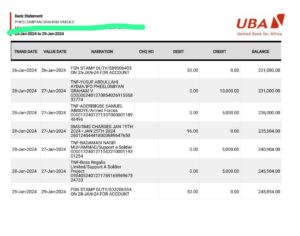
A Bank Statement is a statement prepared by a bank and sent to the customer at periodic intervals showing the transactions that have taken place between the bank and its customer for a particular period.
FORMAT OF A BANK STATEMENT
USES OF A BANK STATEMENT
- To check the transactions that have taken place within that period
- It is used as a source document
- It is used for bank reconciliation
- It is used for auditing purposes
- It is used to determine the opening balance and the closing balance of a bank account
BANK RECONCILIATION STATEMENT
A bank reconciliation statement is a statement prepared by an account holder (i.e. the trader or the business) to identify the causes of disagreement (or discrepancy) between the Cash Book balance and the Bank Statement balance and to reconcile (or harmonize) the two balances.
ITEMS CAUSING DISCREPANCY (DISAGREEMENT) BETWEEN THE CASH BOOK BALANCE AND THE BANK STATEMENT BALANCE
- Items in the Cash Book but not in the Bank Statement eg
- Unrepresented cheques
- Uncredited cheques
- Errors in the Cash Book
- Items in the Bank Statement but not in the Cash Book
- Bank charges
- Dividends
- Standing Order
- Credit Transfers (or Direct Credits)
- Direct Debits
- Dishonored Cheques
- Interest received from the bank e.g. on fixed deposit
- Interest charged on overdrafts/loan
- Errors in the Bank Statement
Unrepresented Cheques
These are cheques issued by the business but are yet to be presented for payment at the bank by the payee.cheques will be found on the credit side of the Cash Book but not on the debit side of the Bank Statement. The effect of cheques is to make the Bank Statement balance to be higher than the Cash Book balance.
Uncredited Cheques
These are cheques received by the business and lodged (or deposited) in the bank but have not been credited in the Bank Statement
Uncredited cheques will be found on the debit side of the Cash Book but not on the credit side of the Bank Statement.
The effect of uncredited cheques is to make the Cash Book balance to be higher than the Bank Statement balance.
Errors In The Cash Book
These are mistakes of omissions, duplications, wrong figures etc. made in the recordings/entries posted into the Cash Book
Bank Charges
These are amounts deducted by the bank from the customer’s account in respect of services rendered by the bank to the customer for that period. Bank charges will include Commission on Turnover (COT), cost of chequebooks issued to customers etc.
Bank charges will be found on the debit side of the Bank Statement but not on the credit side of the Cash Book.
The effect of bank charges is to make the Cash Book balance to be higher than the Bank Statement balance.
Dividends
Dividends represent the part of the profits of a limited liability company that is given to shareholders as a reward for their investments in the company
Dividends will be found on the credit side of the Bank Statement but not on the debit side of the Cash Book
The effect of dividends is that the Bank Statement balance will be higher than the Cash Book balance
Standing Orders
Standing orders represent instructions given by an account holder to the bank to pay on his behalf, regularly, a fixed amount of money to a named beneficiary.
Standing orders will be found on the debit side of the Bank Statement but not on the credit side of the Cash Book.
The effect of the standing order is to make the Cash Book balance to be higher than the Bank Statement balance.
Credit Transfers (Or Direct Credits)
Some customers or debtors of the business may settle their outstanding accounts by paying directly into the business account with the bank.
Credit transfers will be found on the credit side of the Bank Statement but not on the debit side of the Cash Book.
The effect of credit transfer is to make the Bank Statement balance to be higher than the Cash Book balance.
Direct Debits
This is an arrangement whereby a bank will pay on behalf of the account holder, bills that are presented by third parties.
Direct debits will be found on the debit side of the Bank Statement but not on the credit side of the Cash Book.
The effect of direct debits is to make the Cash Book balance to be higher than the Bank Statement balance.
Dishonored Cheques
These are cheques received by the business and lodged in the bank but have been returned unpaid by the drawer’s bank.
Dishonored cheques will be found on the debit side of the Bank Statement but not on the credit side of the Cash Book.
The effect of a dishonoured cheque is to make the Cash Book balance to be higher than the Bank Statement balance.
Interest Received From The Bank e.g. on Fixed Deposits
Where a customer maintains both a current account and a fixed deposit account, the bank may pay interest on such fixed deposits into the customer’s current account.
Interest on fixed deposits will be found on the credit side of the Bank Statement but not on the debit side of the Cash Book.
The effect of interest on fixed deposits is to make the Bank Statement balance to be higher than the Cash Book balance.
Interest Charged On Overdrafts
When a current account holder is allowed to overdraw his account, the bank will charge interest on the balance overdrawn every month.
Interest on overdraft will be found on the debit side of the Bank Statement but not on the credit side of the Cash Book.
The effect of interest on overdraft is to make the Bank Statement balance to be smaller than the Cash Book balance.
Errors In The Bank Statement
These are mistakes of omissions, duplications, wrong figures etc. made by the bank in the recordings made in the Bank Statement.
NOTE:
When the entries on a bank statement are compared to those in the bank account in the cash book it will be found that they are recorded on opposite sides of the account.
It is important to compare the Bank Statement and the bank account in the Cash Book. The balance on the bank account may not agree with the balance on the Bank Statement at any particular date.
When the balances in the Cash Book and Bank Statement do not agree, it is necessary to reconcile them to explain why the differences have arisen. The bank reconciliation will show the correct balance to be used as the figure for cash at the bank.
HOW TO PREPARE A BANK RECONCILIATION STATEMENT
STEP 1: Compare the entries in the bank account in the Cash Book with the Bank Statement. The debit side of the bank account should be compared with the credit side of the Bank Statement and the credit side of the bank account compared with the debit side of the Bank Statement. Put a tick (✔️ ) against those items that appear in both the Cash Book and the Bank Statement.
STEP 2: Update the Cash Book (i.e. prepare an Adjusted Cash Book)
Enter in the Cash Book any item which appears on the Bank Statement but which has not yet been entered in the Cash Book.
Correct any error in the Cash Book
Balance the Cash Book and carry down the balance.
NB: This new Cash Book balance is the correct bank balance. If it is the end of the financial year, this is the balance which should appear in the Balance Sheet.
STEP 3: Prepare a Bank Reconciliation Statement.
This should show why the balance on the updated Cash Book does not agree with the balance shown on the Bank Statement.
- Start with the balance as per
- Adjusted Cash Book
- Add the cheques
- Deduct the uncredited cheques
- Make any adjustment for bank errors by adding amounts credited in error by the bank and deducting amounts debited in error by the bank
- The total of this calculation above should be equal to the balance as per the Bank Statement
NB: It is possible to start the bank reconciliation statement with the balance as per the Bank Statement. In this case, it is necessary to reverse the items (b), (c) and (d) listed above.
A bank reconciliation statement does not form part of the double-entry records of the business. It is a statement which shows that, on a certain date, the bank account and the bank statement were reconciled
ADVANTAGES / PURPOSE / USES OF BANK RECONCILIATION
- It reveals items that cause the discrepancy (disagreement) between the Cash Book balance and the Bank Statement balance
- It harmonizes (reconciles or agrees)the balances of the Cash Book and the Bank Statement
- After updating the Cash Book, an accurate bank balance is available
- It enables a customer to update his Cash Book regarding those items debited or credited in the Bank Statement which have not been entered in the Cash Book
- unpresented cheques and uncredited cheques will be identified
- It assists in discovering fraud and embezzlement either from the bank or office.
- It helps to identify errors in the Cash Book (bank account) and the Bank Statement
- Any stale cheque (cheques over six months old, which will not be paid by the bank )can be identified and written back into the bank account.
- Where the bank reconciliation statement is prepared regularly, (especially by somebody other than the cashier), it helps to reduce /prevent/deter fraud.
- It ensures that the correct bank balance is shown in the Balance Sheet i.e. it reveals the correct amount of cash at the bank.
- Bank reconciliation is an important system of control
- Unintended overdrawing on the bank account can be avoided
- A surplus of cash at the bank can be highlighted and invested to earn interest.
Third Term Financial Accounting Lesson Notes for Other Topics
Balance Sheet
Explore lesson notes covering all topics.
Issues & Classes of Shares
Explore lesson notes covering all topics.
Interpretation Of Financial Statement Using Simple Ratio
Explore lesson notes covering all topics.
Dissolution Of Partnership
Explore lesson notes covering all topics.
Company Accounts
Explore lesson notes covering all topics.
Introduction To Depreciation Of Fixed Assets
Explore lesson notes covering all topics.
Methods Of Depreciation
Explore lesson notes covering all topics.
Departmental Accounts
Explore lesson notes covering all topics.


Lesson Notes for Other Classes
Basic 1 Lesson Note
The complete lesson note to guide your studies.

Basic 2 Lesson Note
The complete lesson note to guide your studies.

Basic 3 Lesson Note
The complete lesson note to guide your studies.

Basic 4 Lesson Note
The complete lesson note to guide your studies.
Basic 5 Lesson Note
The complete lesson note to guide your studies.

Basic 6 Lesson Note
The complete lesson note to guide your studies.