
Description And Property Of Fields SS1 Physics Lesson Note
Download Lesson NoteTopic: Description And Property Of Fields
A Field can be defined as a region or space under the influence of some physical agency such as gravitational, electricity and magnetism.
Types of Field
Fields are of various types namely: gravitational, magnetic and electric fields.
- Gravitational Field
A gravitational field is any region or space around a mass in which the gravitational force of the mass is felt.
If we throw up massive objects, it is our common observation that they move up to their highest points, stay stationary very briefly and eventually move downwards, falling faster and faster until they hit the ground level. The up and down movements of objects on the earth’s surface are subject to the influence of the gravitational field.
Force of Gravity
The force of gravity is the pull of attraction between the earth, itself and objects on or near it.
Newton’s Law of Universal Gravitation
Newton’s law of gravitation states that the force of attraction between two bodies of mass M1 and M2 is inversely proportional to the square of their distance R, between their centres and it is directly proportional to the product of their mass.
Mathematical expression
F α = M1M2
R2
F= GM1M2
R2
Where F is the gravitational force on either particle, M1 and M2 are their masses, R is the distance between them, and G is a universal gravitational constant, whose numerical value depends on the units in which the force, mass, and length are expressed.
Acceleration Due to Gravity
The acceleration of objects due to the earth’s gravitational attraction is called the acceleration due to gravity. It is represented by the symbol g whose average value is about 9.81ms−2.
Without air resistance, different masses or objects released from rest at the same point will fall to the ground at the same time (free fall).
- Magnetic Field
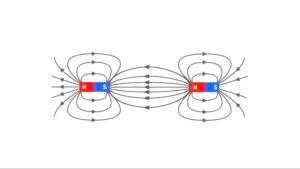
The region or space around a magnet in which the influence of the magnet can be felt or detected is called a magnetic field. If a white sheet of paper is placed over a magnet and iron fillings are sprinkled on the paper, it will be observed that the iron filings will arrange themselves in a definite pattern which illustrates the magnetic lines of force of the magnet. A similar pattern can be obtained by using the compass needle to plot the magnetic lines of force.
Lines of Force
A line of force is an imaginary line drawn in such a way that its direction at any point, that is the direction of the tangent, is the same as the direction of the field at that point.
- Electric Field
The electric field is defined as any region where a charge experiences a force of electrical origin. There are two types of charges namely: positive and negative charges.
Lines of Force
An electric field has been defined as a region where an electric force is experienced. Electric fields can be mapped out by electrostatic lines of force. An electrostatic line of force may be defined as a line whose tangent is in the direction of the force on a small positive charge at that point. Arrows on the lines of force show the direction of the force on a positive charge. The force on a negative charge is in the opposite direction.
Since the direction of a field varies from point to point, lines of force are usually curves.
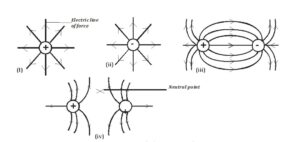
(i) Isolated positive charge
(ii) Isolated negative charge
(iii) Unlike charges positive and negative charges
(iv) Like charges positive and positive charges
Properties of Lines of Force
- Lines of force never intersect.
- Lines of force are usually curves, as the direction of a field varies from point to point.
- In a uniform field, the lines of force are straight, parallel and uniformly spaced.
- No lines of force originate or terminate in the space surrounding a charge.
- Every line of force in an electrostatic field is a continuous line terminated by a positive charge at one end and a negative charge at the other end.
Coulomb’s Law: states that the force experienced by two charges Q1Q2 separated by a distance r is directly proportional to the product of their charges and inversely proportional to the square of their distance apart. It is also known as the verse square law.
Q1←————————>Q2
F α Q1Q2
Fα 1/r2
F α Q1Q2
r²
F = K Q1Q2 __________ (i)
r²
K = 9 x 10⁹ Nm² C-2 ⁄ f/m
K = 1/4ΩЄ0 (Permittivity of Free Space vacuum)
Electric Field Intensity (E)
It is simply the force per unit charge. It is a vector quantity and is measured in
E = F/Q _________ (iii)
Electric Field Potential (V)
It is the work done in moving a unit of positive charge from its point of infinity to a point in the field. It can also be defined as work done per unit charge, it is a scalar quantity and measured in joules per coulomb or volt.
V = W/Q
Flux Density D.
It is denoted by D. It is simply charged by unit area. It is measured in Cm-2/ Clm²
D = Q/A
Third Term Physics Lesson Notes for Other Topics
Triangular And Rectangular Prisms
Explore lesson notes covering all topics.
Lenses
Explore lesson notes covering all topics.

Optical Instruments
Explore lesson notes covering all topics.

Dispersion Of White Light
Explore lesson notes covering all topics.
Sound Waves
Explore lesson notes covering all topics.
Electric Field
Explore lesson notes covering all topics.

Particulate Nature Of Matter
Explore lesson notes covering all topics.
Fluids At Rest And In Motion - Surface Tension
Explore lesson notes covering all topics.

Units Of Measurements And Electrical Continuity Testing
Explore lesson notes covering all topics.


Lesson Notes for Other Classes

Basic 1 Lesson Note
The complete lesson note to guide your studies.

Basic 2 Lesson Note
The complete lesson note to guide your studies.

Basic 3 Lesson Note
The complete lesson note to guide your studies.

Basic 4 Lesson Note
The complete lesson note to guide your studies.

Basic 5 Lesson Note
The complete lesson note to guide your studies.

Basic 6 Lesson Note
The complete lesson note to guide your studies.